The Highest-Converting Local Searches
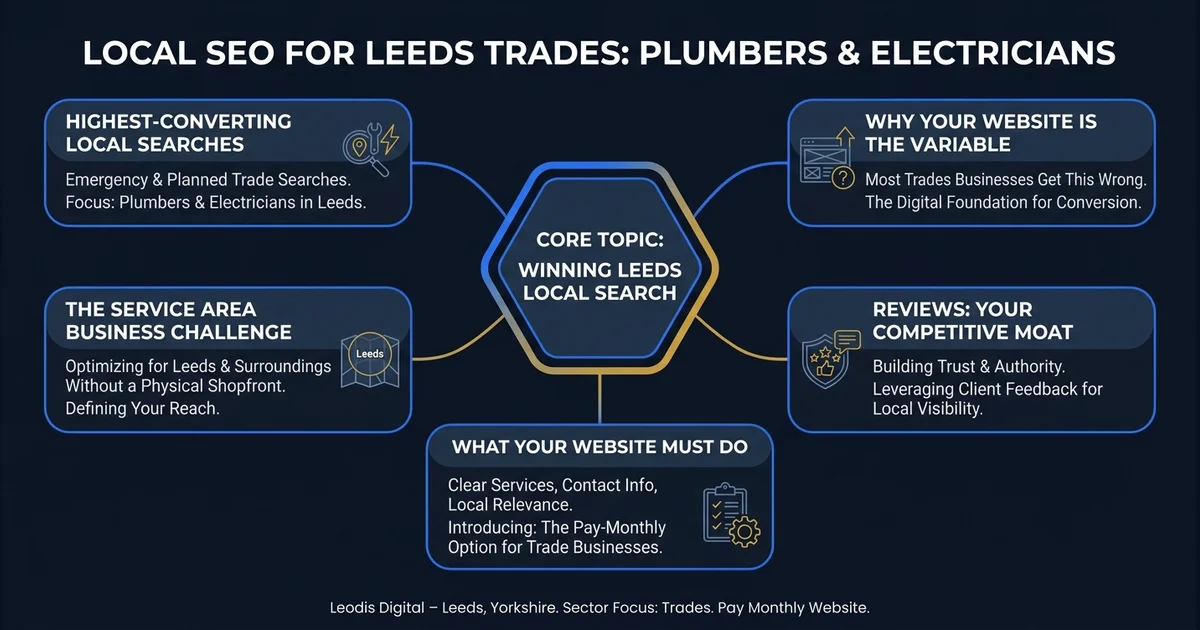
Emergency plumber. Electrician near me. Local builder free quote. These searches have commercial intent that most other sectors cannot match. The person typing them has a problem right now and needs it solved. They are not browsing; they are buying.
This makes local SEO for trade businesses one of the highest-ROI marketing investments available to a Yorkshire sole trader or small firm. A plumbing business that consistently appears at the top of local results for emergency plumbing and boiler repair searches does not need to spend heavily on advertising — organic search delivers pre-qualified leads continuously. The investment is in getting there, and the returns compound indefinitely.
But there is a critical prerequisite: the website.
Why Your Website Is the Variable Most Trades Businesses Get Wrong
Most trade businesses know they need a Google Business Profile and decent reviews. Fewer understand that their website is the foundation that either amplifies or undermines everything else.
When a potential customer sees your business in the Map Pack and clicks through to your website, you have approximately three seconds to retain them. A slow-loading page on mobile — and over 80% of trade searches happen on mobile — will lose them before they see anything. The direct cost of a slow website in lost leads and revenue is measurable, and for trade businesses where each job can be worth hundreds of pounds, it adds up fast. A site that does not immediately answer "can this business help me, and how do I contact them?" will lose them at second three.
For trade businesses in the UK competing in high-intent, high-value searches, a professionally built, fast-loading, mobile-optimised website is not optional. It is the asset that converts Map Pack traffic into enquiries.
The Pay-Monthly Option for Trade Businesses
Historically, a properly built trade business website cost £2,000–£5,000 upfront — a significant outlay for a sole trader or small firm. The pay-monthly website model changes this. For a fixed monthly fee, you get a professionally built, mobile-first website with fast load times, click-to-call functionality, a portfolio of completed work, your credentials displayed prominently, and ongoing maintenance included.
The website is built to the technical standard that helps your Google Business Profile rank — fast, correctly structured, with proper schema markup for local service businesses — rather than undermining it. And there is no large upfront cost.
The Service Area Business Challenge
Many trade businesses operate across a service area rather than from a single fixed location. A UK-based electrician might cover Leeds, Bradford, Wakefield, Harrogate, and surrounding areas. This creates a specific SEO challenge: how do you rank for searches across a wide geographic area?
Service area in Google Business Profile. Your GBP allows you to define a service area listing every town, city, and area you genuinely serve. This is a direct local relevance signal for those areas. Be specific and accurate — listing areas you do not actually serve to extend geographic reach is a guidelines violation. See the full Google Business Profile optimisation guide for every field that matters for service-area businesses.
Location-specific landing pages. For each significant location in your service area, a dedicated page — "Electrician in Bradford," "Plumber in Wakefield," "Builder in Harrogate" — creates a ranking target for that location. Critically, each page must be genuinely distinct: local references, any completed work in that area, relevant testimonials from customers there. Thin, identical pages that simply swap the location name are a spam signal and will not rank — they may actively harm your site's authority.
Long-tail location content. "Emergency electrician Bradford," "boiler repair costs Harrogate," "local builder free quote Wakefield" — these specific, location-qualified queries have low competition and high commercial intent. A trade business with content addressing these specific questions has a meaningful ranking advantage over competitors with a generic homepage.
Reviews: Your Competitive Moat
In the trades sector, reviews are the primary trust signal for the buying decision. A homeowner about to let a stranger into their house wants substantial social proof that they are making the right choice. Reviews close that trust gap faster than any other signal.
A plumbing business with 200 Google reviews averaging 4.9 stars is not competing with a plumbing business with 15 reviews averaging 4.6. The former has social proof that converts at a dramatically higher rate from the same Map Pack position. For the trades sector, review volume matters alongside review quality.
Build review acquisition into your post-job workflow:
- Send a text message one hour after job completion: "Thanks for choosing [Business Name]. If you are happy with the work, a Google review would really help us — here is the link: [review link]." Keep it personal, not corporate.
- Follow up with a second message three days later if no review appears.
- For larger jobs, mention reviews personally before leaving site.
One in three satisfied customers who receive a direct review request will leave one. Systematically applied across every job, this builds review velocity that is very difficult for competitors to match.
What Your Website Must Do
A trades website has a specific conversion task: get the visitor to call or enquire. Everything else is secondary. This should inform every design decision.
Immediately visible above the fold on mobile:
- Your phone number, as a click-to-call link (not just text)
- What trades you cover ("Emergency Plumbing, Boiler Repair, Central Heating")
- What areas you serve ("Leeds, Bradford, Harrogate, Wakefield")
- If you offer emergency call-outs: "24/7 Emergency Call-Out" as a prominent header
What converts for trades:
- Real photos of completed work — before/after is particularly effective
- Specific testimonials from named local customers
- Gas Safe registration number, NICEIC certification, NAPIT membership, or other relevant credentials displayed prominently
- A simple enquiry form with minimal required fields — name, postcode, type of work, preferred callback time
What kills conversion: slow page load, a design that buries the phone number, stock photography that signals inauthenticity, and a complex enquiry form that requires too much information before you will call someone back.
The Seasonal Content Opportunity
Trade search volumes are seasonal in predictable ways:
- Boiler breakdowns and heating emergencies spike in October and November
- Garden landscaping and outdoor builds peak in spring
- Roofing enquiries follow storm season
- Air conditioning installation peaks ahead of summer
Publishing content targeting these seasonal terms six to eight weeks before the peak allows the pages to rank before demand arrives. A heating engineer who publishes "Is Your Boiler Ready for Winter?" in September and ranks for it by October is generating calls at the exact moment of maximum intent. Keyword research for local businesses will help you identify the specific search volumes and seasonal patterns that apply to your trade.
Your pay-monthly website from Leodis Digital includes a blog or insights section built into the structure, ready for this kind of seasonal content. We can support you in developing a content calendar that aligns with the seasonal patterns specific to your trade.
For the full local SEO strategy that supports trade businesses, see our Google Business Profile audit guide and our local SEO playbook for UK businesses. Ready to discuss a website that actively generates leads for your trade business? Get in touch with Leodis Digital.
Frequently Asked Questions
What should a trade business website include to convert mobile visitors?
The single most important element is a prominent click-to-call phone number visible above the fold on every page — no scrolling required. After that: a clear statement of what trades you cover and what areas you serve, photos of real completed work (not stock imagery), your professional credentials (Gas Safe, NICEIC, NAPIT) displayed prominently, and a simple enquiry form. Everything else is secondary. A trade website's job is to get the visitor to call or enquire. Remove every obstacle between the visitor and that action.
How much does a pay-monthly website cost for a trade business in the UK?
At Leodis Digital, pay-monthly websites for trade businesses start from £79/month. That includes a professionally built, custom-designed website on a fast, mobile-optimised platform — not a WordPress template or a page builder. It includes hosting, SSL security, ongoing maintenance, and monthly performance monitoring. No large upfront cost. For a trade business generating a handful of additional jobs per month through improved local search visibility, the return on investment is clear within weeks.
Do I need separate pages for every area I serve?
For your primary location, yes — a well-optimised service page is essential. For secondary areas you genuinely serve, dedicated location pages are valuable if they contain location-specific content: local references, completed work in that area, testimonials from customers in that location. Thin pages that simply swap the location name in a template add no ranking value and can dilute your site's authority. A single comprehensive service area page is more effective than multiple thin location pages.
How important are reviews for a trade business's local rankings?
Critical. In the trades sector, reviews are the primary trust signal — a homeowner letting a stranger into their house wants substantial social proof. Review volume and recency are significant ranking factors for the Google Map Pack. A trade business with 150 reviews averaging 4.8 stars will consistently outrank a competitor with 20 reviews averaging 5.0. Build review acquisition into your post-job workflow — a simple text message with a direct review link sent after every completed job converts at around one in three.
Found this useful? Share it.