A Competitive Market With Clear Rules
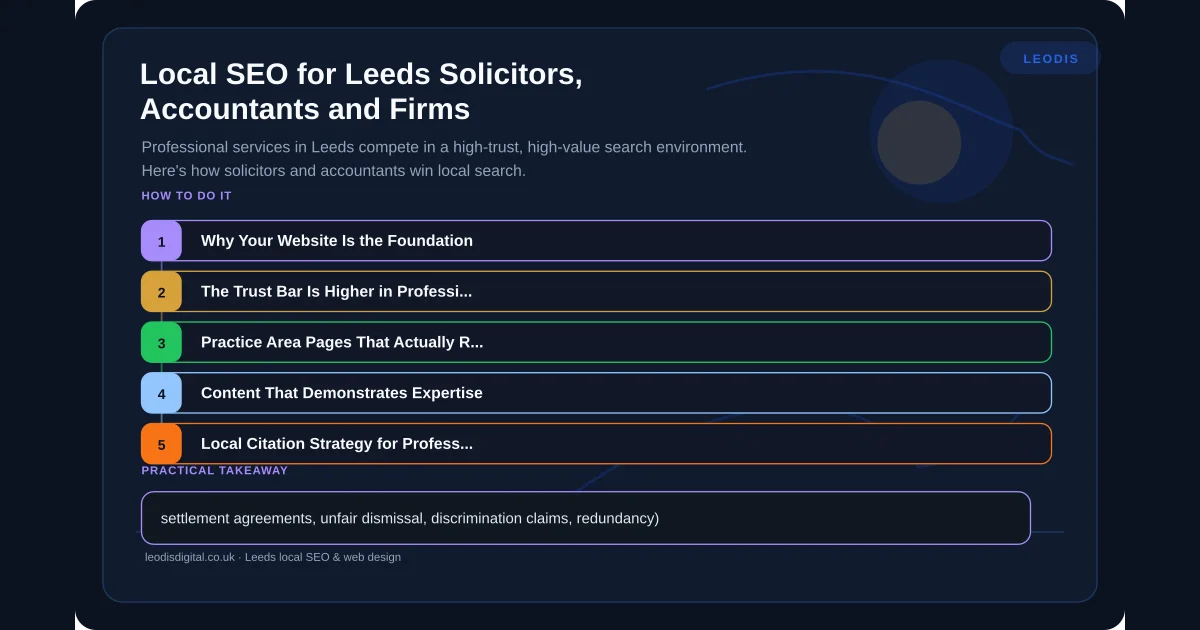
Solicitors, accountants, financial advisers, and other professional services firms compete in some of the most valuable local search markets in the UK. Search terms like "solicitor Leeds," "accountant Leeds city centre," and "employment lawyer the UK" represent high-value commercial intent — potential clients with significant lifetime value, searching with clear intent to instruct.
The result is a market where the difference between ranking position one and position four can represent tens of thousands of pounds in annual client value. But the market also has clear rules, and firms that understand them can compete effectively regardless of size.
Why Your Website Is the Foundation
Professional services SEO is often discussed in terms of content and authority. Both matter. But neither compounds effectively on a poor technical foundation.
A solicitor's firm with excellent practice area content but a slow, poorly structured website is working against itself. Core Web Vitals failures suppress rankings relative to competitors whose sites pass. A missing or incorrect LegalService schema markup means Google is inferring your practice areas from your content rather than reading them directly. A website that loads slowly on mobile — where a growing proportion of professional service searches now happen — loses potential clients at the moment of highest intent.
The pay-monthly website model changes the economics for smaller professional services firms. A properly built, mobile-optimised, schema-rich website historically required a £4,000–£8,000 investment. At a fixed monthly fee, a firm can access the same technical standard from day one, without the capital commitment — and with ongoing maintenance included.
The Trust Bar Is Higher in Professional Services
When someone searches for a local solicitor or accountant, they are making a high-stakes, high-trust decision. The content on your site needs to reflect that. Google's E-E-A-T framework — Experience, Expertise, Authoritativeness, Trustworthiness — was designed in significant part around "Your Money or Your Life" sectors, of which legal and financial advice are the archetypal examples.
This means several things in practice:
Content must be authored and attributed to qualified professionals. An article about employment law attributed to a named, SRA-registered solicitor with their years of qualified experience stated carries far more weight — with Google and with prospective clients — than anonymous copy or a "team at Smith & Partners" attribution. Name the author. State their credentials. Link to an author profile page.
Professional registration details must be prominent and verifiable. Your SRA number, your ICAEW or ACCA registration, your FCA authorisation reference, your regulated complaints procedure — these are not just compliance requirements. They are trust signals that Google's quality systems look for, and that prospective clients use to verify your credentials before instructing you.
Claims must be accurate and appropriately caveated. Overpromising outcomes or presenting legal and financial information without the professional context a qualified practitioner would provide is both a compliance risk and an E-E-A-T failure.
Practice Area Pages That Actually Rank
The most common on-page failure in professional services SEO is service pages that are too broad. A page titled "Legal Services" listing everything the firm does in three paragraphs will not rank for anything specific.
Each practice area needs its own dedicated page, optimised for the specific terms that practice area's clients actually use. A UK solicitors firm should have individual pages for:
- Employment law (and within it: settlement agreements, unfair dismissal, discrimination claims, redundancy)
- Commercial property (commercial leases, property acquisitions, planning matters)
- Residential conveyancing (buying and selling, remortgage, transfer of equity)
- Family law (divorce, child arrangements, financial settlements)
- Wills, trusts and probate
Each sub-page targets the specific, high-intent terms that prospective clients in that situation use: "settlement agreement solicitor Leeds," "commercial lease negotiation Leeds," "contested probate solicitor the UK." These terms have lower competition than broad practice area terms and higher conversion intent — the searcher is in a specific situation and looking for exactly the help you provide. Our keyword research guide for UK businesses explains how to identify and map these long-tail, high-intent terms for each practice area.
The same principle applies to accountancy: separate pages for business tax, personal tax, VAT returns, payroll services, management accounts, R&D tax credits, and sole trader accounts — each targeting the language their specific target clients use.
Content That Demonstrates Expertise
The most effective content for professional services firms answers questions that potential clients are actually asking. "What happens during a settlement agreement process?" "How much does a commercial property transaction cost in the UK?" "When do I need to register for VAT?" "What is the difference between a will and a lasting power of attorney?"
These informational searches come from people early in the decision process — researching before they are ready to instruct. Answering them well, in plain language, with genuine professional expertise, positions your firm as the natural choice when that visitor moves from research to ready-to-instruct.
Content should be updated when laws or regulations change. Outdated guidance on tax rates or employment law is both a compliance risk and an algorithmic signal that the site is not actively maintained. Professional services content has a defined shelf life.
Local Citation Strategy for Professional Services
Professional services firms in the UK have access to a category of citation source that other local businesses lack: regulated professional body directories.
The SRA's solicitor register and the ICAEW/ACCA firm directories are high-authority, trusted sources. A listing on these directories — with consistent NAP data — carries significant authority for local search and provides Google with strong third-party confirmation of your firm's credentials.
Beyond regulated directories, the professional services citation priority list for UK firms includes:
- Leeds Law Society directory (for solicitors)
- Chartered Institute of Taxation (for accountants handling tax)
- Leeds Chamber of Commerce member directory
- Yell, Thomson Local, and Yelp UK (general UK citation sources)
- Local legal or financial advice directories relevant to your specific practice area
The principle for professional services citations is the same as for all local citation work: consistency with your canonical business name, address, and phone number across every listing. The NAP consistency guide covers the full audit and correction process for keeping these listings aligned.
Reviews in Regulated Sectors
Reviews are particularly powerful in professional services because the trust investment required to instruct a solicitor or accountant is significant. A firm with eighty Google reviews averaging 4.8 stars is a compelling proposition for a prospective client comparing two firms with similar practice areas and pricing.
Be aware that professional body rules affect how testimonials can be presented. The SRA and FCA both have specific guidance on endorsements. Your review acquisition approach — asking satisfied clients to leave a Google review — is generally compliant, but selective or curated presentation of testimonials on your own marketing materials requires care.
The Local Visibility Stack
For a professional services firm targeting the Leeds market, the complete local visibility picture includes:
- A fully optimised Google Business Profile in the correct professional category (LegalService, AccountingService, FinancialService)
- Individual practice area pages targeting local terms, written by named, qualified professionals
- Correctly implemented LegalService or AccountingService schema markup
- A consistent citation profile across legal, professional, and local business directories — alongside link building through local professional associations and press coverage
- Author profile pages with verifiable credentials for every named content author
- A content programme targeting informational queries in your practice areas, published consistently
No single element produces dramatic results in isolation. Together, maintained consistently over twelve months, they build a dominant local search presence that is very difficult for competitors to displace.
For the full E-E-A-T strategy that professional services firms need, see our E-E-A-T guide and our content strategy article. Ready to build that presence for your firm? Get in touch with Leodis Digital.
Frequently Asked Questions
What type of website does a Leeds solicitor or accountant actually need?
A fast, professionally built, mobile-optimised website with correct LegalService or AccountingService schema markup, individual practice area or service pages targeting specific search terms, named author attribution on all content, and your professional registration details clearly displayed. This is the technical and content standard that allows professional services firms to compete effectively in local search. A pay-monthly website from Leodis Digital is built to this standard from day one, for a fixed monthly fee without large upfront investment.
How competitive is local search for solicitors in the UK?
Very competitive for broad terms like "solicitor Leeds" and "employment lawyer Leeds" — contested by large established firms with significant domain authority. Less competitive for specific practice area terms: "settlement agreement solicitor Leeds," "commercial lease solicitor Leeds," "wills and probate Leeds." A small or mid-sized firm that builds well- structured, genuinely expert practice area pages can rank meaningfully for specific terms where larger firms have thin or generic content. Specificity is the small firm's competitive advantage.
Can a one-person or small professional services firm compete with larger firms on Google?
Yes, on the right terms. A sole practitioner accountant in the UK who publishes a comprehensive, expert guide to "R&D tax credits for Yorkshire manufacturing businesses" and targets "accountant for contractors Leeds" can outrank a larger firm with a generic "accountancy services" page for those specific searches. Specificity, expertise, and technical website quality can overcome domain authority disadvantages — particularly for long-tail, high-intent terms where larger firms have not invested in specific content.
Are there restrictions on how professional services firms can use reviews and testimonials?
Yes. The SRA, FCA, and ICAEW each have specific guidance on testimonials and endorsements. Generally, reviews on independent platforms like Google are acceptable, but businesses should not cherry-pick or selectively present reviews in a misleading way. Your review acquisition approach should comply with your regulator's current guidelines. This does not prevent you from asking satisfied clients for Google reviews — it applies to how you present those reviews on your own marketing materials.
Found this useful? Share it.