Key Takeaways
- NAP (Name, Address, Phone) inconsistencies across directory listings are one of the most common and fixable causes of suppressed local rankings for Leeds businesses.
- Google cross-references citations to build confidence in your business information — twenty inconsistent listings create a cumulative suppression effect that is hard to diagnose without a dedicated citation audit.
- Your website is the authoritative source of your NAP data: correctly formatted footer details and LocalBusiness schema markup strengthen every external citation you build.
- Focus on 30 to 50 high-quality, consistent citations across Tier 1 UK directories rather than chasing volume on low-quality sites.
- A quarterly citation check takes 30 minutes and prevents the slow accumulation of inconsistencies that erode local search visibility over time.
The Citation Problem Nobody Talks About
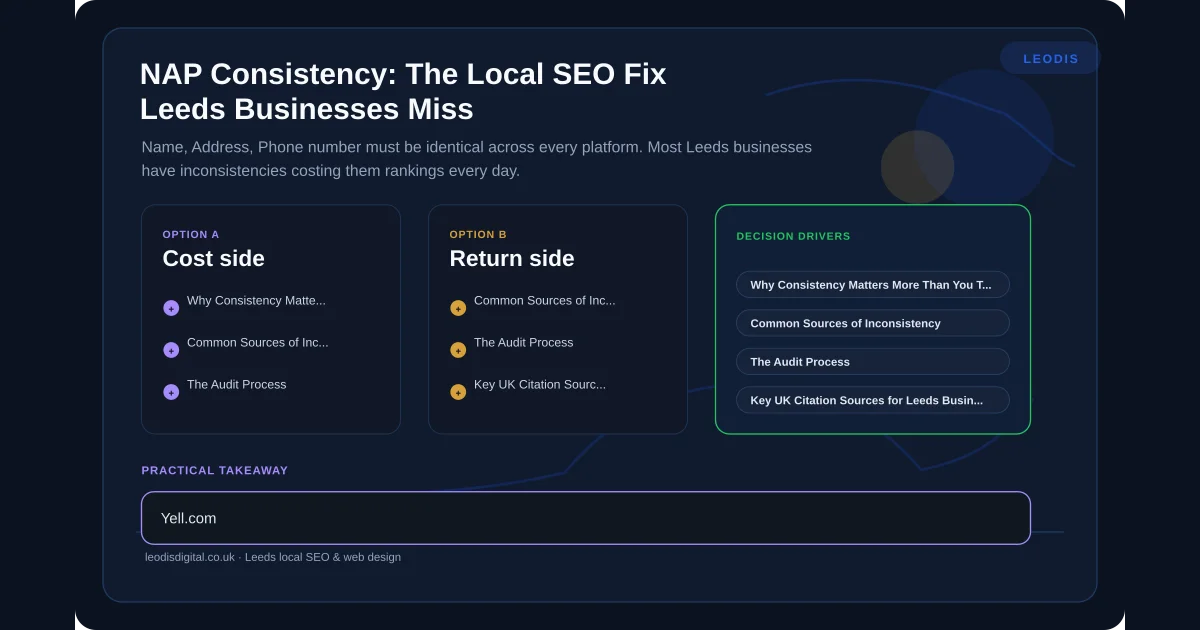
Link building gets the attention. Content gets the attention. Technical SEO gets the attention. NAP consistency — the unglamorous process of ensuring your business name, address, and phone number are identical across every platform they appear on — gets overlooked by almost every business we start working with. Yet it consistently appears as one of the root causes when we work through why a site isn't ranking despite other SEO work being in place.
And yet, in our local SEO assessments of businesses across the UK and the UK, citation inconsistencies are among the most common and most consequential issues we find. They are also among the most fixable.
Why Consistency Matters More Than You Think
Google's local ranking algorithm uses citations — mentions of your business name, address, and phone number across the web — as a signal of business legitimacy. It cross-references these citations to build confidence in the accuracy of the information in your Google Business Profile.
When citations are inconsistent — a slightly different business name spelling, an old address, a discontinued phone number, variations in how your postcode is formatted — Google's confidence in your business information drops. Lower confidence means lower Map Pack rankings. The impact is amplified if your Google Business Profile also contains information that conflicts with your website — a first-party inconsistency that carries more weight than any directory discrepancy.
The effect is difficult to identify from a standard ranking report because it is not dramatic in any single instance. It is cumulative. Twenty inconsistent citations create a chronic suppression of your local visibility that is hard to attribute without a dedicated citation audit. Most business owners experiencing this kind of chronic underperformance attribute it to something else entirely — not enough content, not enough links — while the citation problem quietly persists.
Common Sources of Inconsistency
Business name variations. "Leodis Digital," "Leodis Digital Ltd," "Leodis Digital Agency" — to a human, obviously the same business. To Google's citation matching algorithms, these are different entities. Choose a canonical business name and use it identically everywhere.
Address formatting. "14 Park Square," "14 Park Sq," "14 Park Square, Leeds LS1 2PP," "14 Park Square Leeds" — the formatting matters. Choose one format and apply it consistently across every listing, matching your website's contact page exactly.
Phone numbers. Old phone numbers that still appear on directory listings create a direct conflict with your current number. The previous number on a directory listing you set up four years ago and never updated is a live citation inconsistency. Every disconnected or outdated number needs to be corrected.
Changed addresses. If your business has moved premises, every citation from your old address is an active inconsistency. This is one of the most impactful citation problems we find — it is also one that many businesses overlook because the old directory listings feel like ancient history.
Website domain changes. If your website URL has changed — a domain rebrand, a switch from HTTP to HTTPS — citations that still reference the old URL or the non-preferred protocol version are contributing to mixed signals.
The Audit Process
A citation audit follows a clear, repeatable process:
Step 1: Document your canonical NAP. Decide exactly how your business name, address, and phone number should appear everywhere — including formatting, abbreviations, and whether to include your postcode and country. Write this down. It becomes your reference for every correction you make.
Step 2: Find your existing citations. Search for your business name in quotes on Google. Search for your phone number in quotes. Search for your address. Check every major directory manually. Tools like BrightLocal's Citation Tracker can accelerate this, though they do not catch everything — manual checking of the most important directories is always necessary.
Step 3: Audit each citation. For every listing you find, compare the name, address, and phone number against your canonical format. Note every discrepancy.
Step 4: Correct every discrepancy. Claim the listing if you haven't already, then update it to match your canonical NAP exactly. Some directories allow instant corrections; others require email verification or a postal confirmation process. Build in time for this — it is not always fast.
Key UK Citation Sources for UK businesses
Not all citation sources carry equal weight. Prioritise these:
Tier 1 — Essential:
- Yell.com
- Thomson Local
- Yelp UK
- Bing Places for Business
- Apple Maps Connect (via Apple Business Connect)
Tier 2 — High Value:
- Scoot
- 192.com
- FreeIndex
- Leeds Chamber of Commerce member directory
- Industry-specific directories relevant to your sector
Tier 3 — Sector-Specific:
- Checkatrade or TrustATrader (trades businesses)
- Houzz (home improvement and construction)
- TripAdvisor (hospitality)
- Treatwell (beauty and wellness)
- Rated People (home services)
The value of these citations comes from both their existence and their consistency. A listing that exists but contains incorrect information is, for citation trust purposes, worse than no listing at all — it actively creates a conflicting signal.
Your Website Is the Authoritative Source
Here is a point that most citation guides miss: your website is the primary reference point that Google and other directories use to validate your business information. If your website's contact page shows a different address or phone number than your GBP, you have a first-party inconsistency that is more damaging than any directory discrepancy.
Your website should include:
- Your full business name, address, and phone number in the site footer, on every page
- A dedicated contact page with complete NAP data
- Correctly implemented LocalBusiness schema markup that machine-readably communicates your NAP to Google
This is one of the reasons that a professionally built website is not just a nice-to-have — it is a local SEO infrastructure decision. Every pay-monthly website from Leodis Digital includes correctly formatted NAP data and properly implemented schema markup as standard. When these signals are right at the source, every citation you build on top of them becomes more valuable.
Schema Markup as NAP Reinforcement
Beyond visible NAP data on your contact page and footer, structured data provides a machine-readable, unambiguous version of your business details that Google can parse directly without having to infer meaning from plain text.
LocalBusiness schema includes specific properties for your business name (name), address (address with streetAddress, addressLocality, addressRegion, postalCode, and addressCountry), and phone number (telephone). When these are implemented correctly and match your visible NAP data, they give Google a direct, structured confirmation of your details that significantly strengthens local trust signals.
If your website has LocalBusiness schema but the phone number or address in the schema differs from what appears visibly on the page — perhaps because the schema was set up for an old address and never updated — you have a structured data inconsistency that can be more confusing for Google than no schema at all. This is worth checking as part of your citation audit: validate your schema using Google's Rich Results Test or Schema Markup Validator and compare it against your current contact page.
For the full implementation guide, see our schema markup guide for local businesses.
The Ongoing Process
New citations appear over time. Business directories regularly scrape other sources and create listings automatically, sometimes with errors or outdated information. A quarterly citation check — particularly after any change to your business name, address, or phone number — prevents the slow accumulation of inconsistencies. Building this into the January SEO audit process is an effective way to ensure it actually happens each year.
Set a calendar reminder for every quarter: spend 30 minutes checking your top-tier citations for any new discrepancies. It is genuinely unglamorous work. It reliably improves local rankings.
For the full local SEO strategy that citation consistency supports, see our Google Business Profile audit guide and our local SEO playbook for UK businesses. If you would like a citation audit carried out for your business as part of a broader local SEO engagement, get in touch with Leodis Digital.
Frequently Asked Questions
Does a pay-monthly website help with NAP consistency?
Yes, in a meaningful way. Your website is the authoritative source of your NAP data — it is what Google and directories reference to validate your business information. A professionally built website from Leodis Digital includes correctly formatted NAP data in the site footer and correctly implemented LocalBusiness schema markup, which gives Google a machine- readable, unambiguous version of your business details. This strengthens Google's confidence in your local listing and makes the citation consistency work you do elsewhere more effective.
How many citations does a Leeds business need?
Quality and consistency matter more than quantity. For most local businesses in Leeds, being listed accurately on 30 to 50 well-established directories is more valuable than being listed on 200 low-quality sites. The core UK citation sources — Yell, Thomson Local, Yelp UK, Bing Places, Apple Maps, and industry-specific directories — should be your priority. Once those are consistent and accurate, additional citations provide diminishing returns.
How do I find all the places my business is listed online?
Search for your business name in quotes on Google ("Leodis Digital") and review the results. Also search for your phone number in quotes. Tools like BrightLocal's Citation Tracker or Whitespark's Citation Finder can identify many listings automatically, though they will not catch everything. A manual review of the major directories is still the most reliable approach for ensuring your most important citations are accurate.
How long does it take to clean up citation inconsistencies?
Claiming and correcting listings on major directories typically takes two to four hours of work per business. Some directories allow instant corrections; others require email verification or postal processes that can take two to four weeks. Once cleaned up, the impact on local rankings typically becomes visible within 30 to 90 days as Google re-crawls and re-evaluates the citation landscape.
Found this useful? Share it.