Key Takeaways
- Title tags should lead with the primary keyword, stay under 60 characters, and be unique to each page; keyword-stuffed titles are recognised and discounted by Google.
- There should be exactly one H1 per page containing the primary keyword; Google uses semantic understanding rather than keyword counting for heading assessment.
- Keyword density percentages, meta keywords tags, exact-match keyword repetition, and word count targets are all outdated practices with no basis in modern search algorithms.
- E-E-A-T signals for local businesses include named author credentials, first-hand experience references, a verifiable business address, and a systematic review profile.
- On-page SEO is only effective when the technical foundation is sound; a perfectly optimised page on a slow website has a structural ranking disadvantage that limits all other work.
Separating Signal from Noise
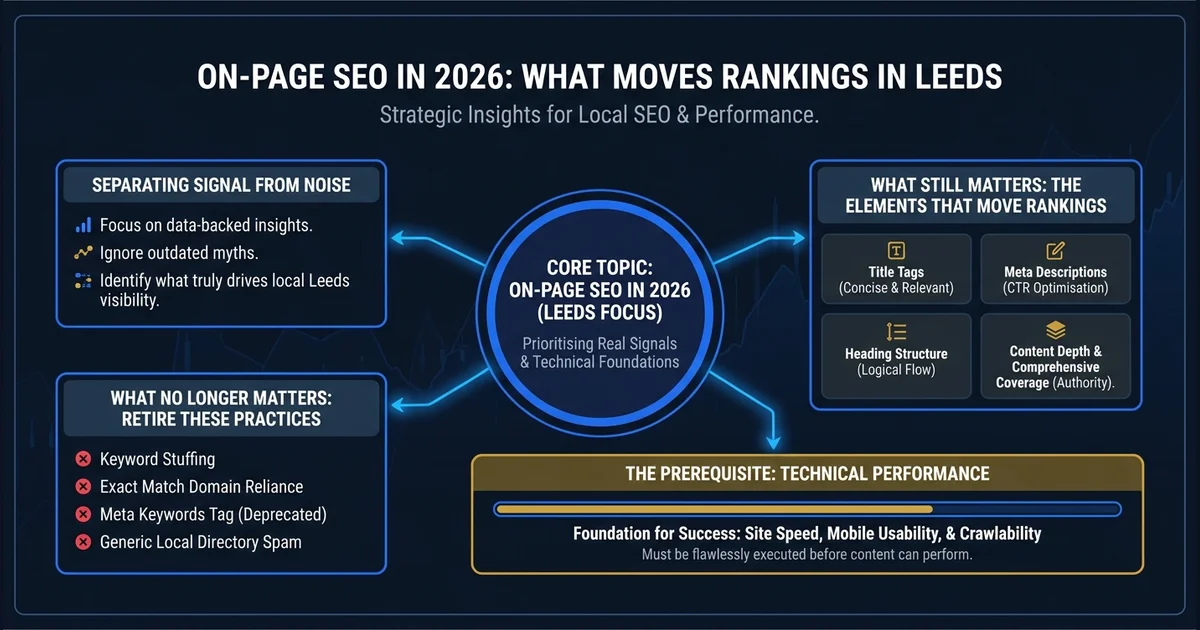
On-page SEO has accumulated years of folklore. Keyword density percentages, exact-match H1 rules, word count targets — the internet is full of advice that was marginal when written and is actively misleading now.
What follows is a clear-eyed look at what on-page optimisation actually consists of in 2026, based on what Google's algorithm demonstrably responds to. It is also written with local businesses in across the UK specifically in mind, because the application of these principles to a local context is distinct from what you will read in most generic SEO guides.
What Still Matters: The Elements That Move Rankings
Title Tags
The title tag — the text that appears as the clickable headline in search results — is one of the most direct on-page ranking signals. It tells Google what the page is about and is the first thing a user reads before deciding whether to click.
For local businesses, best practice is: lead with the primary keyword, keep it under 60 characters to avoid truncation, and write it for the human reader.
"Web Design Leeds | Leodis Digital" works.
"Leeds Web Design, Website Design Leeds, Affordable Web Design Leeds, Pay Monthly Websites Leeds" does not. Keyword stuffing in title tags is a pattern Google recognises and discounts.
Your most important pages — homepage, core service pages, location pages — should each have a unique title tag written specifically for its ranking target. Default titles generated by your CMS (often "Home | Business Name" or "Services | Business Name") are wasted opportunities.
Meta Descriptions
Meta descriptions are not a direct ranking factor — Google frequently rewrites them when it judges a different snippet better matches the search. But they are a click-through rate factor, and CTR influences ranking indirectly. A well-written meta description that accurately describes the page, addresses the user's search intent, and gives a clear reason to click will outperform a generic one.
Write them like a short advertisement: 150–160 characters, active voice, specific, with a clear value proposition. "Professional web design and pay-monthly websites for Leeds small businesses. No large upfront cost. Get a free quote." is more effective than "We offer web design services in the UK."
Heading Structure
A clear heading hierarchy — H1, then H2, then H3 — serves two purposes: it helps users navigate the page, and it helps Google understand the structure and relative importance of the content.
There should be exactly one H1 per page. It should contain or closely align with the page's primary keyword. H2 headings should represent the main sections of the page. H3 headings should be subsections within those sections.
What does not matter: whether your H2 contains the exact phrase "web design Leeds" multiple times. Natural language that clearly communicates the topic is what counts. Google uses semantic understanding, not keyword counting. Pairing correct heading structure with schema markup gives Google the clearest possible picture of what your pages cover.
Content Depth and Comprehensive Coverage
Google's Helpful Content system rewards pages that genuinely address the intent behind a search query. Understanding which search queries to address on each page starts with solid keyword research for UK businesses. A service page for "pay-monthly websites Leeds" that covers what the service includes, who it is designed for, how the process works, what the pricing is, and what results clients have achieved will outrank a thin page with three paragraphs and a contact form.
Depth is not the same as length. A 700-word page that fully answers the question outperforms a 3,000-word page padded with repetition and filler. Write to cover the topic completely, not to hit an arbitrary word count.
For local businesses, depth means addressing the specific questions a UK Business owner would have: what does it cost, how long does it take, who do you typically work with, what will I actually get.
Internal Linking
Internal links pass authority between pages and help Google understand the relationship between your content. Every piece of content should link to related service pages. Service pages should link to supporting articles. The homepage should link to the most strategically important pages on the site.
Use descriptive anchor text. "Click here" is wasted. "Pay-monthly web design for Leeds small businesses" tells Google exactly what the destination page is about and reinforces the relevance of that page for the target term.
For local businesses, ensure your service pages link to relevant location content, and your blog posts link back to the service pages they are designed to support. Our Leeds local SEO strategy guide explains how this fits into the broader picture of local search visibility.
URL Structure
Clean, descriptive URLs are a minor but real ranking signal and a significant usability one. /insights/pay-monthly-website-leeds is better than /page?id=47 or /our-services/what-we-do/pay-monthly-website-service-for-small-businesses-in-the-leeds-area.
Short, descriptive, lowercase, hyphens between words, no unnecessary parameters.
E-E-A-T: Why Who Wrote It Now Matters
Since Google's 2022 update to its Search Quality Evaluator Guidelines, Experience, Expertise, Authoritativeness, and Trustworthiness — collectively E-E-A-T — have become more visible as quality signals. This is particularly relevant for businesses publishing content in professional services, finance, health, or legal contexts (the so-called YMYL — Your Money or Your Life — categories), but it applies meaningfully to any local service business publishing advice content.
For a Leeds digital agency, E-E-A-T has practical implications:
Author credentials matter. Articles written by a named, credentialled author with a visible profile — a LinkedIn page, speaking credits, an About page that demonstrates real expertise — are treated with more confidence than anonymous content. If you are publishing SEO or web design advice under your business name, a byline linking to a credible author profile strengthens the signal.
First-hand experience is a differentiator. The additional "E" (Experience) added in 2022 recognises that genuinely useful content often comes from people who have done the thing, not just read about it. Content that references specific client outcomes, real data from your own projects, or observed patterns from working in a specific market signals authentic experience. Generic advice that could have been written by anyone without doing the work does not.
Your About page and contact information contribute to Trust. A site with a clear About page, a verifiable business address, a real phone number, and named team members signals trustworthiness in a way that anonymous or skeletal contact pages do not. These are assessed by Google's quality evaluators — real human reviewers who assess sample pages across the web and whose judgements train the ranking algorithm.
Review signals extend to content. A business with strong, recent Google reviews is a business that real customers have verified as legitimate. This extends to how Google assesses the authority of content published on your site. Reviews on your GBP, on Trustpilot, or on industry-specific platforms contribute to the broader E-E-A-T picture.
For local businesses in the UK, the practical application is straightforward: put real names on your content, include genuine case examples where possible, maintain an informative About page, and build your review profile systematically. None of this requires sophisticated technical work — it requires consistency.
Image Optimisation: An Underestimated On-Page Signal
Images are one of the most consistently neglected on-page elements. For local businesses, they are also one of the most direct opportunities to reinforce local relevance and improve page performance simultaneously.
Alt text. Every image on your site should have an alt text attribute that accurately describes the image. For SEO purposes, alt text is an additional context signal — an image of a newly built website for a Headingley restaurant can carry alt text that reinforces your service and location context. Do not keyword-stuff alt text; describe the image naturally. "Website design project for a Headingley restaurant, showing the homepage on desktop and mobile" is correct. "web design Leeds website designer Leeds pay monthly" is not.
File format and compression. Images served as WebP or AVIF rather than JPEG or PNG are significantly smaller at equivalent visual quality. Smaller files load faster. Faster loading directly improves your Core Web Vitals scores, particularly LCP. Every image on a properly built website should be converted to a modern format and compressed before serving. This is standard practice on all Leodis Digital builds and a significant source of performance improvement on sites migrating from older platforms.
Explicit dimensions. Images without explicit width and height attributes cause the browser to reserve no space for them during initial render. When they load, they push surrounding content down — this is Cumulative Layout Shift (CLS), and it is both a poor user experience and a negative ranking signal. Every image should have its dimensions declared in the HTML.
Descriptive file names. The filename of an image is read by Google. "IMG_4582.jpg" tells Google nothing. "web-design-project-chapel-allerton-cafe.webp" tells Google what the image contains and reinforces local relevance. Rename images descriptively before uploading.
What No Longer Matters: Retire These Practices
Keyword Density
The idea that a page should contain a target keyword at a specific percentage frequency has no basis in how modern search algorithms work. Google uses semantic understanding — it reads content and understands concepts, not keyword frequencies. Write naturally. If you are covering a topic thoroughly, the relevant terms will appear naturally in the right context.
Meta Keywords
This tag has been ignored by Google since 2009. It is still generated by some CMS plugins. It contributes nothing and can be safely removed.
Exact-Match Keyword Repetition
Forcing your exact target phrase into every heading, paragraph, image alt tag, and button label is not optimisation — it is a legacy habit from a different era of search. Google understands synonyms, related terms, and context. Writing naturally about a topic, using the vocabulary that belongs to it, is more effective.
Chasing Word Count Targets
There is no magic word count for SEO. "At least 1,500 words" is folklore, not algorithm. Write as much as is necessary to comprehensively address your target topic, and stop. If that is 600 words, the page is done. If it requires 2,000 words, write them — and make sure every one earns its place.
A Practical On-Page Checklist for Leeds Service Pages
For each core page on your site — homepage, service pages, location pages — run through the following before considering on-page optimisation complete.
Title tag: Does it contain the primary keyword naturally? Is it under 60 characters? Is it unique to this page?
Meta description: Is it 150–160 characters? Does it describe the page accurately, address the user's intent, and give a clear reason to click? Is it unique?
H1: Is there exactly one H1? Does it contain or closely relate to the primary keyword? Does it accurately describe what the page covers?
Heading hierarchy: Do the H2 headings represent the main sections? Are any H3 headings used correctly as subsections, not as styling choices?
Content completeness: Does the page address all the questions a prospective customer would reasonably have about this service? Have you covered pricing expectations, timescales, what the process looks like, and who the service is right for?
Keyword coverage: Are the primary keyword and its natural variations present in the content, particularly in the opening paragraph, at least one H2, and the conclusion? Are synonyms and related terms used naturally throughout?
Internal links: Does this page link to at least two or three related pages? Do those links use descriptive anchor text? If this is a service page, does it link to supporting blog content, and do the blog posts link back?
Images: Do all images have accurate, descriptive alt text? Are they in a modern format (WebP or AVIF)? Do they have explicit width and height dimensions declared?
Schema markup: For service pages, does the page include appropriate schema — Service, LocalBusiness, FAQPage if applicable? See our schema markup guide for the specific types and implementation.
URL: Is the URL short, descriptive, lowercase, and hyphen-separated?
Mobile presentation: Does the page read clearly on a mobile screen? Are text sizes appropriate, tap targets large enough, and content not obscured or overflowing?
Page speed: Does the page pass Core Web Vitals in Google PageSpeed Insights field data? If not, the on-page optimisation is working against a structural disadvantage.
Working through this checklist methodically for every service page and location page on your site is the most direct and reliable path to improving your on-page foundation. It is methodical rather than creative work, and for most local business sites in the UK the gaps are immediately apparent once you actually look for them.
The Prerequisite: Technical Performance
Here is the thing most on-page SEO guides skip: on-page optimisation works best when the technical foundation of your website is sound.
A perfectly optimised page on a slow, poorly-structured website is working against a structural disadvantage. Google's Core Web Vitals — the performance metrics that are a confirmed ranking signal — apply before the content quality algorithms even come into play. If your site fails Core Web Vitals, you are at a structural ranking disadvantage regardless of how well-optimised your individual pages are.
For local businesses in the UK, this is the most common reason on-page work does not produce the expected results — and it is the one most frequently overlooked when business owners are advised to simply publish more content. The content is good. The title tags are right. The headings are correct. But the site scores 45 on Google PageSpeed Insights for mobile, and every competitor with a faster site has a structural advantage.
A professionally built website — one that passes Core Web Vitals and loads quickly on mobile — is the prerequisite. For businesses that cannot invest £6,000+ in a custom build, a pay-monthly website from Leodis Digital provides the same technical standard for a fixed monthly fee, with no large upfront cost.
The clearest way to think about it: on-page SEO is the argument you make to Google that your page deserves to rank. Technical performance is the credibility that makes Google take your argument seriously. Without credibility, the argument is discounted before it is heard. Most local businesses in the UK are making reasonable on-page arguments on websites that lack the technical credibility to make them land. Fixing the technical foundation first — then applying rigorous on-page optimisation — is the correct sequence, and the one that produces results within a measurable timeframe.
For the technical elements that work alongside on-page optimisation, see our Core Web Vitals article. Our keyword research guide explains how to identify the right terms to optimise each page for. And our local SEO strategy guide shows how on-page work fits into the broader picture of ranking in the UK.
If you want your site's on-page SEO reviewed alongside its technical foundation — with a plain-English report on what is working, what is not, and what to fix first — get in touch with Leodis Digital for a free initial assessment.
Frequently Asked Questions
How important is keyword placement in headings for local SEO?
Important, but not in the mechanical way much advice suggests. Your H1 should clearly communicate what the page is about and ideally contain your primary keyword — "Web Design Leeds" or "Accountant in Harrogate" — because it is one of the clearest signals Google reads. Below that, H2 and H3 headings should describe sections naturally. Forcing the exact keyword phrase into every heading is counterproductive. Write for the human reader and Google will understand the intent.
Should I have a separate page for every location I serve?
For your primary location, yes — a dedicated, substantive page is important. For secondary areas, location pages are valuable if they contain genuinely useful, location-specific content. Thin pages that simply swap the city name in a template add no ranking value and can dilute your site's authority. If you cannot write something genuinely useful about serving businesses in Bradford versus Leeds, a single service area page is more effective than multiple thin location pages.
How long should my service pages be?
Long enough to comprehensively address what a potential customer needs to know — and no longer. A service page that explains what the service includes, who it suits, what the process looks like, and what results to expect is more valuable than a thin page with three paragraphs. But a 3,000-word page padded with repetition is worse than a focused 800-word page. Write to answer the question completely, not to hit a target.
Does on-page SEO matter if my website is slow?
Less than it should. A technically slow website — one that fails Core Web Vitals and scores poorly on Google PageSpeed Insights — has a structural ranking disadvantage that limits how effective your on-page optimisation can be. Think of on-page SEO as the engine and technical performance as the road — your engine cannot perform properly on a poor surface. For local businesses in Leeds, getting the technical foundation right is the prerequisite for on-page work to deliver its full potential.
Found this useful? Share it.