Key Takeaways
- Most charity websites follow a damaging cycle of grant-funded builds followed by years of neglect, causing progressive technical decline and lost search visibility.
- Charities have natural E-E-A-T authority through genuine community relationships, press coverage, and partner links from councils, NHS trusts, and housing associations.
- NGO or Organisation schema markup, DonateAction markup on donation pages, and Event schema on fundraising pages help Google understand a charity's purpose and actions.
- Donation pages need fast load times because slow sites increase abandonment, and the same Core Web Vitals penalties that suppress commercial rankings apply equally to charities.
- A pay-monthly website model eliminates the large upfront cost barrier for charities and includes ongoing maintenance that prevents the technical degradation typical of grant-funded sites.
The Unique Position Charities Occupy in Search
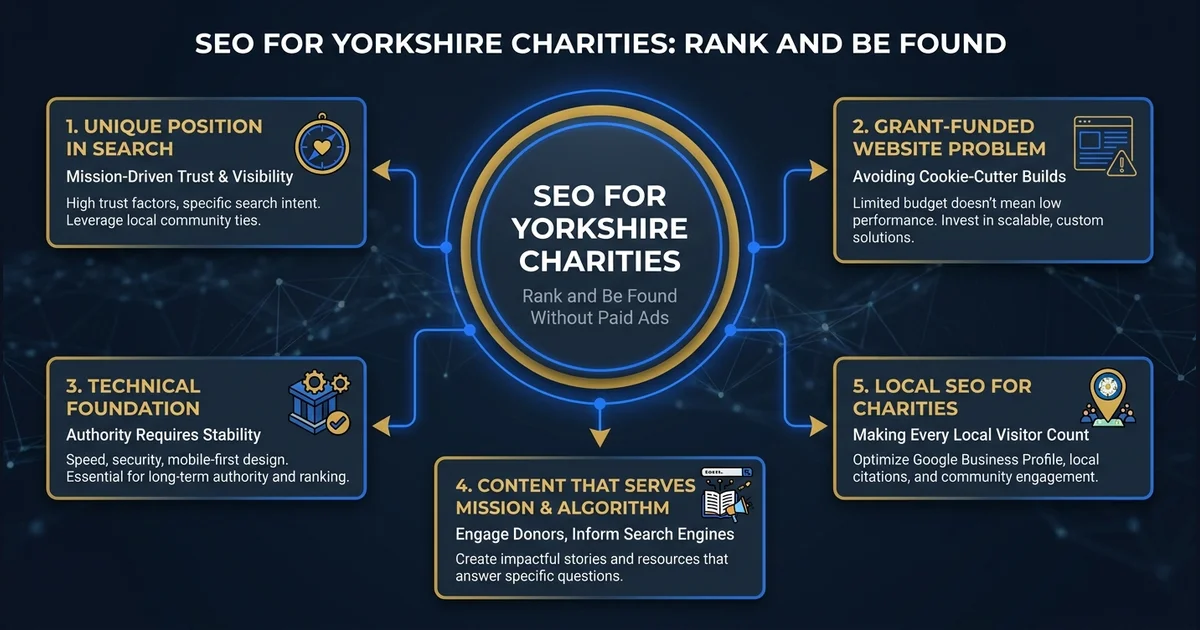
Charities operate at the intersection of community trust, genuine human stories, and tangible local impact. These are qualities that are extremely difficult for commercial competitors to replicate — and they are qualities that Google's E-E-A-T framework specifically recognises and rewards.
The challenge is that most charities do not know how to translate their intrinsic authority into search visibility. They are often operating with websites built years ago on one-off grant funding, limited technical knowledge, and stretched teams who are understandably focused on mission delivery rather than digital marketing.
This guide is for organisations that want to change that — and for the trustees, senior leaders, and communications managers who understand that improved search visibility directly means more people accessing services, more donations, and more volunteer applications.
The Grant-Funded Website Problem
Many charity websites follow a predictable and damaging cycle: a site is built with one-off grant funding, launched with good intentions, and then left unmaintained as the team focuses on service delivery. By year two, the site is falling behind on performance standards. By year four, plugins are outdated and becoming security liabilities. By year six, the site is slower than almost every competitor, not mobile-friendly by current standards, and has been losing ground in search rankings for years.
The eventual result is an expensive emergency rebuild — often with another grant application required — that puts the charity back to where it was at launch, without having solved the underlying structural problem: the lack of ongoing professional maintenance.
The pay-monthly website model addresses this directly. Instead of a large one-off build followed by neglect, the website is built and actively maintained throughout the contract period. Hosting, security updates, performance monitoring, and software maintenance are included. The site does not slowly degrade because the maintenance is built in.
For charities that cannot allocate budget to a standalone maintenance retainer, a pay-monthly website from Leodis Digital provides the right structure: professional quality, ongoing maintenance, and a fixed monthly cost that can be planned for in annual budgets.
The Technical Foundation That Authority Requires
Charities often have genuine community authority — real relationships, press coverage, partner organisations that link to them, community trust built over years of service delivery. But this authority has to be technically accessible for Google to recognise it.
A slow, poorly structured site with no schema markup, broken internal links, and inconsistent NAP data will underperform regardless of how trusted the organisation is in the real world. The technical foundation is the infrastructure through which community authority becomes search visibility.
Page speed matters for charities as much as for commercial businesses. Donation pages in particular need to load fast — slow sites that fail Core Web Vitals increase abandonment significantly, and the same performance penalties that suppress commercial rankings apply equally to charities. A charity that loses donations because its giving page takes six seconds to load on mobile has a solvable technical problem, not an audience problem.
Mobile optimisation is non-negotiable. Charity audiences engage predominantly through social media and community channels, which are overwhelmingly mobile. If your donation page, volunteer application, or service information is hard to navigate on a phone, you are losing the people who want to support you.
Schema markup for charities. At minimum: NGO or Organisation schema markup on the homepage, clearly stating the charity's name, address, registered charity number, and mission. DonateAction markup on donation pages where eligible. Event schema on any fundraising or community event pages. This structured data is a direct communication to Google about what your organisation is and what it does.
Content That Serves the Mission and the Algorithm
The best charity content strategy does not feel like SEO. It feels like the communication the charity would be doing anyway: guides for people seeking the services it provides, resources for volunteers, transparent impact reporting, and stories that illustrate the work in human terms.
This type of content earns links and citations naturally. Local press covers it. Partner organisations reference it. Community members share it. These are the signals that build domain authority and local relevance over time — and they build it in a way that is fully aligned with the charity's mission rather than separate from it.
Target informational keywords that align with your mission. A domestic abuse charity might rank for "leaving an abusive relationship Leeds," "housing support for domestic abuse survivors," or "safety planning guide." A food bank might rank for "where to get emergency food Leeds" or "how to access food bank support in the UK." These searches come from people in genuine need. Content that helps them is both ethically appropriate and algorithmically valuable.
Impact reporting as SEO content. Annual impact reports published as accessible web pages — not PDFs — create searchable, indexable content that builds the transparency and trustworthiness signals Google values for YMYL (Your Money or Your Life) content topics. A charity that publishes detailed, specific impact data demonstrates real-world authority in a way that generic mission statements cannot.
Local SEO for Charities
If your charity serves a defined geographic area in the UK or the UK, treat local SEO with the same rigour a commercial business would.
Claim and optimise your Google Business Profile. Use the nonprofit category where available. Add photos of your work, your team, and your facilities. Respond to every review. Ensure your address, phone number, and website are consistent across every directory listing, grant database, and partner website that references your organisation.
Local links carry enormous value. The relationships that charities have with local councils, housing associations, NHS trusts, local colleges, and community organisations are not just programmatic partnerships — they are link opportunities that carry significant local authority. Ensure every formal partnership results in a mention on the partner organisation's website. Ensure your charity is listed on all relevant Leeds City Council community directories, Voluntary Action Leeds, and community foundation grant listings.
Press coverage. Local press features, charity award citations, and community event coverage in the Yorkshire Evening Post, Leeds Live, and local neighbourhood publications create authority signals that compound over time. Have a media contact list and a process for responding to local journalists seeking expert comment on issues in your area of work.
What Leodis Digital Does Differently for Third-Sector Organisations
We understand that charity budgets are constrained and that every pound spent on digital infrastructure is a pound not spent on service delivery. Our approach to third-sector work starts from that reality.
We offer pay-monthly website contracts specifically designed to work within charity budget cycles — fixed monthly costs that can be included in grant applications and operational budgets, with no large upfront expenditure. The monthly fee includes everything: hosting, SSL security, maintenance, software updates, and technical support.
We build to WCAG 2.1 AA accessibility standards as a baseline — essential for charities serving diverse communities, many of whom may rely on assistive technology. We implement the correct schema markup for third-sector organisations. And we build sites that are genuinely fast on mobile, because that is where the people you serve and the people who want to support you are most likely to find you.
The digital presence a charity builds over the next two years will determine how many people can access its services, how many donors find it, and how many volunteers apply. The investment in getting it right is not separate from the mission — it is part of delivering it.
For the technical foundation that underpins charity SEO, see our Core Web Vitals guide and our technical SEO audit article. Ready to discuss your charity's digital presence? Get in touch with Leodis Digital.
Frequently Asked Questions
Can Leodis Digital build a pay-monthly website for a charity?
Yes. We work with third-sector organisations and understand that every pound spent on a website is a pound not spent on service delivery. Our pay-monthly website model is particularly well-suited to charities because it eliminates the large upfront cost of a traditional agency build. The monthly fee includes hosting, maintenance, security updates, and technical support — removing the ongoing overhead that often causes charity websites to degrade over time. We will have an honest conversation about what your charity actually needs before recommending an approach.
Why do charity websites tend to perform poorly in search?
The most common cause is the grant-funded website cycle: a site is built with one-off grant funding, launched, and then left unmaintained for five to seven years until it is too outdated to function. During that time, the site becomes slower, less secure, and increasingly outperformed by competitors whose sites are actively maintained. The pay-monthly website model solves this structurally — the site is maintained throughout the contract, not just at launch.
What schema markup should a charity website use?
At minimum, NGO or Organisation schema on the homepage, clearly stating the charity's name, address, contact details, and mission. Donation pages should use DonateAction markup where eligible. Event pages should use Event schema for any fundraising or community events. This structured data helps Google understand what the organisation is and what visitors can do when they arrive — important for charities where the primary conversion actions (donating, volunteering, accessing services) are distinct from commercial transactions.
How can a charity build local authority signals in Leeds?
Through the genuine community relationships that most charities already have. Links from Leeds City Council, local NHS trusts, housing associations, universities, colleges, and partner charities carry significant local authority. Press coverage in the Yorkshire Evening Post or Leeds Live is an E-E-A-T signal. Listings on Charity Commission directories, community foundation grant databases, and local volunteer platforms are citation signals. These are not manufactured links — they are the digital reflection of the community relationships the charity has built through its work.
Found this useful? Share it.