Key Takeaways
- WaaS (Website as a Service) replaces the traditional one-off website build with a monthly subscription that includes design, hosting, maintenance, technical SEO, and support.
- The traditional web build model has a structural incentive misalignment: the agency moves on after delivery and has no ongoing stake in the site's performance.
- A WaaS website includes technical SEO foundations from day one: LocalBusiness schema, Core Web Vitals performance, semantic HTML, mobile-first design, and correct title tags and meta descriptions.
- By year three, a comprehensive WaaS subscriber has spent around twenty-seven thousand pounds and has a technically current, actively optimised site with SEO included, while the traditional route with equivalent SEO management has spent around thirty-four thousand pounds on a site that still faces a redesign cycle.
- WaaS adoption in West Yorkshire is still early, creating a time-limited competitive advantage for businesses that build technical SEO foundations before the baseline rises.
A New Model for an Old Problem
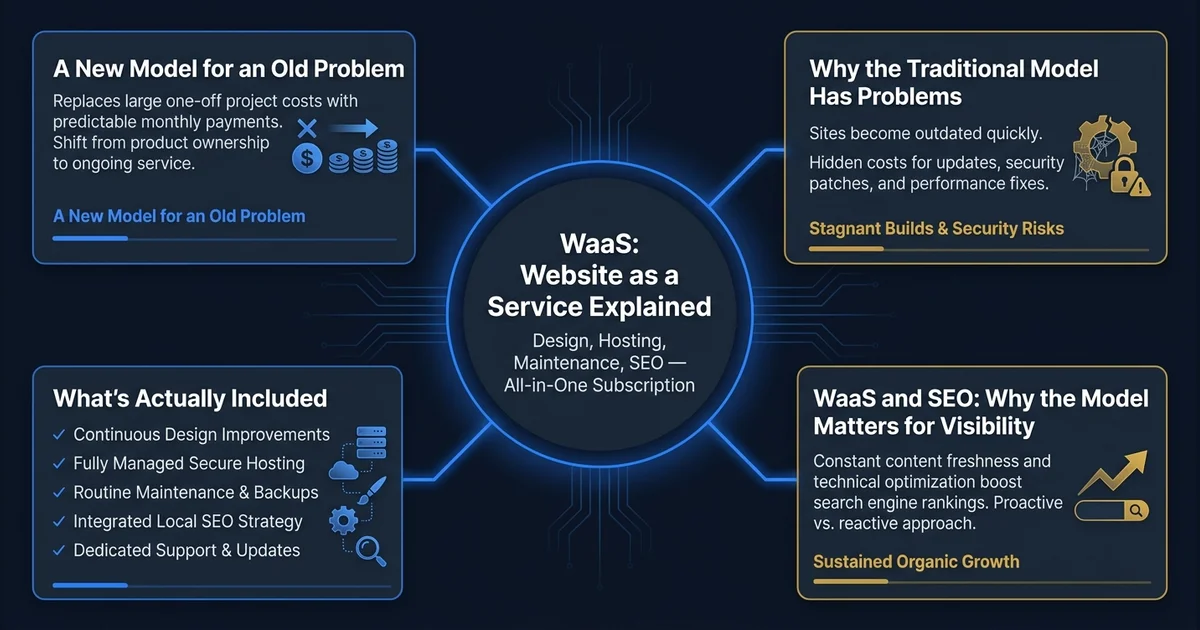
Every small business in the UK needs a website. That much has been true for twenty years. What has changed is the economics of getting one — and the industry is splitting into two very different approaches to solving the same problem.
The traditional approach: brief an agency, pay £3,000–£8,000 upfront, receive a website, own it, and then maintain it yourself for the next four years until it falls behind technically and the whole cycle begins again.
The newer approach: pay a fixed monthly fee, receive a professionally built and actively maintained website, and have it stay current as long as you remain a customer.
This second approach is called WaaS — Website as a Service. It is also sold as a "pay-monthly website," a "subscription website," or a "managed website service." The terminology varies between providers and markets; the underlying model is the same.
The Core Idea
WaaS borrows the subscription logic that has reshaped software, media, and business services over the last decade. Rather than purchasing an asset outright — a website — you subscribe to an ongoing service that includes the website as its primary deliverable.
In practice, this means:
- A professionally built website designed specifically for your business, not a template you've filled in yourself
- Hosting included on infrastructure chosen for UK performance — no separate hosting bill, no managing server configurations
- Ongoing maintenance — security updates, plugin or dependency management, performance monitoring
- Technical SEO foundations built in from day one: schema markup, Core Web Vitals performance, semantic HTML, mobile-first design
- Active support when you need changes, updates, or additions — with a real turnaround commitment, not a ticket queue with no ETA
What you are not paying for: a large upfront build cost, a handover of something you then own and must maintain, or the accumulated technical debt that comes from a site that nobody is actively looking after.
Why the Traditional Model Has Problems
The one-off website build works well in theory. In practice, it has a structural flaw: the incentive misalignment.
An agency that builds your website for a fixed fee and hands it over has no ongoing incentive to ensure it performs. They move on to the next project. Your site sits on the same hosting, with the same plugins, accumulating debt. When something breaks eighteen months later, you pay again. When a Google algorithm update rewards modern Core Web Vitals performance, your site is running a theme from 2021 that nobody is going to update.
The 2021 Google research is instructive: sites that consistently fail Core Web Vitals — real-world measures of page speed and responsiveness — are at a competitive disadvantage in search rankings. A one-off website build that was technically fine at launch can be technically behind within two years without active maintenance. This isn't hypothetical; it's the standard lifecycle of an unmanaged site.
WaaS changes this incentive structure entirely. Because the provider is paid monthly, their interest is in the site continuing to perform. A site that falls behind technically or stops delivering results for the client is a site that will be cancelled.
What's Actually Included
The specifics vary between providers, but a full WaaS offering — like a pay-monthly website from Leodis Digital — includes the following:
Design and build. A custom-designed, professionally built website that reflects your brand, targets your audience, and is built on a modern, lightweight framework. Not a template. Not something you assembled from components.
Hosting. UK-based managed hosting or CDN delivery, chosen for speed and reliability. No separate contracts, no managing cPanel, no worrying about server capacity.
Technical SEO. From day one, the site includes: correct LocalBusiness schema markup, FAQPage schema for content, accurate title tags and meta descriptions targeting your primary keywords, semantic HTML structure, and mobile-first architecture that passes Google's Core Web Vitals. These are not optional add-ons — they are build requirements, and they are verified against PageSpeed Insights scores before any site goes live. See our technical SEO audit guide for the full checklist of what a technically sound site requires.
Performance maintenance. As standards evolve — new Core Web Vitals metrics, new schema formats, new best practices — the site is updated to stay current. This is the part that the traditional model systematically fails to deliver.
Support. When you need to update your services, change your pricing, add a new team member, or respond to something in the market, you contact the team rather than opening a page builder and hoping nothing breaks.
WaaS and SEO: Why the Model Matters for Visibility
The reason WaaS is particularly relevant to local businesses in across the UK is that website quality is a ranking signal. Google does not separate "good website" from "visible website" — the technical quality of your site directly affects whether it appears in search results for your target terms.
A pay-monthly website from Leodis Digital achieves 90+ on Google PageSpeed Insights for mobile from day one. It includes the schema markup that helps Google understand your business, the service areas you cover, and the questions you answer. It is built with the accessibility and semantic structure that modern search algorithms reward.
A site on a bloated WordPress theme with outdated plugins and inadequate hosting cannot achieve this, regardless of how much content you publish. The platform is the ceiling on all other SEO work. Core Web Vitals explains precisely how performance affects rankings and what the benchmarks are.
The WaaS model also keeps the technical foundation current over time. When Google's Page Experience update added new signals, when mobile-first indexing became the standard, when schema formats were updated — a managed site adapts. An unmanaged one doesn't.
The Pricing Reality
The objection to WaaS is almost always financial: "I don't want to pay forever."
This objection makes sense only if you compare a monthly subscription to the upfront cost of a website — and then imagine the website having no ongoing costs. That is not what happens. Traditional websites have ongoing costs: hosting (£10–£50/month typically), maintenance when things break, redesign when the site falls behind, technical SEO work when rankings slip.
A realistic comparison for a Leeds small business:
| Approach | Year 1 | Year 2 | Year 3 |
|---|---|---|---|
| Traditional (£5k build + ongoing) | £5,800 | £600 | £600 |
| WaaS at £79/month | £948 | £948 | £948 |
By year three, the WaaS subscriber has spent £2,844 and has a site that is actively maintained and technically current. The traditional route has spent £7,000 and has a site that is two years behind the maintenance cycle.
The maths changes with more expensive WaaS tiers, but the principle holds: the total cost of ownership of an unmanaged website is higher than it appears at point of purchase.
There is also an opportunity cost that the table above does not capture. A traditionally built site that falls behind technically — failing Core Web Vitals, running outdated plugins, accumulating security vulnerabilities — is not a neutral asset. It is actively suppressing your search rankings, potentially exposing your business and customers to security risks, and creating a poor impression on every visitor who loads it on a mobile phone and waits six seconds for the page to appear. The cost of that suppressed ranking is real revenue not earned. A WaaS subscription that prevents this outcome is not a cost — it is an insurance policy with a measurable return.
How to Evaluate a WaaS Provider: The Right Questions to Ask
Not all WaaS offerings are equivalent. The model name covers everything from a single freelancer charging £25 a month for a Squarespace site they manage loosely, to a full-service agency delivering a custom-built, performance-optimised website with active SEO management and technical monitoring. Before committing to a WaaS subscription, the following questions will tell you what you are actually getting.
What is the website built on? The platform matters. A WaaS built on WordPress with a premium theme is a very different product to one built on a modern, lightweight JavaScript framework like Preact, Astro, or Next.js. The latter will consistently outperform the former on Core Web Vitals, which translates directly to ranking advantage. Ask to see PageSpeed Insights scores for existing client sites.
Who owns the domain? This is non-negotiable. Your domain is your most valuable long-term digital asset. It carries your brand recognition, your backlink profile, and your search history. If a provider registers the domain in their own name, you are exposed — you cannot take it with you if you leave. Insist on domain ownership in your name from day one.
What happens to my content if I cancel? Some WaaS providers make exit deliberately difficult by refusing to export your content or charging exit fees. A reputable provider will offer a full content export on cancellation. The content you have written belongs to you, regardless of who built the platform.
What is included in "maintenance"? Maintenance can mean anything from quarterly plugin updates to daily performance monitoring and proactive security patching. Clarify specifically what is monitored, how often, and what the response process is if something breaks.
How do content changes work? Do you email a request and wait, or is there a portal? What is the typical turnaround? Is there a limit on the number of changes per month, or is it unlimited within the subscription?
What reporting do you receive? A WaaS provider investing in your site's performance should be able to show you data: organic traffic trends, Core Web Vitals scores, Google Search Console impressions and clicks. If a provider cannot show you how your site is performing over time, they are not managing it actively.
Is there a minimum contract period? Some providers require twelve or twenty-four month commitments upfront. Others, including Leodis Digital, operate on a rolling monthly arrangement with a notice period. The right model aligns incentives: a monthly contract keeps the provider accountable for continued performance, because the relationship continues only as long as it delivers value.
WaaS and Long-Term Digital Strategy
For most local businesses in the UK, a website is the centre of their digital marketing — the destination that all other activity is designed to drive traffic toward. Social media, Google Ads, local PR, word of mouth — every channel works best when it points to a website that loads quickly, communicates clearly, and converts visitors into enquiries.
WaaS is a model that treats the website as an ongoing strategic asset rather than a one-time capital project. This shift in framing has implications beyond the initial build:
The site evolves with the business. A growing business changes its services, updates its pricing, adds team members, and expands into new areas. A WaaS model accommodates this as an ongoing part of the service. A traditionally built site often ends up frozen in the state it was launched because requesting changes costs money each time.
Technical standards are maintained automatically. Google's technical requirements for websites have changed materially in the last five years: mobile-first indexing, Core Web Vitals, structured data requirements. A WaaS provider maintains the site against current standards. A site left unmanaged after a one-off build will fall behind these standards progressively.
SEO compounds over time. A site that is technically sound, actively maintained, and regularly updated with well-targeted content will accumulate domain authority, ranking history, and topical coverage over time. This compounding effect is the primary reason local businesses that invest consistently in their website outperform those that treat it as a one-time project. WaaS creates the structural conditions for this compounding to happen.
The fixed monthly cost supports financial planning. For a small business managing cash flow carefully, a predictable monthly cost is materially easier to manage than a large irregular capital expense. WaaS converts a lumpy capital item into a fixed operational cost — which is how most software and services businesses now price their offerings.
Who WaaS Is Right For
WaaS works best for businesses that:
- Need a professional web presence but cannot justify a large upfront capital expense
- Have been quoted £3,000–£8,000 and found the traditional model inaccessible
- Currently have a website that is technically falling behind but face the same upfront cost barrier to replace it
- Want predictable monthly costs rather than unpredictable one-off bills
- Understand that SEO and web performance are not a one-time project but an ongoing discipline
It is not the right model for businesses that need a highly customised web application, an e-commerce platform with complex integrations, or a large enterprise site with custom development requirements. For those cases, the build-and-own model is appropriate.
For the majority of small and medium businesses in across the UK — trades, professional services, hospitality, retail, charities — WaaS provides everything needed at a cost structure that makes commercial sense.
The Leeds Landscape
WaaS adoption in the UK is still early. Most local agencies continue to operate on the traditional project model. This creates a specific opportunity: businesses that adopt WaaS now — and the technical foundation it provides — are building a competitive SEO advantage over competitors whose sites are accumulating technical debt on aging platforms.
The local competitive landscape for many Leeds service categories is still relatively fragmented online. A significant proportion of businesses competing for local search terms are doing so on outdated, slow, unmanaged websites that fail Core Web Vitals and have thin or duplicated content. For a business that invests in a properly built, actively maintained WaaS site and couples it with a consistent content strategy, outranking these competitors is achievable within months — not the years it would take in a more technically sophisticated market.
This window of advantage will not remain open indefinitely. As WaaS adoption grows and more UK businesses invest in technically sound websites, the baseline will rise. The businesses that act now — while the competitive gap between a properly built site and the average local competitor site is at its widest — will accumulate ranking history, domain authority, and customer reviews that compound in value over time and become increasingly difficult for later entrants to replicate quickly.
Leodis Digital is positioned as the premier WaaS provider for across the UK. Every pay-monthly website is built on a performance-first framework, maintained actively, and designed to provide the technical foundation for local SEO that consistently ranks.
For the comparison between WaaS and traditional web design — the specific trade-offs, total costs, and which model fits which business — see our WaaS vs traditional web design guide. For the specific SEO advantages the model delivers, see how WaaS improves your SEO.
Ready to understand what a pay-monthly website from Leodis Digital would look like for your business? Get in touch for a straightforward conversation about what's involved and what it costs.
Frequently Asked Questions
Is WaaS the same as a pay-monthly website?
Yes — WaaS (Website as a Service) is the industry term for the model that most UK businesses encounter as a "pay-monthly website." The terminology differs depending on whether you're speaking to an agency or a business owner. The underlying model is the same: a professionally built, actively maintained website delivered for a fixed monthly subscription, with no large upfront cost. Leodis Digital uses both terms interchangeably, though most Leeds businesses recognise "pay-monthly website" immediately.
Who owns the website in a WaaS arrangement?
This varies by provider and is the most important question to ask before signing. At Leodis Digital, you own your domain and your content throughout the contract. The design and platform are part of the service agreement. If you ever leave, your content is yours — we provide a full export. Some providers retain all rights, including the domain, so read your terms carefully before committing to any WaaS arrangement.
How is WaaS different from a website builder like Wix or Squarespace?
Website builders charge a subscription for access to a platform — you still do all the work: design, build, content, maintenance, SEO. WaaS is a done-for-you service. You pay a monthly fee and receive a professionally built, actively maintained website with technical SEO, schema markup, Core Web Vitals performance, and expert support included. The distinction matters enormously for businesses that need results, not a platform to manage.
What happens if I want to cancel a WaaS subscription?
Cancellation terms vary by provider. Leodis Digital operates on a rolling monthly contract with a notice period — there is no multi-year lock-in. The model is designed to retain clients through quality and results, not contractual entrapment. If you cancel, your domain is yours to take to any new provider.
Found this useful? Share it.