Key Takeaways
- The technical quality of a website is the ceiling on all other SEO work; content on a slow, technically deficient site will underperform the same content on a fast, well-structured site.
- Every pay-monthly website from Leodis Digital achieves 90+ on Google PageSpeed Insights for mobile from day one as a build requirement, not a goal.
- Correct schema markup (LocalBusiness, Service, FAQPage, BreadcrumbList, WebSite) is part of the WaaS build specification, tested against Google's Rich Results Test before launch.
- The most significant SEO advantage of WaaS is sustained technical quality over time, as a managed site adapts to evolving standards while a one-off build depreciates.
- Google's research shows bounce probability increases by 32% as load time goes from one to three seconds and reaches 90% at five seconds (Google/SOASTA, 2017).
The SEO Case for Pay-Monthly Websites Is Technical
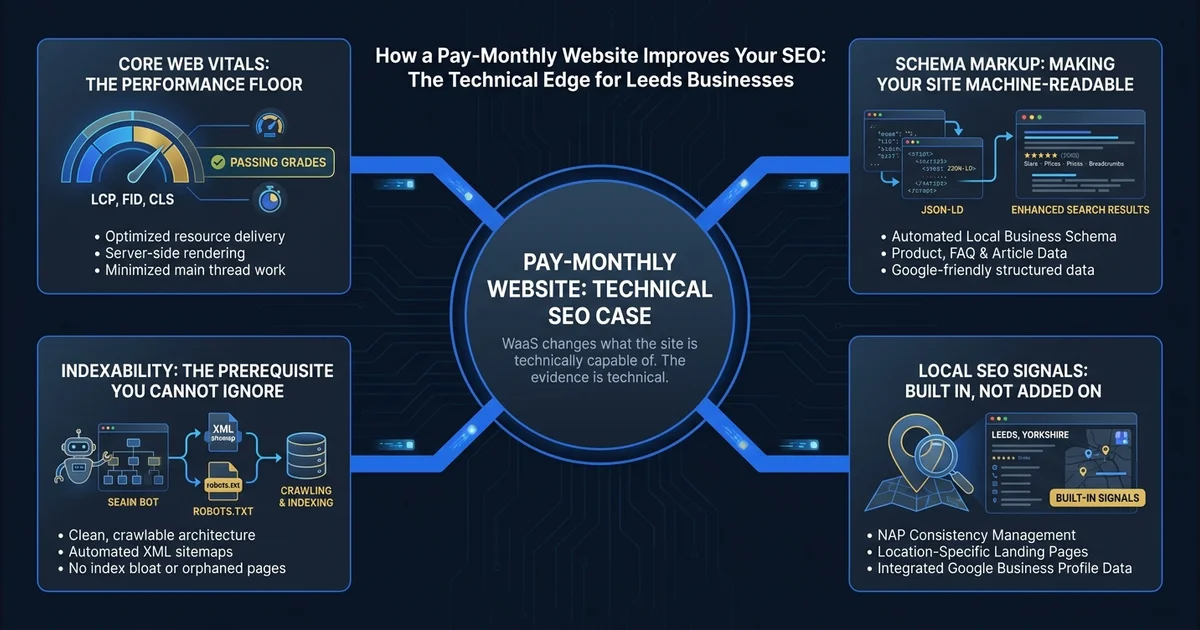
There is a persistent misunderstanding about how website quality affects SEO. Many business owners think of SEO as a content problem — write more, publish more, get more links.
It isn't.
The technical quality of your website is the ceiling on all other SEO work. Content published on a slow, technically deficient site will underperform relative to the same content on a fast, well-structured site.
A pay-monthly website — WaaS — improves SEO not because it includes an SEO service, but because it changes what the website is technically capable of doing. This guide explains the specific mechanisms.
Core Web Vitals: The Performance Floor
Google has confirmed Core Web Vitals as a ranking signal. Three metrics determine your Page Experience score:
- LCP (Largest Contentful Paint): How quickly the main content appears. Target: under 2.5 seconds. Sites above 4 seconds are classified "Poor."
- INP (Interaction to Next Paint): How quickly the page responds to interaction. Target: under 200ms.
- CLS (Cumulative Layout Shift): How much the page layout shifts during loading. Target: under 0.1.
The significance of these metrics is not theoretical. Google's own research shows that as page load time increases from one to three seconds, bounce probability increases by 32%. At five seconds, it reaches 90%. For local businesses whose rankings depend on organic search, this means: a slow site that somehow ranks will not convert the traffic it receives.
Most unmanaged WordPress sites fail at least one Core Web Vitals metric on mobile. The causes are well-documented: oversized images, bloated page builder CSS and JavaScript, inadequate hosting, render-blocking third-party scripts.
Every pay-monthly website from Leodis Digital achieves 90+ on Google PageSpeed Insights for mobile from day one. This is not a goal — it is a build requirement. The framework is chosen for performance, images are optimised as part of the build process, and hosting is selected for UK latency specifically. There are no performance plugins doing remedial work on a slow platform. The platform is fast.
Schema Markup: Making Your Site Machine-Readable
Schema markup is structured data that tells search engines — in unambiguous, machine-readable format — exactly what your business is, where it operates, what services it offers, what hours it's open, and what questions it answers.
Most websites have no schema markup. Of those that do, many have it misconfigured — referencing old addresses, missing required fields, or using deprecated schema types.
The ranking impact of correct schema is indirect but significant. Google uses schema to understand content with greater confidence, which affects whether it surfaces your pages for relevant queries.
For content-heavy pages, FAQPage schema can generate rich results in the search listings — an expandable Q&A block that appears directly in the SERP and increases click-through rate. Our own schema markup guide ranks for multiple schema-related queries specifically because the page itself implements the FAQPage schema correctly.
A pay-monthly website from Leodis Digital includes the following schema types from day one:
- LocalBusiness — name, address, phone, opening hours, service area, geo coordinates
- Service — for each primary service page, describing what the service includes
- FAQPage — on content pages with question-and-answer sections
- BreadcrumbList — for clear site hierarchy signals to Google
- WebSite — with sitelinks search box where eligible
These are not configured as an afterthought. They are part of the build specification, tested against Google's Rich Results Test before launch, and maintained as schema formats evolve.
Indexability: The Prerequisite You Cannot Ignore
Before rankings, before content, before authority — Google must be able to crawl and index your pages. Indexability failures are the most fundamental SEO problem, and they are alarmingly common in sites built without technical SEO as a requirement.
The most common indexability failures:
Disallow: /in robots.txt from a development environment that was never corrected before launch — this blocks Google from the entire sitenoindexmeta tags applied site-wide from a WordPress development setting that wasn't removed- JavaScript-rendered content that Googlebot cannot execute, leaving page content invisible
- Canonical tags pointing to wrong URLs, splitting ranking signals between duplicate pages
A pay-monthly website built on a server-side rendered, statically generated framework eliminates the JavaScript rendering problem entirely — content is in the HTML response that Googlebot reads. txt is configured correctly as a build requirement, not a post-launch fix.
For a full diagnostic of indexability issues and how to identify them, see our site ranking problems guide.
Local SEO Signals: Built In, Not Added On
for UK businesses, the local relevance signals that determine Map Pack and local organic visibility are not content additions — they are architectural requirements that should be present in every page of the site.
Title tags and meta descriptions for service pages must reference Leeds (or the specific locality) as part of the core keyword targeting. Not as an afterthought appended to a generic title, but as an integral part of the keyword strategy.
Address and contact information in the footer on every page — not just the contact page. This is a crawlable signal of location that reinforces the LocalBusiness schema.
Internal linking between location-relevant pages — service pages, area pages, and the homepage — that creates a clear sitemap of what the business offers and where it operates.
NAP consistency — name, address, phone number matching exactly between the website and Google Business Profile. Inconsistencies here reduce the trust signal in both directions.
These signals are built into a pay-monthly website from Leodis Digital as structural requirements, not post-launch additions. A site built without them requires remedial work to add them — work that is often incomplete because it's done retrospectively rather than architecturally.
The Maintenance Advantage: Sustained Technical Quality
The most significant SEO advantage of WaaS is not what it delivers at launch — it is what it sustains over time.
Google's ranking signals evolve. Core Web Vitals metrics have changed and will change again. Schema formats are updated.
An unmanaged site is evaluated by the standards of the year it was built. A managed site is maintained to the current standard.
The businesses in the UK that are currently ranking consistently for competitive local terms are almost uniformly those with sites that are being actively maintained. They are not necessarily the businesses that spent the most on their original build. They are the businesses whose sites have stayed technically current.
This is the core of the WaaS SEO argument: not that it delivers something a traditional build cannot deliver at launch, but that it sustains technical quality through the lifecycle of the site. A one-off build depreciates. A managed service does not.
Measuring the Impact
If you're moving from an unmanaged traditional site to a pay-monthly website, here's what to monitor in the 90 days after launch:
Google Search Console — Core Web Vitals report: Should show improvement within 28 days as Google collects new field data from real users. A site that was failing will begin to show passing scores as the new site accumulates impressions.
Search Console — Coverage report: Should show zero indexability errors. If errors appear, they are addressed immediately as part of the managed service.
Average position for primary commercial terms: Expect gradual improvement over 3–6 months as Google re-evaluates the improved technical foundation. Dramatic short-term jumps are not typical — sustained, compound improvement is.
Organic traffic to service pages: The commercially important metric. As rankings improve on primary terms, organic sessions to service pages should increase correspondingly.
For the full measurement framework — what to track, what to ignore, and what time horizons are realistic — see our measuring SEO success guide.
The Technical Foundation Is Not Optional
The argument for WaaS as an SEO tool is ultimately an argument about what the technical foundation of a website enables. Content excellence built on a technically deficient site is partially wasted. Content excellence built on a technically excellent site compounds in value over time.
for UK businesses competing in local search — where the competition is real, the Map Pack positions are limited, and the margin between ranking and not ranking determines whether the phone rings or not — the technical foundation is not optional. It is the prerequisite.
A pay-monthly website from Leodis Digital provides that foundation from day one, and maintains it as standards evolve. That is the SEO case for WaaS.
To understand the complete model: what WaaS includes, how it compares to traditional web design, and why UK businesses specifically benefit.
Ready to audit your current site's technical SEO performance? Get in touch with Leodis Digital for a direct assessment of where your site is limiting your rankings and what a pay-monthly rebuild would change.
Frequently Asked Questions
Does WaaS include SEO as part of the service?
A pay-monthly website from Leodis Digital includes the technical SEO foundations — schema markup, Core Web Vitals performance, correct indexability, local signals, and mobile-first architecture — as part of the build specification. What it does not include (unless separately arranged) is ongoing content strategy, keyword research, link building, or Google Business Profile management. The site provides the technical platform for SEO; the content and authority work builds on top of that platform.
Will my rankings improve immediately after switching to a pay-monthly website?
Technical improvements typically register within weeks as Google recrawls and reassesses the site. Core Web Vitals improvements show up in Search Console's Page Experience report within 28 days. Schema markup becomes effective in the next crawl cycle. Ranking improvements for competitive terms take longer — 3–6 months is a realistic timeline for meaningful movement on primary commercial keywords, with continued improvement as content depth and authority accumulate.
Is a pay-monthly website worth it if I'm already ranking well?
If your current site is technically sound — passes Core Web Vitals, has correct schema, is actively maintained — the incremental SEO improvement from switching may be modest. The WaaS value in this case is more about sustaining current performance and removing the maintenance burden. If your site is technically deficient but ranking through content and authority despite it, a WaaS rebuild will unlock the performance ceiling you're currently hitting.
How does a managed website prevent ranking losses over time?
Technical debt accumulates quietly. WordPress plugins go unmaintained, performance degrades as hosting ages, schema formats evolve, and Core Web Vitals benchmarks tighten. An unmanaged site declines relative to competitors who are maintaining and improving their sites. A managed WaaS site adapts to changing standards as part of the service — not as a reactive fix after rankings have already dropped, but as ongoing maintenance that keeps the site competitive.
Found this useful? Share it.