Key Takeaways
- The primary category on your Google Business Profile is the single most important field for determining Map Pack eligibility for non-branded local search queries.
- Review velocity — the rate at which new reviews arrive — matters as much as total review volume for local ranking, and a business with 60 recent reviews often outperforms one with 200 old reviews.
- Your GBP business name must be your actual trading name without added keywords; adding keywords violates Google's guidelines and risks profile suspension.
- Google cross-references your GBP data against your website's content, schema markup, and local signals, so a slow or poorly structured website undermines GBP performance.
- Weekly Google Posts, managed Q&A sections, and enabled messaging all signal an actively managed business and contribute to local ranking prominence.
Your Most Visible Local SEO Asset Is Probably Underperforming
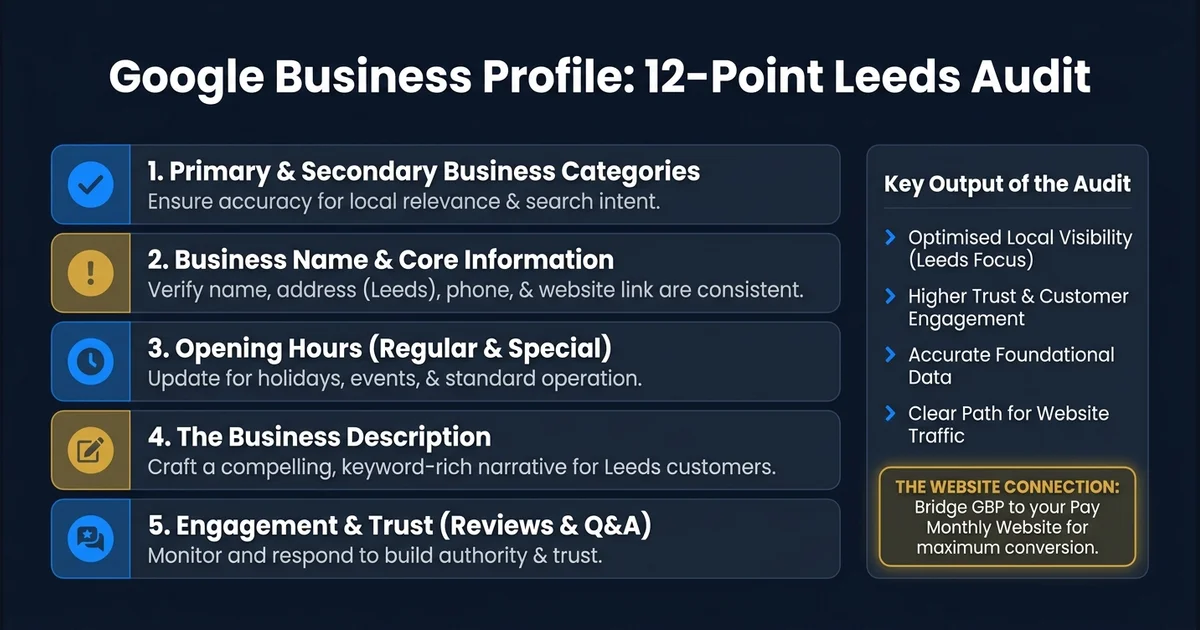
Before a potential customer visits your website, reads your reviews, or clicks through to your content, they see your Google Business Profile. It appears in the Map Pack for local searches, in the knowledge panel when someone searches for you by name, and its data increasingly feeds Google's AI-generated search answers.
An incomplete or neglected GBP does not just underperform — it actively undermines trust and costs you enquiries. We see it consistently with new clients across across the UK: profiles with incorrect hours, weak service descriptions, and a complete absence of engagement signals.
This is not a passive directory listing. It is an active marketing channel that requires management. Work through these twelve points systematically and you will see measurable improvement in your Map Pack visibility, your call and click-through rates, and your enquiry volume.
Section One: Foundational Accuracy
These are the non-negotiables. Getting them wrong makes you invisible for the right searches or sends customers to the wrong place.
1. Primary and Secondary Business Categories
This is the single most important field in your entire profile. Google uses your primary category to determine your eligibility for non-branded local search queries. If you are a specialist commercial solicitor in the UK and your primary category is the generic "Law Firm," you are at a significant disadvantage against a competitor whose category is "Commercial Law Firm."
Choose the most specific, accurate primary category available from Google's list. Then add every other relevant category as a secondary option. A web design agency might have "Web Designer" as its primary, with "Internet Marketing Service" and "Software Company" as secondary categories. Each one opens up an additional set of relevant queries your profile can appear for.
2. Business Name and Core Information
Your GBP business name must be your actual trading name — not your trading name plus keywords or a location. "Leodis Digital" is correct. "Leodis Digital — Web Design Leeds Pay Monthly Websites" is a guidelines violation that risks profile suspension.
Your address and phone number must be identical to what appears on your website's contact page and across your major directory listings. This is the foundation of NAP (Name, Address, Phone) consistency — a key local ranking signal. Any discrepancy erodes Google's confidence in your business information and suppresses your local visibility.
3. Opening Hours
Keep your standard hours completely accurate and use the "Special Hours" feature for bank holidays, Christmas closures, and any other deviation from your normal schedule. A customer who drives to your location based on incorrect hours is a near-certain negative review and an avoidable damage to your reputation.
Understanding the GBP Ranking Factors
Google uses three primary factors to rank businesses in local search results: relevance, distance, and prominence. Understanding each helps you direct your optimisation effort correctly.
Relevance is how well your profile matches what the user is searching for. Your categories, services description, and the keywords throughout your profile all contribute to relevance signals. A profile that accurately and comprehensively describes what you do — using the language your customers actually use to search — ranks for more queries with commercial intent.
Distance is how far your location is from where the search is happening or from the location specified in the query. You cannot change your physical location, but you can ensure your address is accurately represented and that your service area is correctly set if you serve customers who come to you as well as customers you travel to.
Prominence is a reflection of how well-known and trusted your business is, both on and off Google. This includes your review volume and velocity, the authority of your website, the quantity and quality of your citations across the web, and any press coverage or mentions. Prominence is the most directly improvable factor over time — it is the dimension that responds to consistent effort across all twelve points in this audit.
Understanding that local rankings are a combination of these three factors helps explain why a business with fewer reviews sometimes outranks a competitor with more — if the first business is more directly relevant to the specific query and closer to where the search is originating.
Section Two: Relevance and Authority
Once the core data is correct, build out your profile to tell Google precisely what you do and why you are the right result for a local search.
4. The Business Description
You have 750 characters. The first 250 are displayed before a user has to expand the description, so they are the most important.
Do not fill them with generic statements about being "passionate about customer success." Write something specific, factual, and keyword-informed. For example: "Leodis Digital builds pay-monthly websites and provides local SEO services for small businesses across the UK, Bradford, and the UK. No large upfront costs. Professionally built, mobile-optimised sites from £79/month."
That description states what the business does, where it operates, who it serves, and what makes it distinctive — all in the first 200 characters.
5. Services List
Do not list broad service categories. Every distinct service you offer should be listed individually with a title and a detailed description of up to 1,000 characters. These descriptions are indexed by Google and directly contribute to your relevance for long-tail service queries.
A web agency that lists "Pay-Monthly Websites," "Local SEO," "Website Maintenance," "Google Business Profile Management," and "Technical SEO Audits" as separate services — each with a full description — will consistently outperform a competitor whose profile simply lists "Web Design." Be exhaustive. This is a free, high-impact expansion of your keyword footprint.
6. The Products Section
Many service businesses ignore the Products tab, assuming it is for physical goods. This is a mistake. You can use it to showcase your core service offerings visually: a high-quality image, a clear service name, and a description of what is included.
This adds a visually prominent layer to your profile that makes it more engaging than a text-only listing — and each product entry is additional keyword-rich content that Google can index.
Section Three: Engagement and Trust
A complete profile is the starting point. An active, trusted profile is what wins in competitive local markets.
7. Photos: Quality, Quantity, and Recency
GBP profiles with photos receive significantly more requests for directions and more website clicks than those without. Stock photography does not count — Google increasingly distinguishes between authentic and generic imagery.
Upload high-quality, real photographs: your team, your office, your work in progress, completed projects, client meetings. Aim for a minimum of fifteen images to start, and add new photos every quarter. Google treats recent photo uploads as a signal of an active, well-managed business.
8. Reviews: Velocity, Responses, and Quality
Review velocity — the rate at which new reviews arrive — matters as much as total volume. A profile with 60 reviews and a consistent stream of new ones often outperforms a profile with 200 old reviews and no recent activity.
Build a systematic review acquisition process: a follow-up email after project completion, a direct text message with your review link, or a simple ask in person or over the phone. Respond to every review within 24 to 48 hours. A considered, personal response to a positive review shows appreciation. A professional, non-defensive response to a negative review demonstrates accountability to everyone who reads it.
9. Google Posts
Google Posts are short updates — up to 1,500 characters — that appear directly on your profile. They are an underused tool. Use them for: new service announcements, seasonal offers, completed project highlights, answered FAQs, and local business news.
Standard posts expire after seven days. A weekly posting cadence keeps your profile looking active and takes under ten minutes. Consistent posting signals to Google that your business is actively managed.
10. Q&A Section Management
The Questions and Answers section on your profile can be populated by anyone. If you do not manage it, you risk unanswered questions or, worse, incorrect answers from other users. Proactively seed the section yourself by posting the most common questions you receive from new customers, along with accurate answers. This gives you control over the information prospective customers see before they contact you.
11. Messaging
Enable the messaging feature to add a "Chat" button to your profile, allowing potential customers to contact you directly from the search results page. This removes a significant friction point in the enquiry process. Google tracks your average response time — responding within a few hours, not days, is important both for user experience and for the signals it sends.
12. Track Your Performance
The GBP Insights dashboard shows how customers are finding and interacting with your profile. Focus on three search type metrics:
- Direct: People searching specifically for your business name. They already know you.
- Discovery: People searching for a category or service you offer. This is your new customer acquisition metric.
- Branded: People searching for brands associated with your business.
As you implement the improvements above, your Discovery search count and the actions flowing from it — calls, direction requests, website visits — should trend upward. That is the ultimate measure of a successful GBP strategy.
Set a monthly reminder to check GBP Insights. A drop in Discovery searches can signal that a competitor has improved their profile significantly, that your profile has been flagged for review, or that a seasonal pattern is at work. Catching these changes early means you can respond quickly rather than wondering months later why enquiry volume has declined.
The GBP Insights data also informs your content strategy. If your Discovery searches are dominated by one service category, this tells you which service page and which content cluster to prioritise. Data-driven content decisions consistently outperform publishing articles based on internal guesses about what prospective clients are searching.
Managing Multiple Locations
For businesses with more than one physical location in the UK or across the UK, each location should have its own Google Business Profile. This is not optional — Google expects a distinct profile per business location, and a single profile with multiple addresses often fails verification and produces inconsistent local results.
Each location profile should have:
- The specific address and phone number for that location
- Opening hours specific to that location (which may differ from other sites)
- Photos specific to that location — Google increasingly prioritises location-specific imagery over generic brand photography
- A business description that references the specific service area for that location
- Reviews that mention the specific location or area
For a trade business operating across West and South Yorkshire, this means a profile for each major hub or depot. For a retail chain, a profile for each individual shop. Managing multiple profiles is more work, but the local ranking improvement from location-specific signals consistently justifies the effort.
The GBP and AI Search Connection
As Google integrates AI Overviews and AI-generated local summaries into more search result types, your Google Business Profile data is becoming an increasingly important source for these AI responses.
When Google's AI systems generate a response to a local query — "good accountants across the UK city centre" — the structured business data from verified GBP profiles is a primary input. Businesses with complete, accurate, and active profiles are more likely to appear in these AI-assisted results than those with sparse or outdated listings.
This means the optimisation work described in this guide is increasingly valuable for two distinct search surfaces simultaneously: the traditional Map Pack and the emerging AI-assisted local results. The investment in a complete, well-managed profile serves both channels without requiring separate optimisation work.
Common GBP Mistakes That Suppress Visibility
Beyond the twelve positive optimisation points above, these are the most frequent mistakes that actively suppress Map Pack visibility for UK businesses:
Keyword stuffing in the business name. Adding "Web Design | Pay Monthly | Leeds" to your business name after the actual trading name violates Google's guidelines. Profiles that do this risk manual penalties, profile suspension, or suppression in results. The business name field is strictly for your actual trading name.
Leaving the profile unclaimed. Google creates profiles for businesses automatically using data from public sources. An unclaimed profile is not optimised, often contains inaccurate information, and cannot receive the management signals that help it rank. Claiming your profile is the mandatory first step.
Ignoring the Q&A section entirely. Questions from users that go unanswered for weeks signal an unmanaged profile. Incorrect answers posted by other users that go uncorrected actively damage your reputation. Check the Q&A section every week and respond promptly.
Using a call tracking number as your primary number. If you rotate call tracking numbers for different marketing channels, use these as secondary contact methods rather than your primary GBP number. Your primary number must be consistent with the number on your website, in directory listings, and across all local citations. Inconsistency here directly undermines your NAP consistency signals.
Failing to respond to negative reviews. A negative review that sits unanswered for months signals poor customer management. A considered, professional response that acknowledges the concern and invites direct contact demonstrates accountability. Future prospective customers read your responses to negative reviews carefully — how you handle criticism tells them more about your business than the criticism itself.
The Website Connection
Your GBP works best when it is supported by a technically sound website. Google cross-references your profile data against your website's content, schema markup, and local signals. A website that correctly implements LocalBusiness schema, has consistent NAP data in its footer, loads quickly on mobile, and has location-specific content strengthens the confidence Google has in your local listing.
A slow, poorly structured website with no schema markup undermines your GBP performance regardless of how well-optimised the profile itself is — Core Web Vitals failures in particular are a ranking penalty that no amount of profile work can fully overcome. This is one of the most commonly overlooked factors in local SEO — businesses invest heavily in their Google Business Profile while running it alongside a website that is actively working against them.
Every pay-monthly website from Leodis Digital is built with these local SEO signals from day one: correct schema markup, fast load times, mobile-first design, and consistent NAP data. The two assets — your GBP and your website — work together as a system rather than in isolation.
For the full picture on local authority building, see our NAP consistency guide and our local SEO strategy for UK businesses. for UK businesses with a correctly built website working alongside an optimised Google Business Profile, the results compound — each improvement reinforces the other. If you have worked through this audit and are still not achieving the visibility you need, get in touch with Leodis Digital for a free local SEO assessment.
Frequently Asked Questions
How long does it take for changes to my Google Business Profile to go live?
Most text-based changes — updating your description or services list — are typically live within minutes. More significant changes, such as a change of address, business name, or primary category, may go into a manual review process that takes 24 hours to a few days. Make significant changes during a quieter business period where possible and monitor your profile for the following week to ensure nothing has been inadvertently reverted.
My specific business category isn't available. What should I choose?
Choose the most specific, accurate category that is available from Google's predefined list as your primary category. Then use broader, related categories as secondary options. You can add much more specific detail about what you do through your business description and services list — this text is also indexed by Google and contributes to your relevance for specific queries.
How do I handle a fake or negative review on my profile?
Respond to it publicly, professionally, and without defensiveness. State that you have no record of the reviewer as a customer and invite them to contact you directly. This shows potential customers that you are responsive and that the review may not be genuine. Flag the review to Google by clicking the three dots next to it and selecting "Report review." Google's bar for removal is high — the strongest grounds are spam, a conflict of interest, or an experience that did not take place.
Does my Google Business Profile work better with a professionally built website?
Significantly better. Your GBP and your website work together as local SEO signals. Google cross-references your GBP data against your website's content, schema markup, and local signals. A professionally built website with correct LocalBusiness schema, consistent NAP data, and fast load times strengthens the confidence Google has in your local listing. A slow, poorly structured website undermines it. A pay-monthly website from Leodis Digital is built with these local SEO signals implemented from day one.
Found this useful? Share it.