Looking Forward from the End of 2026
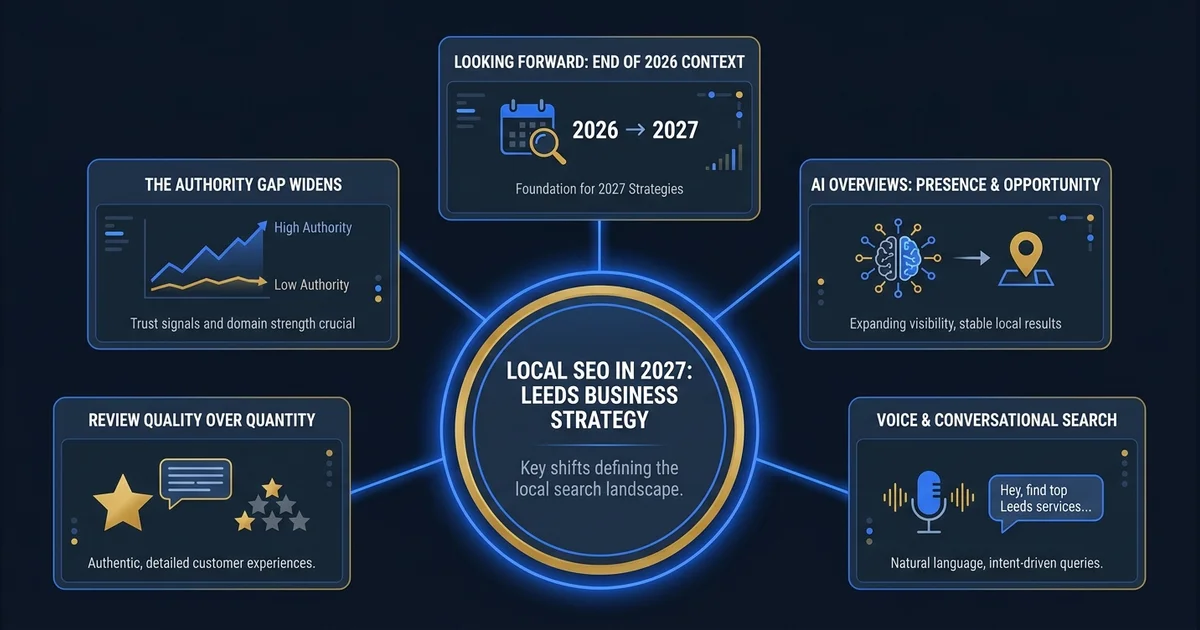
As 2026 closes, local search is in a period of genuine structural change. AI integration into search results, the continued dominance of mobile, the growing importance of structured data, and Google's increasing sophistication in identifying genuine versus manufactured authority are all reshaping what effective local SEO looks like.
for UK businesses, the question is not just what is changing — it is how to position now so that those changes work in your favour rather than against you.
Here is what we expect to define local SEO in 2027, and the specific actions that will determine which local businesses thrive through this period.
AI Overviews: Expanding Presence, Stable Local Opportunity
AI Overviews — Google's AI-generated summaries appearing above traditional search results — are continuing to expand into more query types. For informational searches ("how to choose a web designer" or "what is the difference between SEO and PPC"), they now satisfy many users without a click.
For local businesses, the critical point is where AI Overviews are not yet dominant: transactional local searches. "Plumber Leeds," "restaurant near me," "solicitor the UK" — these continue to surface Map Pack results and local organic listings, not AI summaries. This is where local service businesses still compete on the terms they have always competed on.
However, the businesses that appear in AI-generated summaries for informational queries related to their field are building brand recognition and authority that translates into higher conversion rates when those same users move to a transactional search. A UK Business that is cited in an AI Overview about "how to find a reliable web designer" is better positioned when that user searches "web designer Leeds" a week later. Our full analysis of how AI search affects local businesses in the UK explains the specific implications and how to prepare.
The strategy: continue building genuine topical authority through expert content, because that is what gets cited in AI Overviews and what ranks in traditional results. The same investment serves both.
Voice and Conversational Search
Voice search queries are longer, more conversational, and more locally specific than typed queries. "Where's the nearest accountant in the UK that specialises in small businesses" is a voice query. These queries are growing with the increasing use of smart speakers, phone assistants, and AI-integrated car systems.
Websites optimised for conversational language — FAQ content that mirrors natural speech patterns, complete local structured data specifying your service area and specialisms, and clear service-area information — are better positioned for voice results. This is not a separate strategy; it is a more thorough application of the existing content and schema approach.
Every pay-monthly website from Leodis Digital includes FAQPage schema implementation for pages with FAQ content — one of the most accessible optimisations for voice search visibility.
Review Quality Over Review Quantity
Google's review systems are becoming more sophisticated. The algorithm is increasingly able to identify and discount generic, low-detail, or potentially manufactured reviews. The signal is shifting from pure volume toward a combination of volume, specificity, and recency. Measuring whether your SEO is actually working includes monitoring review velocity as a local ranking signal alongside traffic and enquiry metrics.
What this means in practice: a business with 80 detailed, specific, attributed reviews — each describing a named customer's experience with a particular service — will increasingly outperform a business with 200 generic one-line reviews, even if the average rating is similar.
Review acquisition should shift toward asking for specific, detailed feedback: "Could you mention the specific work we did and what you found most valuable about the service?" This produces review content that is more useful to prospective customers and more valuable as an algorithmic signal.
The Authority Gap Widens
The businesses that have consistently invested in content, local links, technical excellence, and review acquisition through 2025 and 2026 will enter 2027 with an authority gap over competitors who did not. Genuine domain authority and local reputation are built slowly and cannot be compressed. This gap is increasingly difficult to close quickly.
For businesses that have not yet built this foundation, 2027 is not too late — but it requires starting now. The businesses that will dominate local search in the UK in 2028 are building their authority signals today.
Technical Performance Becomes the Entry Ticket
Core Web Vitals and mobile performance are no longer differentiators — they are increasingly the minimum required to rank competitively. As Google's algorithm becomes more precise in measuring real-world page experience, sites that fail these metrics face an increasing competitive disadvantage relative to sites that pass.
For 2027, the expectation is that Core Web Vitals thresholds will be maintained at current levels, but the proportion of local business websites failing them will continue to create clear ranking opportunities for those that pass.
A professionally built website — one that achieves 90+ on Google PageSpeed Insights for mobile from launch, and is actively maintained to sustain that performance — is the foundation that makes everything else in a local SEO strategy more effective. This is one of the strongest arguments for the pay-monthly website model: you get a technically excellent site from day one, and it remains technically excellent throughout the contract because maintenance is included.
First-Party Data as a Business Asset
As third-party cookies complete their disappearance and privacy regulations continue to tighten, local businesses that have built their own contact databases — email lists, SMS opt-ins, loyalty schemes — are better positioned than those who rely entirely on organic or paid platform traffic.
SEO drives organic traffic. The businesses that convert that traffic into owned relationships — email subscribers, direct communication channels — are building an asset that persists through algorithm changes and platform shifts. Content that generates organic traffic should always include a mechanism for capturing that traffic into a first-party relationship. Understanding what makes Google algorithm updates affect local businesses helps clarify which signals to protect and which to strengthen.
What This Means for Your Business in 2027
The strategic priorities for local businesses heading into 2027 are an extension of what has been driving results through 2026, executed with greater consistency and greater technical rigour:
- A technically excellent, fast, mobile-first website — Core Web Vitals passing, accessible, with correct schema markup throughout
- A complete, active Google Business Profile — full services list, regular posts, systematic review acquisition, prompt responses
- A consistent content programme — building topical authority through expert, attributed content on topics your prospective customers are searching for
- Local link building through genuine community participation — Chamber of Commerce, local press, sponsorships, educational partnerships
- Schema markup correctly implemented and maintained — LocalBusiness, Service, FAQPage, BreadcrumbList as a minimum
None of this is new. The businesses that execute these consistently will dominate their local markets. The businesses that wait for a simpler answer will wait indefinitely, while the authority gap grows.
The insights across this site cover each element in depth. For 2027 strategy specifically, the most important starting points are our local SEO playbook for UK businesses, our Core Web Vitals guide, and our content strategy article.
Ready to build your 2027 local SEO strategy on the right foundation? Get in touch with Leodis Digital.
Frequently Asked Questions
Will AI search make local SEO less important for UK businesses?
No — and in some respects it makes it more important. AI Overviews currently have the least impact on transactional local searches ("plumber Leeds," "restaurant near me") which continue to surface Map Pack results and local organic listings. The businesses that appear well in both traditional and AI-enhanced search are those with strong local authority signals, complete and accurate structured data, and a technically sound website. These are the same requirements as traditional local SEO — executed with greater rigour.
Is a pay-monthly website future-proof against algorithm changes?
More so than most alternatives. A website built on a modern, lightweight framework with correct schema markup, fast mobile performance, and accessible, semantic code is aligned with every direction Google's algorithm has moved in over the past five years — and is likely to remain aligned. The businesses most vulnerable to algorithm changes are those built on platforms with structural performance problems, thin or generic content, and manufactured authority signals. A pay-monthly website from Leodis Digital is built on the opposite principles.
How important will reviews be in 2027?
Increasingly important. Google's review systems are becoming more sophisticated at distinguishing genuine, specific reviews from generic or manufactured ones. The signal weighting is shifting toward review quality and specificity alongside volume. A business with 80 detailed, specific, attributed reviews — each describing a real experience — will outperform a business with 200 generic reviews in the ranking algorithm. Build a review acquisition process that asks satisfied customers for honest, detailed reviews.
What is the biggest mistake UK businesses make with their online presence heading into 2027?
Treating their website as a finished product rather than an ongoing asset. A website that is not actively maintained — with software updates, content refreshes, performance monitoring, and schema validation — degrades over time relative to competitors who are maintaining theirs. The pay-monthly website model solves this structurally: the site is actively maintained throughout the contract. Businesses that treat their website as a one-off purchase and move on are starting 2027 in a worse position than they started 2026 in.
Found this useful? Share it.