The Search Surge Is Already Starting
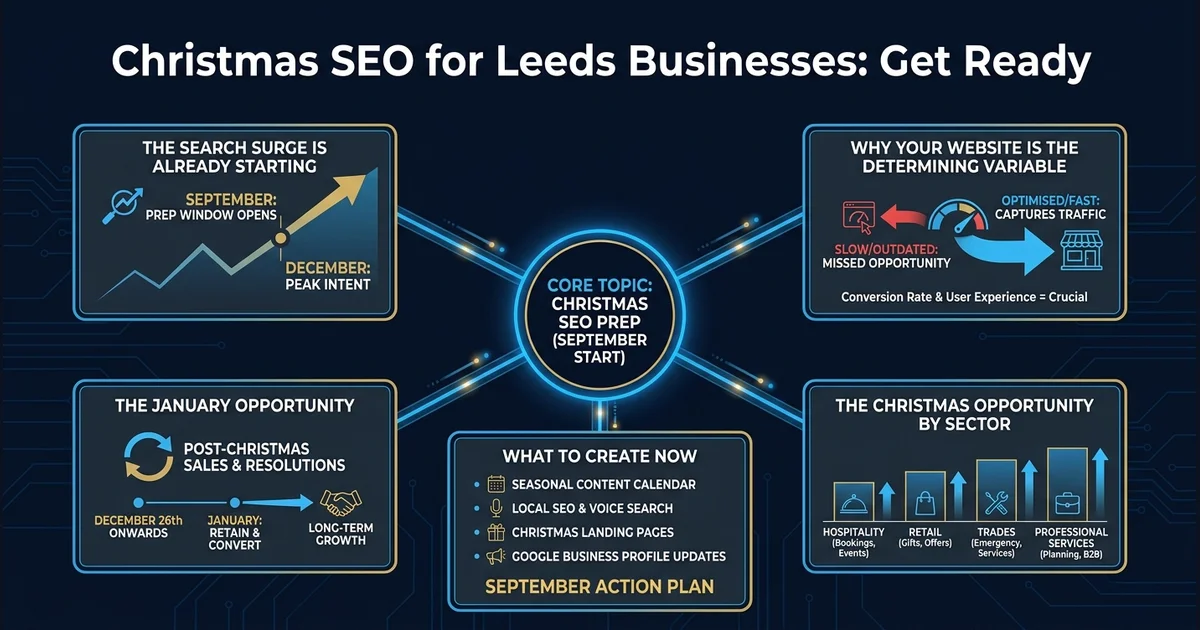
By early November, local Christmas search volumes are rising sharply. "Christmas party venues Leeds," "Christmas gifts local," "gift vouchers near me," "New Year's Eve events Leeds" — these terms are being searched now, and the businesses that prepared in September and October are already ranking for them.
If you are reading this and have not yet prepared, you are not too late for everything. But the window for new content to rank for Christmas searches is closing rapidly. Here is what to prioritise right now — and what to build into your plans for next year.
Why Your Website Is the Determining Variable
The businesses that capture the Christmas search surge have two things in common: seasonal content published early enough to rank, and a website that is technically capable of ranking and converting.
A seasonal landing page on a slow, poorly-structured website will struggle to rank — Core Web Vitals failures are a direct ranking suppressor. And even when it does rank, a poor mobile experience will lose the conversion. Most Christmas searches happen on mobile phones. A page that loads in six seconds and has a difficult-to-use booking form will generate a fraction of the enquiries that a fast, mobile-optimised page would.
A pay-monthly website from Leodis Digital is built to the technical standard that allows seasonal content to rank efficiently and convert when it ranks. If your current website is underperforming on mobile or failing Core Web Vitals, this Christmas is the moment to address that — not next autumn.
The Christmas Opportunity by Sector
Hospitality
Christmas party bookings, Christmas Day dining, New Year's Eve events, and festive afternoon teas all generate significant local search volume from October through December. Dedicated landing pages for each occasion — specific to your venue, optimised for local terms — are the primary opportunity.
"Christmas party venue for 20–30 people Leeds city centre" will outrank "Christmas parties at [Restaurant Name]" for that search intent. Be specific. The searcher who types that query knows what they need; your page needs to answer it precisely.
Promote every seasonal page through weekly Google Business Profile Posts from October. Add a QR code to your existing menus linking to your Christmas booking page. Update your GBP special hours for December and January in November.
Retail
"Gift ideas Leeds," "independent gift shops Leeds," "local Christmas markets Leeds," "Christmas hampers the UK" — local retail can compete effectively for these terms by being both local and specific in ways national retailers cannot.
An independent gift shop in Headingley has a genuine advantage for "unique Christmas gifts Leeds" that John Lewis does not. Publish a curated gift guide with local context. Create a dedicated "Christmas gifts from [your area]" page. If you offer click-and-collect, make this prominently visible.
Trades
Pre-winter boiler servicing, Christmas lighting installation, pre-Christmas deep cleaning and carpet cleaning — seasonal service pages targeting these terms generate bookings during a period when customers are proactively preparing their homes.
A heating engineer who publishes "Boiler Service Before Winter — Book Now in the UK" in October and ranks for it by November is generating enquiries at exactly the right moment. The same applies to any trade service that has a natural pre-Christmas demand spike. Our guide to local SEO for UK trades covers the full seasonal content strategy for plumbers, heating engineers, and electricians.
Professional Services
"Financial planning for the new year," "review your will before Christmas," "business planning for 2027" — professional services can use the year-end period to target clients who are in a reflective, planning mindset.
A content piece about year-end tax planning published in October can rank for November and December searches from business owners approaching their financial year-end. This is evergreen content that can be updated each year rather than recreated.
Charities
December is the peak donation month for most charities. "Donate to local charity Leeds," "local charity Christmas appeal," "volunteer in the UK this Christmas," "gift aid donation Leeds" — giving-intent searches peak in November and December. Our SEO guide for Yorkshire charities covers the full strategy for maximising visibility during the peak giving season.
A charity with a dedicated Christmas appeal page, promoted through their GBP and published by early November, can capture significant donation intent at the moment it is highest. This is worth the investment regardless of other digital marketing priorities.
What to Create Now
Dedicated seasonal landing pages. One URL per seasonal service or occasion, specific enough to rank. A restaurant's Christmas page should not be one paragraph on the homepage — it should be a standalone, indexed page with full details of menus, capacity, booking process, and pricing where available.
GBP Christmas posts. Post weekly from October through January. Seasonal content, opening hours reminders, specific offers, booking call-to-actions. Posts expire after seven days, so weekly frequency is required to maintain visibility. See our Google Business Profile optimisation guide for the full list of fields to complete before the peak season begins.
Special hours. Update your Google Business Profile with Christmas, Boxing Day, New Year's Eve, and New Year's Day hours in November. Customers are planning now. An incorrect hours listing when someone checks before making a journey is a guaranteed reputational problem.
Gift vouchers page. If you offer gift vouchers for any service, create a dedicated page optimised for "gift vouchers [your service] Leeds." This is consistently one of the highest-converting local searches in December. The person searching has already decided to buy — they just need to find you.
Tracking Seasonal Ranking Performance
For seasonal content to improve year on year, you need to track how it performs and use that data to improve it. The process is straightforward.
Check Google Search Console in January after the Christmas period. Filter by date range (1 October to 31 December) and look at your seasonal landing page URLs. Note the queries they appeared for, their average position, and their click-through rate.
For each page, ask: which queries did I rank well for? Which queries generated impressions but poor CTR — suggesting a title tag that needs improving? Which relevant queries did I fail to appear for — suggesting content gaps to address before next year?
These insights, recorded and actioned in January for the following October, produce consistent year-on-year improvement. A Christmas page that ranked in position 8 for "Christmas party venue Leeds" in year one and achieves position 3 in year two — because you strengthened the content and earned two additional local citations in the intervening months — generates materially more bookings from the same period of search volume.
The January Opportunity
While November and December get the attention, January is consistently underestimated. "New year new kitchen," "start the year with a new website," "financial planning for 2027," "join a gym Leeds" — January is a high-intent month for services that people have been considering and are ready to commit to in the new year.
Create content in October and November that targets January intent. It will be indexed and ranking by the time January arrives. A web design agency that publishes "Is Your Business Website Ready for 2027?" in October is in position to capture those January new year resolution enquiries from business owners who have spent Christmas thinking about improvements they want to make.
For the on-page optimisation that makes seasonal pages rank effectively, see our on-page SEO guide. For the website foundation that seasonal content needs, get in touch with Leodis Digital — a properly built website is a year-round seasonal content advantage, not a one-time upgrade.
Frequently Asked Questions
When is it too late to optimise my website for Christmas searches?
For new content pages, meaningful Google rankings typically take four to eight weeks to develop for low-competition terms. Content published in early October should rank meaningfully by mid-November. Content published in November may rank by mid-December but will have a shorter window. Content published in December is unlikely to rank in time for that year's Christmas season. The lesson: start in September, publish by early October, and promote through your Google Business Profile Posts from that point.
Should I update my existing website or build a new one for Christmas?
Seasonal content works on any well-built, properly indexed website. However, if your existing website is slow, not mobile-optimised, or performing poorly on Core Web Vitals, seasonal content will rank below its potential and convert poorly when it does rank. A pay-monthly website from Leodis Digital provides the technically sound foundation that seasonal content needs — launched quickly enough to capture the current season if started in October, and in position for full impact from the following year.
What should my Christmas landing page include to rank and convert?
A specific, keyword-optimised title and heading ("Christmas Party Venue for Up to 30 People — Leeds City Centre"), genuinely useful content about what you offer and how to book, real photos of your space or service, testimonials from previous Christmas customers where available, clear pricing or a simple enquiry form, and your booking or contact CTA prominently placed. The page should be a standalone, indexable URL — not a PDF, not a pop-up, not content buried in an existing page.
Does Google Business Profile help with Christmas visibility?
Significantly. GBP Posts allow you to publish weekly seasonal updates directly to your profile, visible in the Map Pack and Knowledge Panel. Posts expire after seven days, so weekly publishing from October through December keeps your profile looking current and active. Update your special hours for Christmas and New Year in November — before customers start planning visits and before Google's data scraping updates your profile with incorrect hours from elsewhere.
Found this useful? Share it.