The Unfair Competition Problem — and How to Stop Playing Into It
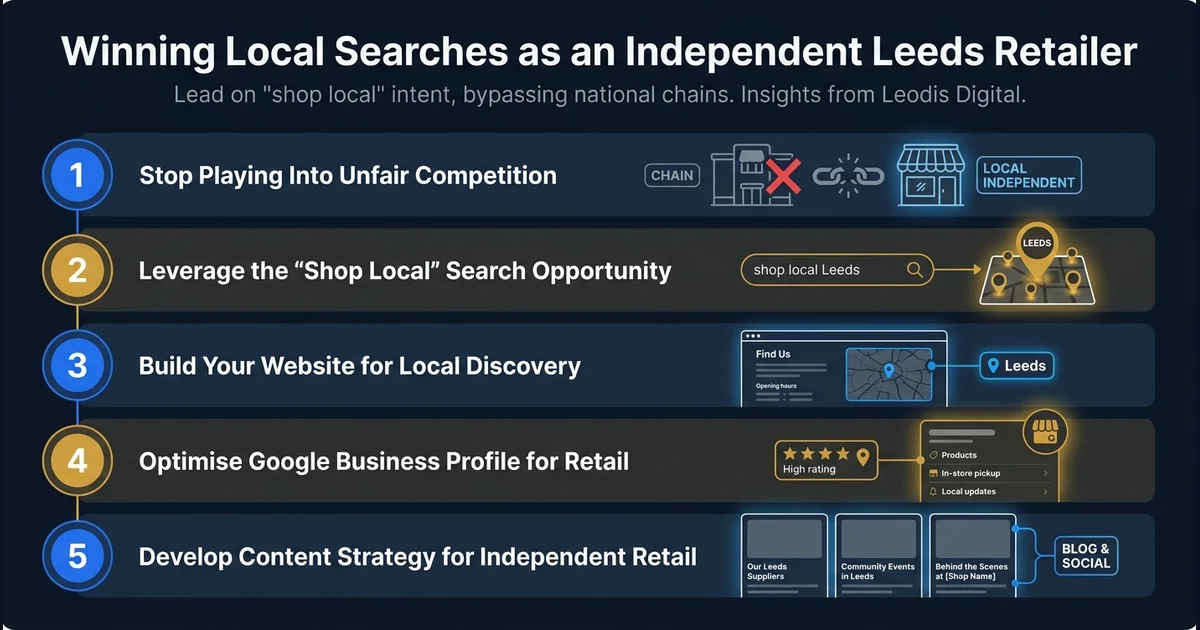
Independent retailers face a structural challenge in online search. National online retailers have domain authority built over twenty years, enormous product catalogues that capture every conceivable long-tail search, and marketing budgets that dwarf what a local shop can spend.
The mistake most independent retailers make is trying to compete with nationals on their terms: price, range, and visibility for generic product searches. That is a fight that most independent shops cannot win.
The correct strategy is to compete on the searches nationals are structurally absent from — hyper-local, community-embedded, and "shop local" intent searches — and to build a website and local presence that makes you the obvious choice for customers who are already committed to buying locally.
The "Shop Local" Search Opportunity
A meaningful and growing segment of local search comes from consumers actively seeking local alternatives to national retailers. "Independent bookshop Leeds," "local gift shop the UK," "handmade jewellery Leeds," "vintage clothing Headingley," "Leeds craft market" — these searches come from buyers who are already committed to buying locally. They just need to find you.
This is a segment where local retailers can win outright. National competitors are largely absent from hyper-local searches, and the competition is between local businesses — a dramatically more level playing field than broad product searches.
The key is being discoverable for these searches. That requires a properly built website, a complete Google Business Profile, and content that aligns with local intent search terms.
Your Website: Built for Local Discovery
Most independent retailer websites fall into one of two failure modes: either they are built cheaply on a template that performs poorly on mobile and in search, or they are expensive e-commerce builds that are over-engineered for the business's actual needs.
A pay-monthly website from Leodis Digital is the middle path: professionally built, mobile-first, fast-loading, and correctly structured for local search — without the capital outlay of a bespoke agency build or the limitations of a template platform.
For most independent retailers in the UK, the most commercially effective website is not a full e-commerce site. It is a well-designed, fast-loading site that clearly communicates what the shop sells, where it is located, when it is open, and why shopping there is worth the trip — with a strong Google Business Profile and local SEO strategy on top.
Where e-commerce does make sense, we build it. But the starting point is always the question: what does this business actually need to generate more customers, not what is technically possible.
Google Business Profile for Retail: The Sector-Specific Opportunity
Retail-specific GBP fields carry particular value when completed correctly:
Products section. Unlike service businesses repurposing this section, retailers should use it for its intended purpose — showcasing actual products with images, descriptions, and prices. This makes your GBP significantly more visually rich and gives Google product-level keyword context that expands your search footprint.
In-store shopping attribute. Mark this clearly. Customers searching for a local shopping experience are specifically filtering for this. Marking it accurately is both a user experience improvement and a search visibility signal.
Photos. High-quality product photography, in-store atmosphere shots, seasonal window display images, and team photos keep the profile visually engaging and current. Retail profiles with strong, regularly updated photos generate significantly more direction requests and website clicks.
Special hours. Update for every bank holiday, seasonal extension, and market day. A customer who arrives to find you closed based on incorrect hours will not give you a second chance easily.
Content Strategy for Independent Retail
The content opportunity for independent retail is built around the things that national competitors genuinely cannot offer: your buying expertise, your supplier relationships, your product knowledge, and your community connection.
Content that performs for independent retailers:
- "Our favourite [product category] picks this season" — showcases expert curation and gives Google a topically relevant page to rank
- "Where we source our [product type] — the suppliers behind our range" — supplier stories build trust and genuinely differentiate
- "Gift guide for [occasion] — curated by [your shop name]" — captures seasonal search intent with content a national retailer cannot credibly produce
- "The story behind [specific product or maker]" — builds emotional connection and generates content that gets shared in community channels
This type of content positions you as an expert curator. It is the kind of E-E-A-T signal — demonstrating real experience and expertise — that Google's Helpful Content system rewards, and that a national online retailer cannot replicate.
Seasonal Search Strategy for Independent Retailers
Independent retailers have a meaningful seasonal search opportunity that requires planning three to four months in advance to capture effectively. Christmas search intent begins building in October. Valentine's Day searches peak in late January. Mother's Day in February. Easter from March.
For each relevant season, publish a dedicated page or significantly update an existing one targeting specific, local intent: "Christmas gifts for men Leeds," "independent florist Leeds Valentine's Day," "Easter chocolate Yorkshire." These pages should exist as standalone indexed URLs — not seasonal sections buried in a homepage or a popup that search engines cannot read.
The tactical approach is simple: identify your three or four most commercially relevant seasonal moments each year, map the specific search terms your prospective customers use for each, and publish targeted pages at least six weeks before the seasonal peak. This lead time is necessary for the page to rank before the search volume arrives.
Update these pages each year rather than creating new ones. A page that ranked in position 12 for "Christmas gifts Leeds" in year one, updated with fresh content and new products in year two, will rank higher in year two — accumulating the authority of an established URL while staying current.
Local Community and Event Participation
Leeds has a thriving independent retail culture, supported by markets, pop-up events, and community initiatives. Online visibility in these contexts — being listed on Leeds market websites, appearing in local press coverage of independent retail events, having your participation mentioned on community websites — generates exactly the locally authoritative links that strengthen your Google ranking.
Get listed on:
- Leeds Indie Food and independent business directories
- Leeds Market and any physical markets you participate in
- Local neighbourhood community sites and Facebook groups (these generate citations even without formal links)
- Yorkshire-focused lifestyle and food publications
Each of these is a signal to Google that you are a genuine, active part of the UK Business community.
The Click-and-Collect Opportunity
Click-and-collect behaviour — buying online, collecting in store — has become a permanent fixture of retail after the pandemic. If you offer click-and-collect, make it visible in your GBP, prominently on your website, and in your content.
"Buy online, collect in the UK" is both a user message and a local SEO signal. Customers who search specifically for local click-and-collect options for a specific product category are highly motivated buyers. Appearing for these searches with a clear CTA converts at a very high rate. The principles behind conversion rate optimisation for local websites apply directly to this type of high-intent retail traffic.
For the complete local SEO strategy that independent retailers need, see our Google Business Profile guide and our local SEO playbook for UK businesses. Ready to build a local digital presence that genuinely drives footfall? Get in touch with Leodis Digital.
Frequently Asked Questions
Can a small Leeds independent shop afford a professional website?
With a pay-monthly website from Leodis Digital, yes. There is no large upfront cost — you pay a fixed monthly fee and get a professionally built, custom-designed, fast-loading website that is built for local search from day one. For a retailer generating even a handful of additional sales per month from improved Google visibility, the return typically exceeds the monthly cost within the first two to three months.
Should my retail website include an online shop?
Potentially, but it depends on your business. E-commerce adds significant complexity and ongoing management overhead. For some independent retailers, a strong local presence with click-and-collect and an enquiry function delivers better returns than a full e-commerce build. For others, an online shop is a meaningful additional revenue channel. We will advise on the right approach for your specific business before building — not every retailer needs e-commerce to benefit from a professional web presence.
How can an independent shop compete with national retailers on Google?
By competing on the searches nationals are not optimised for: hyper-local and "shop local" intent searches. "Independent bookshop Leeds," "handmade jewellery the UK," "local gift shop Headingley" — national competitors are largely absent from these searches. A local business with a properly built website, a complete Google Business Profile, and content targeting local intent searches can rank in positions where nationals simply do not compete. This is the correct competitive strategy for independent retail.
What content works best for an independent retail website?
Content that highlights the things national competitors cannot offer: your buying expertise ("how we choose our stock"), your supplier relationships ("where our products come from"), your local knowledge ("our favourite gifts for Leeds people"), and your community connections. This type of content builds the E-E-A-T signals — experience, expertise, authoritativeness, and trust — that Google rewards, and it genuinely differentiates your business from an online retailer in a way that a list of products cannot.
Found this useful? Share it.