Software Built Around Your Business, Not the Other Way Around
Every business uses software. Email, accounting, spreadsheets, maybe a CRM or a booking system. Most of this is off-the-shelf — products built for a general market and used by thousands of businesses.
Off-the-shelf software is fine when your needs are standard. Accounting is accounting. Email is email. But every business has processes that are specific to how they operate. The way a Leeds plumbing firm tracks jobs is different from how a Leeds accountancy practice manages client engagements. The way a restaurant handles bookings is different from how a salon handles appointments.
Custom business software is software built specifically for those unique processes — the ones where generic tools force you into workarounds, spreadsheets, or manual steps that should not exist.
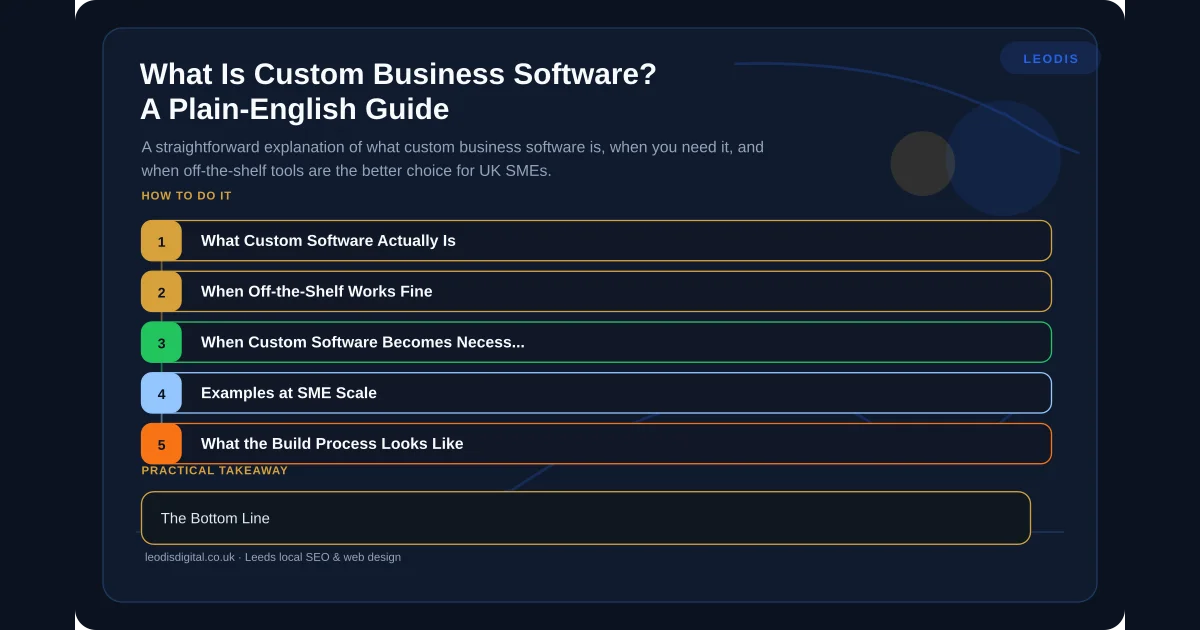
What Custom Software Actually Is
Custom software is an application built to solve a specific problem for a specific business. It is not a product you buy off a shelf. It is a tool designed around your actual workflow.
This does not mean building everything from scratch. Modern custom software development uses existing frameworks, libraries, and services as building blocks. The custom part is how those blocks are assembled — configured, connected, and tailored to match the way your business actually works.
A useful analogy: off-the-shelf software is like buying clothes from a shop. Custom software is like having clothes tailored. The tailor uses the same fabrics and techniques — they are not inventing a new way to make trousers. But the result fits you specifically, rather than fitting a general idea of what someone your size might want.
When Off-the-Shelf Works Fine
Before we make the case for custom software, let us be honest about when you do not need it.
Standard business functions. Accounting (Xero, QuickBooks), email (Google Workspace, Microsoft 365), basic CRM (HubSpot free tier), project management (Trello, Asana). These tools exist because these functions are largely the same across businesses. Unless you have genuinely unusual requirements, the off-the-shelf tool will serve you well.
When your processes are still forming. If you are a new business still working out how you operate, custom software is premature. You need to understand your workflow before you can automate it. Use off-the-shelf tools, figure out what works, and then consider custom solutions for the gaps.
When the volume does not justify the cost. If a manual task takes ten minutes a week, building custom software to automate it rarely makes financial sense. Custom software delivers value when it eliminates significant time, reduces meaningful error rates, or enables something that was not previously possible.
For a detailed comparison of when each approach makes sense, see our custom software vs off-the-shelf guide.
When Custom Software Becomes Necessary
Custom software earns its place when off-the-shelf tools start creating problems rather than solving them.
You Are Living in Spreadsheets
Spreadsheets are the most common sign that a business has outgrown its tools. When your team maintains spreadsheets to track things that your official software cannot handle — job progress, custom pricing, client-specific requirements, stock across multiple locations — you have a process that needs its own tool.
Spreadsheets are flexible but fragile. They do not enforce data quality, they do not handle multiple users well, and they are one accidental deletion away from disaster. Custom software takes those spreadsheet processes and turns them into reliable, structured systems.
You Are Using Workarounds Everywhere
When your team says things like "we use the notes field for that" or "we export it to CSV and then reformat it" or "we have a separate system for tracking that" — those are workarounds. Each one represents a gap between what your software does and what your business needs.
A few workarounds are normal. Every business has them. But when workarounds become the system — when your actual workflow depends on a chain of manual steps, exports, reformats, and re-entries — custom software eliminates the chain.
Your Data Is Trapped in Silos
Your CRM has customer data. Your accounting software has financial data. Your job management tool has project data. None of them talk to each other. Getting a complete picture of a customer — their contact details, their job history, their payment record, their outstanding quotes — requires opening three different applications and cross-referencing manually.
Custom software can either replace those silos or, more commonly, sit on top of them and connect them through APIs, giving you a unified view without replacing the tools that work.
Examples at SME Scale
Custom software does not have to be complex. Here are examples at the scale UK SMEs actually operate at.
Quote Generator for a Building Firm
A Leeds builder sends quotes by editing a Word document template, manually calculating materials and labour costs from a mental price list. A custom quote generator lets them select job type, enter measurements, and automatically produces a professional PDF quote with accurate pricing, terms, and branding. Saved time per quote: twenty minutes. At ten quotes a week, that is over three hours recovered.
Job Tracker for a Trades Business
A plumbing firm tracks jobs on a whiteboard and in the owner's head. A custom job tracker shows every active job with its status, assigned engineer, materials needed, and customer details. The team updates status from their phones on-site. The office sees everything in real time. No phone calls to ask "where are we with the Headingley job?"
Booking Dashboard for a Salon
A salon uses a booking system that does not track client preferences, product usage, or rebooking patterns. A custom dashboard pulls data from their existing booking tool and adds the information that matters: which clients have not rebooked, which treatments are most profitable, which time slots consistently go unfilled.
Client Portal for an Accountant
An accountancy practice receives documents from clients via email — tax returns, receipts, bank statements. A custom client portal gives each client a secure login where they upload documents directly. The system categorises them, links them to the correct client record, and notifies the relevant team member. No more searching through inboxes.
Stock Management for a Retailer
A retailer selling online and from a physical shop in the UK manages stock in two separate systems. A custom integration keeps both in sync in real time, preventing overselling and giving the owner a single view of total inventory.
What the Build Process Looks Like
Building custom software is not a mysterious process. At Leodis Digital, we follow a structured approach.
Discovery. We sit down with you, map your current workflow, identify the pain points, and define what success looks like. This is the most important step — getting the requirements right before writing any code.
Design. We design the solution — not just how it looks, but how it works. You see wireframes and workflows before any development begins. Changes at this stage are cheap. Changes after building are expensive.
Build. We build incrementally, showing you working software at regular intervals. This is not a "disappear for three months and reveal the finished product" process. You see progress, provide feedback, and course-correct along the way.
Deploy and Support. We deploy the software, train your team, and provide ongoing support. Software is never truly finished — your business evolves, and your tools need to evolve with it.
The Cost Question
Custom software for UK SMEs typically starts from two to five thousand pounds for a focused tool. More complex applications with multiple integrations, user roles, and advanced functionality range from five to fifteen thousand pounds. Enterprise-scale projects go higher, but that is not the market we serve.
The relevant comparison is not the upfront cost in isolation. It is the total cost of the problem you are solving — the hours spent on manual processes, the cost of errors, the revenue lost to inefficiency, and the monthly subscriptions to multiple tools that almost-but-not-quite do what you need. Our guide on how manual processes cost your business money helps you quantify this.
The Bottom Line
Custom business software is not about technology for its own sake. It is about building tools that match your workflow instead of forcing your workflow to match your tools. for UK businesses that have outgrown spreadsheets and workarounds, it is the next logical step.
Got a process that is not working? Tell us about it and we will tell you honestly whether custom software is the right solution or whether an off-the-shelf tool will do the job.
Frequently Asked Questions
Is custom software only for large companies?
No. Custom software used to require enterprise budgets, but modern development tools and frameworks have brought the cost down significantly. A focused internal tool for a Leeds SME — a quote generator, a job tracker, a client portal — can be built for a few thousand pounds. The question is not company size but whether you have a specific problem that off-the-shelf tools cannot solve efficiently.
How long does it take to build custom business software?
A focused tool — a dashboard, a simple booking system, a quote calculator — typically takes four to eight weeks from discovery to deployment. More complex applications with multiple integrations and user roles take longer, usually three to six months. We scope every project through a structured discovery process so you know the timeline before committing.
What happens if the developer disappears?
This is a legitimate concern and one reason why how software is built matters as much as what it does. We build with standard technologies, clean code, and thorough documentation. If you ever needed to move to a different developer, they could pick up where we left off without starting from scratch. You own the code, and the documentation means you are never dependent on a single person or company.
Can custom software integrate with tools I already use?
In most cases, yes. Modern business tools like Xero, QuickBooks, Mailchimp, Google Workspace, and most CRMs offer APIs that allow custom software to connect with them. Integration is usually a core requirement of custom builds — the whole point is often to connect systems that do not talk to each other natively. We assess integration feasibility during our discovery process.
Found this useful? Share it.