Leeds has one of the strongest hospitality scenes outside London. From the restaurants along Call Lane and the independent kitchens in Kirkgate Market to the hotels around the station and the events venues across the city, hospitality is a cornerstone of the Leeds economy.
It is also one of the most operationally demanding sectors. Thin margins, high staff turnover, perishable stock, volatile demand, and a customer base that expects seamless service every single time. Technology cannot fix all of these problems, but it can take significant pressure off the team behind the scenes.
This guide covers where AI and custom software genuinely help hospitality businesses in the UK — and where you should save your money.
We covered the website and SEO side of hospitality in our local SEO guide for restaurants, hotels, and venues. This post is about what happens behind the website — the operational technology that makes the business run more efficiently.
Booking Management: Beyond the Basic Calendar
Most UK restaurants and venues use a booking platform — ResDiary, OpenTable, or similar. These work, but they also charge per-cover fees, own the customer relationship, and force your operations into their workflow.
Where AI Adds Value
Predictive no-show management. No-shows cost UK restaurants an estimated £16 per empty cover in lost revenue. AI can analyse your booking patterns — day of week, party size, how the booking was made, whether a deposit was paid — and flag bookings with a higher probability of no-show. This lets you proactively confirm, request deposits for higher-risk bookings, or slightly overbook on nights where history suggests cancellations.
Capacity optimisation. AI can suggest optimal table configurations based on upcoming booking patterns. If Wednesday night bookings tend towards couples while Saturday skews towards groups of four to six, the system can recommend different table layouts for each.
Automated confirmation and reminders. Simple automation, not even AI — but a surprising number of venues still handle this manually. Automated SMS or email confirmations at booking, 24-hour reminders, and post-visit thank-you messages with review requests should all run without human intervention.
When Custom Makes Sense
If your venue has complex booking requirements — multiple spaces with different capacities, private dining with bespoke menus, event bookings that require AV setup coordination — a generic platform may not fit. A custom booking system built around your specific operation can handle these complexities without the workarounds that generic platforms require.
A Leeds events venue we worked with was managing bookings across four spaces with different configurations, each requiring coordination between the kitchen, bar, AV team, and front-of-house. The generic platform they used could not handle this, so the team resorted to spreadsheets alongside it. A purpose-built system consolidated everything into one view and automated the coordination between teams.
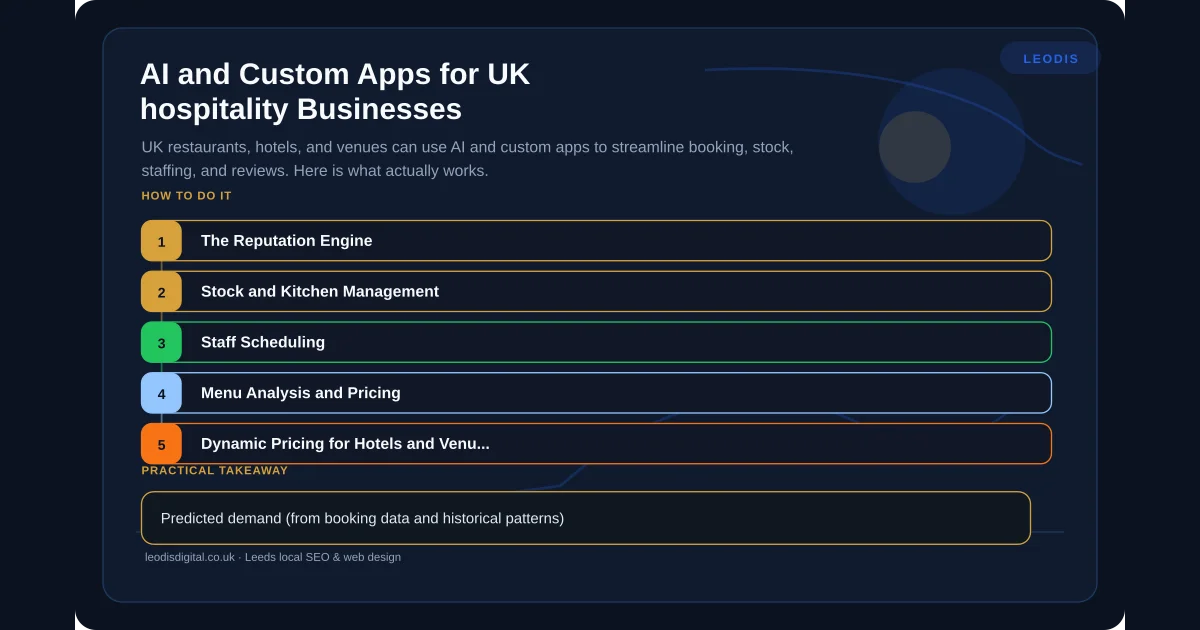
Review Management: The Reputation Engine
Reviews drive hospitality more than any other sector. A one-star improvement on Google can increase revenue by 5-9%. But managing reviews across Google, TripAdvisor, Booking.com, and social media is time-consuming.
AI-Powered Review Response
AI can draft responses to reviews in your brand voice, distinguishing between positive reviews (grateful, personalised) and negative reviews (empathetic, addressing specific concerns).
Important: AI should draft responses, not publish them. A human should review every response before it goes live, particularly for negative reviews where nuance matters. The AI handles the routine thanks and acknowledgements, freeing up the manager for the responses that require genuine thought.
Sentiment Analysis
Across hundreds of reviews, AI can identify recurring themes — positive and negative. If six reviews in a month mention slow service on Friday nights, that is an operational signal that might not be obvious from reading reviews individually. If customers consistently praise a specific dish, that is intelligence for menu planning and marketing.
Stock and Kitchen Management
Food waste costs the average UK restaurant between 5% and 15% of food purchases. For a Leeds restaurant spending £8,000 per month on ingredients, that is up to £1,200 per month lost to waste.
Smart Stock Ordering
AI can correlate booking data, historical sales patterns, weather forecasts, and local events to predict demand more accurately than manual estimation. If Leeds United are playing at home on Saturday, a restaurant near Elland Road can expect higher footfall. If the weather forecast is poor, a beer garden venue can reduce stock accordingly.
Practical implementation: This does not require building a system from scratch. Integrating booking data with inventory management and using AI analysis to generate suggested orders — which the chef reviews and adjusts — is achievable at a reasonable cost.
Kitchen Display Systems
A custom kitchen display system (KDS) replaces paper tickets with a digital screen showing orders, timing, dietary requirements, and special requests. AI enhancement can optimise the order in which dishes are prepared to ensure everything for a table is ready simultaneously, accounting for different preparation and cooking times.
For a busy Leeds restaurant kitchen running multiple sections, the efficiency gain from a well-designed KDS is substantial. It reduces verbal communication errors, tracks preparation time, and gives the head chef real-time visibility of kitchen performance.
Staff Scheduling
Hospitality rotas are notoriously difficult. Variable demand, staff availability, working time regulations, skill requirements, and the need to balance fairness with operational needs make scheduling a weekly headache.
AI-Assisted Rota Planning
AI scheduling tools can generate draft rotas based on:
- Predicted demand (from booking data and historical patterns)
- Staff availability and preferences
- Working time regulations and contracted hours
- Skills required per shift (experienced bartender on Friday night, trainee on Tuesday morning)
- Cost targets (balancing full-time and part-time staff for labour cost optimisation)
The manager reviews and adjusts the AI-generated rota rather than building one from scratch. For a venue with 20 or more staff, this saves hours per week and typically produces more efficient schedules than manual planning because it considers more variables simultaneously.
Tools to consider: RotaCloud and Planday offer AI scheduling features and are popular with UK hospitality businesses. For venues with specific requirements, custom scheduling tools can integrate directly with your booking and POS systems for tighter demand-staffing alignment.
Menu Analysis and Pricing
Your EPOS system holds valuable data about what sells, when, and in what combinations. Most restaurants look at basic sales reports but do not dig deeper.
What AI Can Surface
Menu engineering: Classifying every dish by popularity and profitability. High-profit, high-popularity items are your stars — promote them. High-profit, low-popularity items need better positioning on the menu. Low-profit, high-popularity items may need recipe or pricing adjustments. Low-profit, low-popularity items should probably go.
Price sensitivity analysis: Based on historical data, AI can suggest which items could absorb a price increase without affecting volume and which are price-sensitive. In a market where ingredient costs are rising, this intelligence helps protect margins without losing customers.
Combination analysis: Understanding which dishes are commonly ordered together informs menu design, upselling suggestions, and set menu composition.
Dynamic Pricing for Hotels and Venues
Hotels and events venues operate in a market where demand fluctuates dramatically. AI-powered dynamic pricing adjusts rates based on occupancy levels, local events, competitor pricing, seasonal patterns, and booking lead time.
For UK hotels, the difference between static and intelligent dynamic pricing can be significant — particularly around major events at the First Direct Arena or during Leeds Festival season. For independent hotels, tools like Pricelabs or RoomRaccoon offer AI pricing at a scale appropriate for independent operations.
Automated Guest Communication
From pre-arrival emails with check-in instructions and local recommendations to post-stay follow-ups requesting reviews, guest communication can be almost entirely automated without feeling impersonal.
AI enhances this by personalising communications based on the guest profile — recommending different restaurants and activities for a business traveller versus a family, adjusting the tone for a first-time guest versus a loyal regular, and timing communications based on the guest's journey.
Where to Start
If you run a hospitality business in the UK, the highest-impact starting points are typically:
- Automated review responses — saves management time immediately
- Booking-integrated stock ordering — reduces waste within the first month
- AI-assisted staff scheduling — saves hours per week and often reduces labour costs
- Automated guest or customer communications — improves the experience while reducing admin
These are all achievable without large budgets or complex technology projects. Start with one, measure the impact, and expand from there.
For the website and online visibility side of hospitality marketing, see our hospitality SEO guide. For the broader picture of AI and automation for UK businesses, see our complete AI automation guide.
If you want to explore what AI and custom software could do for your restaurant, hotel, or venue, get in touch. We understand the operational realities of hospitality — tight margins, demanding customers, and teams that are already stretched — and we will only recommend technology that genuinely makes your business run better.
Frequently Asked Questions
Can AI really help a small independent restaurant in the UK?
Yes, but the value is in operational efficiency rather than flashy customer-facing features. Automated review responses, smarter stock ordering based on booking data, and AI-assisted rota scheduling save real time and money. These are tools that help a small team do more, not technology for its own sake.
How much does a custom booking system cost?
A basic custom booking system typically costs between three and eight thousand pounds. The cost depends on complexity — a simple table reservation system is at the lower end, while a system that manages multiple event spaces, deposit handling, and capacity optimisation is at the higher end. Compare this to the ongoing commissions charged by third-party platforms and the ROI becomes clear quickly.
Should a restaurant use a third-party booking platform or build its own?
For most restaurants, starting with a third-party platform makes sense because it provides immediate exposure to new customers. But if you are paying significant commissions and most of your bookings come from repeat customers or your own marketing, a custom system that eliminates those fees can pay for itself within a year. The right approach depends on where your bookings actually come from.
What AI tools work for hotel and venue management?
Dynamic pricing tools that adjust rates based on demand patterns, automated review response systems, predictive maintenance scheduling, and AI-powered chatbots for handling booking enquiries and FAQs. The most impactful tools are usually the least visible — back-office automation that frees up staff to focus on guest experience rather than admin.
Found this useful? Share it.