As a charity trustee, your primary duty is to protect organisational assets, ensure compliance, and maximise the impact of every pound raised. Yet, many boards struggle to evaluate their digital infrastructure objectively when managing charity websites. When a site feels sluggish or looks dated, deciding whether to invest in a rebuild often gets deferred. You might be wondering: does our charity need a new website, or will a few minor content tweaks suffice to keep donors engaged?
Evaluating a digital platform does not require a computer science degree or a massive agency budget. By running a few targeted technical tests, your board can quickly determine if your current web presence is actively supporting your mission or quietly turning donors and volunteers away. Here are five practical tests that trustees can run in under ten minutes to diagnose the health of their charity's web presence.
How Do We Test Charity Websites for Mobile Speed and Performance?
Over sixty percent of visitors will view your charity's website on a smartphone. If your pages take more than three seconds to load on a standard 4G connection, potential donors will leave before they even read your mission statement. Furthermore, slow platforms suffer heavily in search engine results, limiting your organic reach to new supporters and grant funders.
To run this check, open Google PageSpeed Insights on your device, enter your website URL, and review the mobile performance score. At Leodis Digital, we maintain strict engineering standards: every modern platform should score 90 or above on both mobile and desktop. For context, when we rebuilt the digital infrastructure for the Buttercup Children's Trust, their performance score jumped from a failing 14 up to a flawless 100, resulting in an estimated 150% increase in organic growth.
If your current score sits below 50, your charity website is fundamentally out of date technically. Bloated plugins, uncompressed imagery, and legacy content management systems are almost always the culprits. A sluggish site directly impacts donations by creating friction during the checkout or sign-up process.
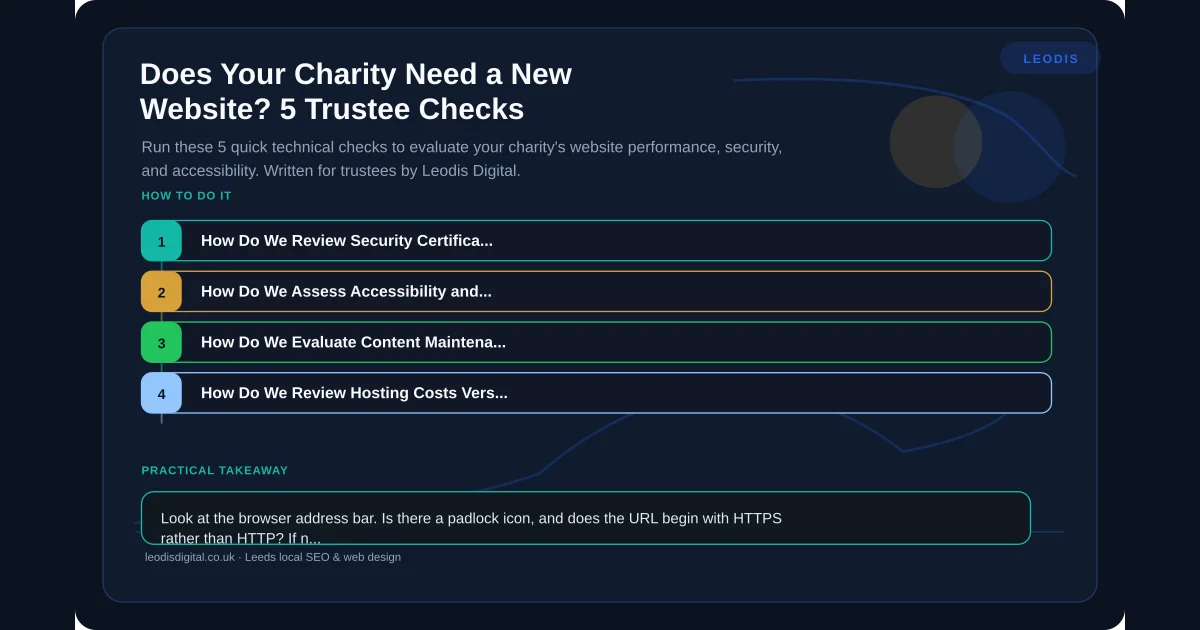
How Do We Review Security Certificates and Software Updates for Charity Websites?
Security is a fundamental trustee responsibility under charity governance guidelines. If your charity collects online donations, manages volunteer databases, or stores sensitive donor contact details, you have a legal and moral obligation to protect that data. An insecure website exposes your organisation to data breaches, malware injections, and severe reputational damage.
- Look at the browser address bar. Is there a padlock icon, and does the URL begin with HTTPS rather than HTTP? If not, your site is flagged as 'Not Secure' by modern browsers, scaring off donors immediately.
- Check when your content management system—such as WordPress—and its underlying plugins were last updated. Unpatched software is the primary entry point for automated cyber attacks.
- Verify who actually owns your domain name and hosting accounts. Too many charities discover too late that a former volunteer or defunct agency holds the keys to their digital infrastructure.
If your platform relies on core software that is no longer supported with security patches, patching individual vulnerabilities is merely a temporary sticking plaster. You need a structured web design and development approach that prioritises lightweight, secure code frameworks.
How Do We Assess Accessibility and Plain-English Compliance on Charity Websites?
Charities exist to serve communities, and your website should reflect that inclusive ethos. Beyond moral considerations, UK organisations have a clear legal duty under the Equality Act 2010 to ensure their services—including digital platforms—are accessible to disabled users. An inaccessible site alienates the exact people you may be trying to help, while risking compliance penalties.
Take ten minutes to navigate your site using only your keyboard, without touching a mouse. Can you easily tab through the main navigation menu, skip to the main content, and interact with donation forms seamlessly? Next, check your colour contrast: are your text elements legible against their backgrounds for users with visual impairments or age-related sight loss?
Many older charity websites fail basic accessibility audits because they rely on heavy themes or poorly coded plugins. Ensuring proper HTML semantic structure, descriptive alt text for images, and clear typographic hierarchies makes your content readable for both human visitors and search engine crawlers. This directly improves your technical SEO management without requiring complex or expensive marketing tactics.
How Do We Evaluate Content Maintenance and Donation Journeys on Charity Websites?
An outdated visual identity often signals an organisation in decline to a first-time visitor. If your homepage features news items from three years ago, or if your annual impact reports are buried four clicks deep, visitors will assume your charity is inactive. A proper charity website audit starts by mapping out your primary user journeys from end to end.
- Try to make a test donation or sign up for a newsletter on your mobile phone. Count the exact number of clicks and form fields required to complete the action.
- Search for your core services or local impact areas using Google in an incognito window. Does your site appear prominently, or are local competitors taking up all the search visibility?
- Review your 'About Us' and trustee pages. Are they up to date, transparent, and written in clear, concise language rather than heavy internal administrative jargon?
If updating a simple piece of text requires contacting an expensive agency or navigating a convoluted dashboard, your operational efficiency is suffering. Modern custom business software and streamlined content models empower staff to keep information fresh without technical bottlenecks.
How Do We Review Hosting Costs Versus Long-Term Value for Charity Websites?
Many boards view their website as a static overhead rather than a dynamic operational tool. However, if your current site requires constant bug fixes, emergency developer hours, and expensive plugin licence renewals, it may be costing you far more than you realise in hidden annual maintenance fees.
Look at what your charity spends annually on hosting, maintenance retainers, and security add-ons. Compare those figures against the actual value the site generates in terms of online donations, volunteer sign-ups, and service delivery. If you are paying monthly retainers for a sluggish, vulnerable platform built on bloated technology, that money could be far better utilised.
Shifting towards a modern architecture—such as static-site generators built with Astro or Vite—eliminates database vulnerabilities and reduces hosting overheads to near zero. When founder Karl Coulter established Leodis Digital, drawing on decades of experience building platforms for major environmental and global trusts, the goal was simple: build high-performance digital infrastructure that pays for itself through reliability and speed.
Making a trustee website decision ultimately comes down to risk management and strategic impact. If your current platform fails three or more of these checks, patching it together will only cost more in the long run. To discuss a practical path forward for your organisation, get in touch with our team today or call us directly on +44 7595 920924.
Frequently Asked Questions
How often should a charity evaluate its website performance?
Trustees should review core performance metrics, security updates, and donation user journeys at least once a year as part of digital governance and risk management.
What is a realistic budget for a charity website rebuild?
Through modern models like Website as a Service (WaaS) starting from £99/month, charities can secure lightning-fast, secure platforms without large upfront capital expenditure.
Do charity websites legally need to meet accessibility standards?
Yes. Under the Equality Act 2010, UK charities must ensure their services, including digital platforms, are accessible to disabled users, following WCAG guidelines.
Found this useful? Share it.