The Problem With AI Hype
Every AI vendor promises transformative ROI. Productivity gains of 40%. Cost reductions of 60%. Payback periods measured in weeks. These numbers are not necessarily wrong, but they are almost always context-free — extrapolated from ideal scenarios rather than measured from real implementations.
For a UK Business considering an investment in automation or AI, the question is not "does AI deliver ROI?" The question is: "how do I measure whether this specific automation delivers ROI for my specific business?"
The answer starts before you automate anything.
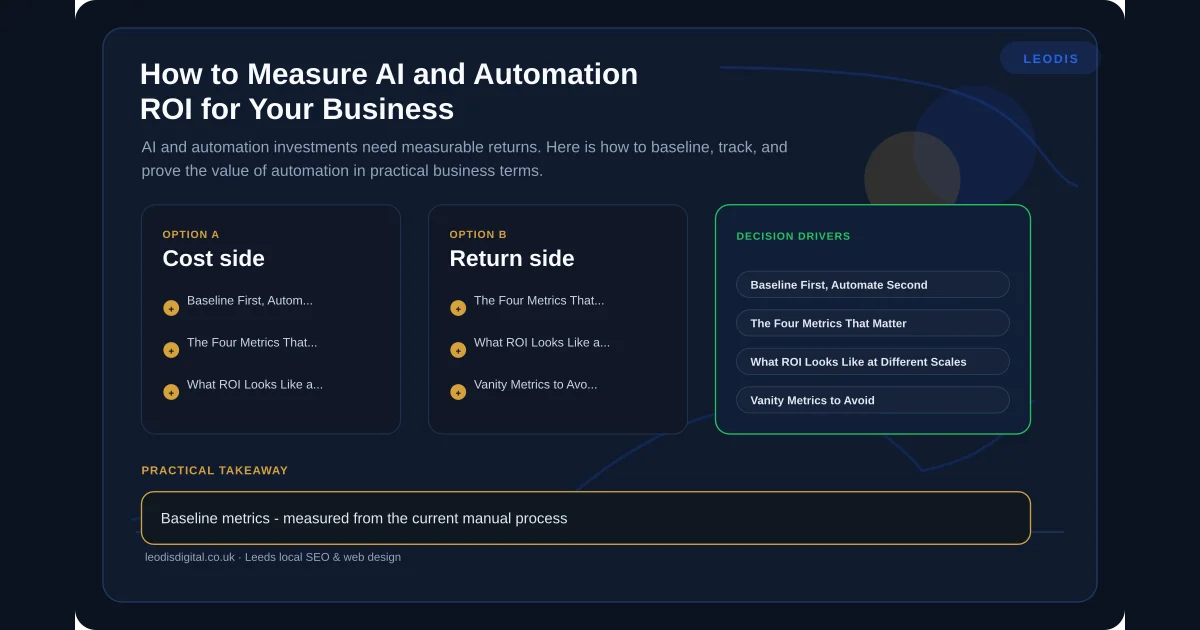
Baseline First, Automate Second
You cannot measure improvement if you have not measured the starting point. This is the single most common mistake businesses make with automation — they implement it, feel that things are better, but cannot quantify by how much.
Before automating any process, measure:
Time per occurrence. How long does the manual process take, from trigger to completion? Time several instances, not just one. Real-world processes take varying amounts of time depending on complexity, interruptions, and the person doing them. Use an average across at least ten occurrences.
Frequency. How many times does this process happen per day, week, or month? Multiply by time per occurrence for total monthly time investment.
Error rate. How often does the manual process produce errors — data entry mistakes, missed steps, incorrect calculations? Errors have downstream costs: rework, customer complaints, compliance issues. Quantify them.
Cost per occurrence. Time multiplied by the fully loaded cost of the person performing the task. Include salary, employer NICs, pension, and overhead. For a Leeds SME, a staff member earning thirty thousand pounds costs roughly forty thousand when you include all employment costs — approximately twenty pounds per hour.
Throughput. How many units can the current process handle per day or per person? If you are processing fifty invoices per day manually, that is your throughput baseline.
Document these numbers. They are your evidence base for every ROI calculation that follows.
The Four Metrics That Matter
1. Time Saved
The most tangible metric. If a process took fifteen minutes manually and takes two minutes with automation (including human review), you save thirteen minutes per occurrence. At a hundred occurrences per month, that is roughly twenty-two hours — nearly three full working days.
But time saved is only valuable if the saved time is used productively. Twenty-two hours freed from data entry is twenty-two hours available for revenue-generating work, strategic thinking, or customer service. If those hours simply dissipate into unfocused activity, the financial return is less clear.
Track both the time saved and how the freed time is reallocated. The strongest ROI cases are where automation frees skilled staff from routine tasks, allowing them to focus on higher-value work they were previously unable to get to.
2. Error Reduction
Errors are expensive. A data entry mistake in an invoice might mean chasing the wrong amount, issuing a credit note, and re-invoicing — turning a two-minute task into a thirty-minute correction. A compliance error could mean regulatory consequences. A scheduling error means a missed appointment and a lost customer.
Measure your error rate before automation and after. Express the difference in terms of rework hours avoided and downstream costs prevented. For businesses in regulated sectors — solicitors and accountants, for example — error reduction often delivers more value than time saving because the cost of an error includes regulatory risk, not just wasted time.
3. Throughput Increase
Automation does not just do the same work faster — it can increase the volume of work your business can handle without adding headcount. A business processing fifty invoices a day manually might process two hundred with automation. The marginal cost per invoice drops dramatically.
This matters most for growing businesses. If your current processes are at capacity and growth means hiring, automation offers an alternative path — handling increased volume with existing staff. The cost comparison is clear: the annual cost of automation versus the annual cost of an additional employee.
4. Cost Per Transaction
Divide the total cost of the process — staff time, software, error correction, management oversight — by the number of transactions processed. This gives you a unit cost that you can track over time and compare between manual and automated approaches.
For a process that costs four pounds per transaction manually and forty pence automated, the ROI calculation is straightforward. The difference, multiplied by transaction volume, is your annual saving. Compare that against the cost of building and maintaining the automation.
What ROI Looks Like at Different Scales
A 10-Person Business
A ten-person business in the UK — an accountancy practice, a small manufacturer, a professional services firm — typically has two to four people whose roles include significant administrative work. Automating the most time-consuming administrative processes might save each of those people five to ten hours per week.
At an effective cost of twenty pounds per hour, that is two hundred to four hundred pounds per week in time savings — roughly ten to twenty thousand pounds per year. Against an automation investment of three to eight thousand pounds, the payback period is measured in months.
The less visible benefit is capacity. Those five to ten hours per person per week represent the ability to handle 15-25% more business volume without hiring — or the ability to redirect staff towards activities that generate revenue, such as business development and client relationship management.
A 50-Person Business
At fifty people, automation ROI scales non-linearly because processes are typically more formalised, more repetitive, and performed by more people. An onboarding process that involves six departments and takes two weeks of elapsed time might be compressed to three days. A monthly reporting cycle that requires three people spending two days compiling data might be automated to a one-click dashboard.
The financial case is clearer at this scale because the numbers are larger, but the implementation complexity is also higher — more integrations, more stakeholders, more change management. Budget for the organisational change effort, not just the technology.
Vanity Metrics to Avoid
Not everything that can be measured should drive decisions. Watch out for these:
"AI interactions per month." The number of times people use an AI tool tells you nothing about whether it is delivering value. A chatbot that handles a thousand conversations but resolves none of them is not delivering ROI.
"Automation uptime." Your automation running 99.9% of the time is a technical achievement, not a business outcome. Measure what it produces, not whether it is running.
"Tasks automated." Counting the number of tasks you have automated is meaningless without knowing the value of each task. Automating ten low-value tasks might deliver less return than automating one high-value process.
"Time saved" without context. Saying "we saved 200 hours this quarter" sounds impressive. But if those hours were redistributed to meetings that could have been emails, the business outcome is neutral. Always connect time saved to what the saved time was used for.
Building a Measurement Framework
For any automation investment, establish this framework before implementation:
- Baseline metrics — measured from the current manual process
- Target metrics — the specific improvements you expect, expressed numerically
- Measurement method — how you will collect the data (system logs, time tracking, sampling)
- Review cadence — when you will assess performance (monthly for the first quarter, then quarterly)
- Decision criteria — what results would lead you to expand, adjust, or retire the automation
This framework serves two purposes. It gives you the evidence to justify the investment internally. And it gives you the data to make informed decisions about where to invest in automation next.
The same discipline applies here as in measuring SEO success — the metrics that matter are the ones connected to business outcomes, not the ones that are easiest to measure.
Honest ROI Conversations
At Leodis Digital, we will not tell you that every process in your business should be automated. Some manual processes are efficient enough that the cost of automating them exceeds the return. Some processes are too variable or require too much genuine human judgement to automate effectively.
What we will do is help you identify the processes where automation delivers clear, measurable value — and help you build the measurement framework to prove it. We baseline before we build, we set realistic targets, and we measure results against those targets honestly.
If you want to understand where automation can deliver genuine ROI in your business — not theoretical savings, but measurable ones — get in touch. We will walk through your processes and give you an honest assessment of where the returns are real.
Frequently Asked Questions
How quickly should I expect to see ROI from automation?
Simple automations — lead notifications, invoice reminders, appointment confirmations — deliver ROI within days because the implementation cost is low and the time savings are immediate. Custom AI solutions with higher upfront investment typically show clear ROI within three to six months. If an automation has not demonstrated measurable value within six months, something needs reassessing — either the automation, the metrics, or both.
What is a realistic time saving from automation for a small business?
It varies by process, but a common benchmark is 60-80% reduction in time spent on the automated task. A process that takes 20 hours per month manually might take 4-8 hours with automation — the remaining time covers review, exception handling, and oversight. The goal is not zero human involvement; it is eliminating the repetitive portions that do not require human judgement.
Should I measure automation ROI differently for internal tools vs customer-facing ones?
Yes. Internal tools are measured primarily on time saved and error reduction — the metrics are operational. Customer-facing automations should also be measured on customer satisfaction, response time, and conversion rates. A customer-facing chatbot that saves staff time but frustrates customers is a net negative, regardless of the internal efficiency gains.
How do I avoid overstating the ROI of automation?
Be honest about what time saving actually means. If automation saves an employee two hours per day but they fill that time with lower-value tasks, the financial return is different from if they fill it with revenue-generating work. Measure both the time saved and what happens with that time. Also account for ongoing costs — maintenance, updates, and the time spent managing the automation itself.
Found this useful? Share it.