The Admin Problem Every Tradesperson Knows
You are a plumber, an electrician, a builder. You are good at your trade. You did not start your business because you love admin.
But admin is what fills your evenings. Writing up quotes at the kitchen table after a full day on the tools. Chasing invoices. Trying to remember which customer you promised a callback to. Juggling a diary that exists partly in your head, partly in your phone, and partly on a scrap of paper in the van.
This is not a time management problem. It is a systems problem. And it is solvable without hiring office staff, buying expensive software, or changing how you work.
How Trade Businesses Actually Operate
Before talking about solutions, it is worth being honest about how most trade businesses in the UK actually run. Not how business consultants think they should run — how they actually do.
Communication happens on WhatsApp and phone calls. The diary is Google Calendar or a pocket diary. Quotes are typed up in the evening, sometimes from memory, sometimes from notes scribbled on site. Invoices go out late because invoicing is the last priority after a twelve-hour day. Follow-ups — calling past customers for annual servicing, chasing quotes that did not convert — rarely happen consistently because there is no system for it.
This is not laziness. It is the reality of running a one-person or small trade business where every hour on admin is an hour not earning on site. The margins do not support a full-time office administrator, and most off-the-shelf business software is designed for desk-based work, not someone who spends their day under boilers or in ceiling voids.
AI automation works for trade businesses precisely because it fits around this reality rather than trying to change it.
Auto-Quoting From Job Photos
This is where AI gets genuinely practical for trades. You visit a site, take photos of the work needed, and dictate a few notes into your phone. An AI system processes the photos and notes, identifies the work required, pulls pricing from your rate card, and generates a professional PDF quote — formatted with your branding, terms, and contact details.
You review it on your phone, make any adjustments, and send it to the customer. What used to take thirty minutes at the kitchen table takes three minutes in the van.
For a plumber quoting bathroom refits or a builder pricing extension work, this is not about replacing your judgement on pricing — you still set the rates and approve every quote. It is about eliminating the formatting, typing, and document creation that turns a five-minute pricing decision into a thirty-minute admin task.
Smart Scheduling
Double-bookings. Forgetting a callback. Driving from Horsforth to Garforth and back to Horsforth because the diary was not planned geographically. These are daily realities for trade businesses without a scheduling system.
AI scheduling does three things that manual diary management cannot:
Route optimisation. When you have four jobs booked for Tuesday, the system sequences them to minimise driving time. For a UK tradesperson covering the UK, this can save an hour of driving per day — which is either an extra job or an earlier finish.
Intelligent slot allocation. When a customer requests a booking, the system suggests available slots based on your existing commitments, travel time between jobs, and the estimated duration of the work. No more mental arithmetic about whether you can fit a two-hour job in Roundhay between a morning in Pudsey and an afternoon in Morley.
Automated confirmations and reminders. The customer gets a text confirmation when booked and a reminder the day before. No-shows and "I forgot you were coming" calls drop significantly. This is basic automation, but most trade businesses do it manually or not at all.
Automated Follow-Ups
You quote a job. The customer says they will think about it. Three weeks later, you have forgotten about it. They have gone with someone who followed up.
Automated follow-up sequences solve this without requiring you to maintain a mental list of outstanding quotes. When a quote is sent, the system schedules a follow-up message — polite, professional, timed appropriately. If the customer does not respond, a second follow-up goes out a week later. You set the timing and the tone. The system handles the execution.
The same principle applies to existing customers. An annual boiler service reminder sent automatically to every customer twelve months after their last service is a reliable revenue stream that costs nothing to maintain once set up. A Gas Safe engineer with three hundred past customers can generate significant recurring work from automated service reminders alone.
Invoice Generation From Job Notes
You finish a job. You send a voice note or type a quick message: "Replaced 15mm isolation valve and two radiator valves at Mrs Thompson's, three hours plus materials." An AI system converts this into a formatted invoice with your business details, the correct VAT treatment, an itemised breakdown, and a payment link.
The invoice is sent the same day the job is completed — not three days later when you get around to the paperwork. Faster invoicing means faster payment. For a trade business where cash flow is tight, getting invoices out on the day of completion rather than the end of the week can materially improve your financial position.
Material Ordering
For trades that involve regular material purchasing — plumbing supplies, electrical components, building materials — AI can streamline the ordering process. Photograph what you need, or describe it, and the system can generate an order list matched to your preferred suppliers' catalogues. This does not replace your knowledge of materials — you know what you need. It eliminates the time spent searching supplier websites and filling in order forms.
For larger jobs, the system can maintain a running materials list as the job progresses, track what has been ordered against what has been used, and flag when reorders are needed.
What This Actually Looks Like in Practice
Here is a realistic day for a Leeds electrician using AI automation:
7:00am — Check phone. Today's schedule shows three jobs, route-optimised. Customer confirmations went out automatically yesterday.
7:30am — Arrive at first job. Complete the work. Dictate job notes into phone. Invoice is generated and sent before leaving the property.
10:00am — Travel to second job. During the drive, a quote sent last week gets an automated follow-up. The customer replies accepting. The system adds the job to next week's schedule.
12:30pm — Take photos at a quoting visit. AI generates a draft quote. Review and send from the van before heading to the third job.
4:30pm — Day complete. No evening admin. The system has sent today's invoices, followed up on outstanding quotes, and confirmed tomorrow's appointments.
This is not a futuristic scenario. Every component described here is achievable with current technology.
The Connection to Your Online Presence
AI automation handles your operations. But the customers need to find you first. That is where your website and local SEO for trades come in. A trade business that ranks well for "electrician Leeds" or "emergency plumber Horsforth" and converts those enquiries efficiently through automated quoting and scheduling is operating at a level that most competitors simply are not.
The two investments — online visibility and operational automation — compound each other. More leads handled more efficiently means more completed jobs, more reviews, better rankings, and more leads. It is a flywheel that starts with getting the basics right on both fronts.
Starting Small and Practical
You do not need to automate everything at once. Start with the single process that costs you the most time or loses you the most money. For most trade businesses, that is one of three things:
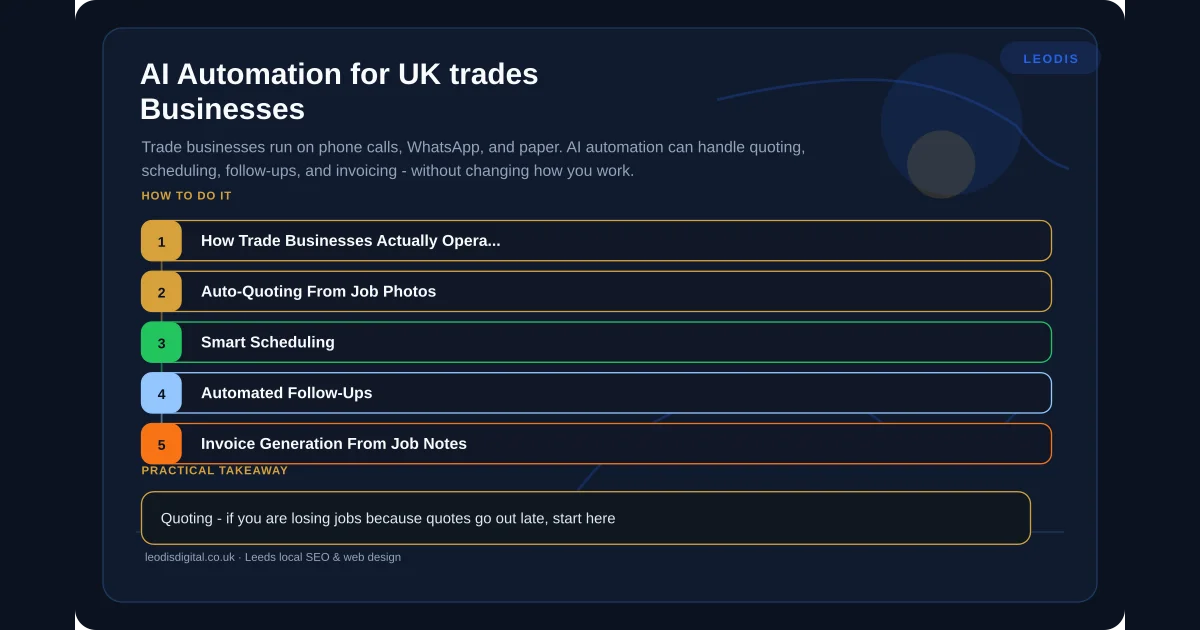
- Quoting — if you are losing jobs because quotes go out late, start here
- Follow-ups — if you are losing jobs because you do not chase, start here
- Invoicing — if your cash flow suffers because invoices go out late, start here
One automation, delivering clear value, gives you the confidence and the evidence to tackle the next.
At Leodis Digital, we build practical AI automation for Leeds trade businesses — tools that work with WhatsApp, phone calls, and the way you actually operate. No enterprise software, no steep learning curves, no changing how you work. If you are spending your evenings on admin instead of with your family, get in touch and let us show you what can be automated.
Frequently Asked Questions
Do I need to be technical to use AI tools in my trade business?
No. The best AI automations for trade businesses are invisible — they work behind the scenes without changing how you operate day to day. You still take the call, still visit the job, still do the work. The AI handles the admin that happens around the work: sending quotes, chasing payments, booking follow-ups. If you can use WhatsApp, you can use these tools.
How much does AI automation cost for a small trade business?
Individual automations — like an auto-quoting system or an invoice generator — can be built for a few hundred to a couple of thousand pounds, depending on complexity. The ROI is usually clear within weeks. If you spend two hours a day on admin and automation cuts that to thirty minutes, the payback period is short. We scope every project with a fixed price before starting.
Will AI replace the need for a good website and local SEO?
No. AI automation handles your internal operations — quoting, scheduling, invoicing. Your website and local SEO bring the customers in. They solve different problems. A trade business that ranks well in local search and runs efficient operations through automation is in a very strong competitive position. See our guide to local SEO for trades for the other half of the equation.
Can AI automation work with the tools I already use like WhatsApp and Google Calendar?
Yes. Most AI automation for trade businesses is built to work with the tools you already use rather than replacing them. Automations can read WhatsApp messages, create calendar entries, generate PDFs, send emails, and update spreadsheets. The point is not to learn new software — it is to make your existing tools do more of the work for you.
Found this useful? Share it.