Trust Is Not a Feature You Add Later
Every business implementing AI faces the same fundamental challenge: getting people to trust it. Not just to use it — to trust it enough to rely on its outputs and to believe it is operating in their interests.
This applies to customers, staff, business owners making decisions based on AI insights, and regulators increasingly scrutinising how businesses use AI.
Trust is not a technical feature you bolt on after the system works. It is a design principle that shapes how you build, deploy, and communicate about AI from the beginning. Businesses that treat trust as an afterthought discover that technically excellent AI systems fail because nobody uses them.
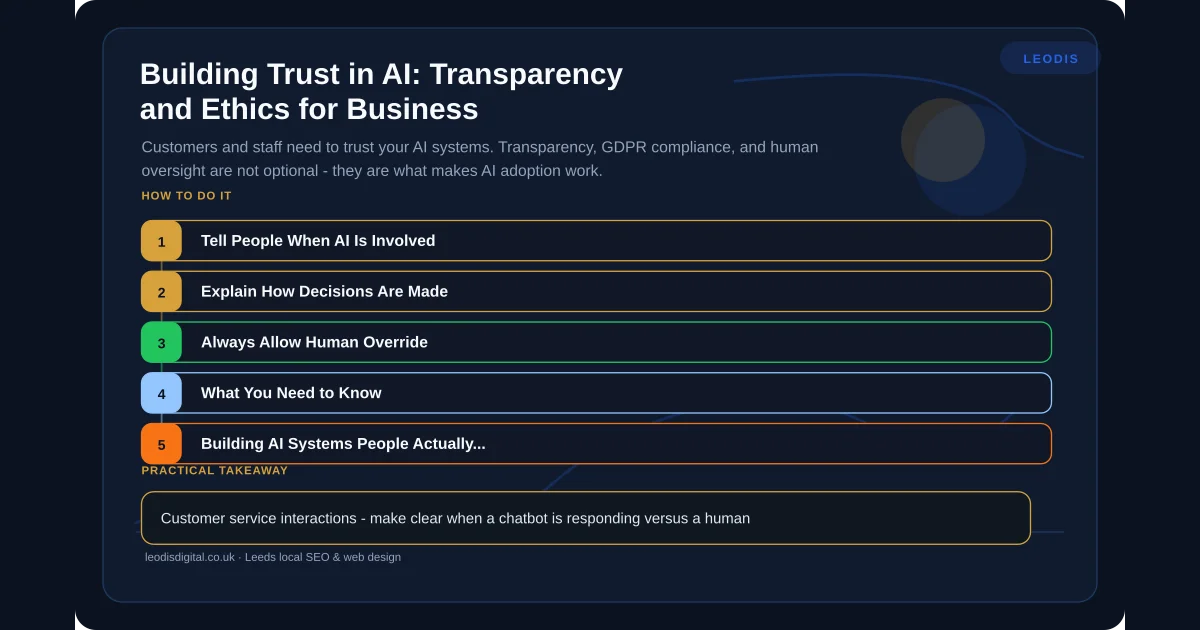
Tell People When AI Is Involved
This is the simplest and most important principle. If a customer is interacting with an AI — a chatbot, an automated email response, an AI-generated recommendation — tell them.
Research consistently shows that the trust damage from discovering undisclosed AI is far greater than any trust reduction from upfront disclosure.
A message like "This initial response was generated by our AI assistant. A member of our team will review and follow up personally" is honest, sets appropriate expectations, and signals that a human is in the loop. Most customers are comfortable with this — particularly for routine interactions like appointment confirmations and order updates.
Where disclosure matters most:
- Customer service interactions — make clear when a chatbot is responding versus a human
- Personalised recommendations — explain that suggestions are based on stated preferences or purchase history
- Content generation — if AI contributed to written materials, say so
- Decision-making — if AI influenced a decision about a customer (pricing, eligibility, risk assessment), this must be disclosed under GDPR
The pattern in E-E-A-T content principles applies directly here — expertise, experience, authoritativeness, and trustworthiness are not just SEO concepts. They are principles for how any business communicates, including how it communicates about its use of AI.
Explain How Decisions Are Made
Transparency goes beyond disclosure. When an AI system makes a decision or recommendation, the people affected should be able to understand why.
This does not mean explaining the neural network architecture. It means providing a human-understandable reason. "We recommended this product because you purchased similar items in the past" is sufficient. "Our algorithm determined this was optimal" is not.
For internal AI tools, the same principle applies. If an AI system prioritises customer enquiries, your team should understand the prioritisation criteria. If an AI flags a transaction for review, the reason for the flag should be visible. If an AI suggests a course of action, the factors it considered should be apparent.
Explainability serves two purposes. It allows people to assess whether the AI's reasoning makes sense — catching errors before they have consequences. And it builds confidence in the system over time, as users learn that the AI's reasoning is generally sound.
Black box AI — systems where decisions emerge from opaque processes with no visible reasoning — is appropriate for some applications. Business decision-making that affects customers and staff is not one of them.
Always Allow Human Override
Every AI system in a business context should have a clear mechanism for human override. A person should always be able to:
- Escalate from AI to human. A customer interacting with a chatbot should be able to reach a person with a single action, not after navigating a maze of automated menus.
- Override an AI decision. If an AI recommends declining a customer application or flagging a transaction, a qualified human should be able to review the decision and override it with documented reasoning.
- Correct an AI output. If an AI generates a document, classification, or response that is wrong, there should be a straightforward process for correction — and ideally, the correction should feed back into the system to improve future outputs.
Human override is not a concession to imperfect technology. It is a design requirement. AI systems make probabilistic decisions — they are right most of the time, but they are never right all of the time. The human override handles the cases where the AI is wrong, and it maintains the human agency that both regulation and trust require.
GDPR and AI: What You Need to Know
GDPR applies to all personal data processing, including processing by AI systems. for UK businesses implementing AI, the key considerations are:
Lawful Basis for Processing
You need a lawful basis for any personal data your AI system processes. For most business AI applications, this is either legitimate interest or consent. If your AI processes sensitive categories of data — health information, religious beliefs, ethnic origin — explicit consent is typically required.
Data Minimisation
Collect and process only the personal data your AI system actually needs. If an AI chatbot only needs a customer's name and enquiry to function, it should not be collecting their date of birth, address, and purchase history. The principle of data minimisation applies to AI inputs just as it applies to any other processing.
The Right to Explanation
Under Article 22 of GDPR, individuals have the right not to be subject to decisions based solely on automated processing that produce legal or similarly significant effects. If your AI system makes decisions about pricing, eligibility, credit, or employment, you must provide meaningful information about the logic involved and allow human intervention.
In practice, this means any AI system that makes consequential decisions about individuals must have human oversight, and you must be able to explain the decision-making criteria in terms the individual can understand.
Data Protection Impact Assessments
For AI implementations that process personal data at scale or involve new technologies, a Data Protection Impact Assessment (DPIA) is advisable and may be legally required. This is not bureaucracy for its own sake — it is a structured process for identifying and mitigating privacy risks before the system goes live.
Building AI Systems People Actually Want to Use
The most common reason AI implementations fail is not technical — it is adoption. Staff do not use the tools. Customers do not engage with the features. The AI system works perfectly in testing and sits unused in production.
Adoption failures almost always trace back to trust and usability problems:
Staff fear replacement. If your team believes AI is being introduced to replace them, they will resist it — actively or passively. Be explicit that AI is handling the routine, repetitive parts of their role so they can focus on the work that requires their expertise and judgement. And mean it.
The AI is not reliable enough. If an AI tool produces wrong outputs 20% of the time, staff will stop trusting it after a few bad experiences. Better to launch with a narrower scope where accuracy is high than a broad scope where it is inconsistent. Trust is hard to rebuild once lost.
There is no feedback loop. Staff who cannot correct the AI when it is wrong feel powerless. Build feedback mechanisms — "this is wrong" buttons, correction workflows, human review queues — that give users agency over the AI's outputs and contribute to improving the system over time.
The change was imposed, not consulted. People adopt tools they helped shape. Involve your team in identifying which tasks should be automated, testing the tools during development, and refining the workflows post-launch. The implementation process matters as much as the technology. The same principle applies to software design and usability — tools built with users, not just for them, get adopted.
No Techno-Utopianism, Please
AI is a tool. It is a powerful tool, and it is becoming more capable rapidly. But it is not magic, it is not infallible, and it is not a substitute for good business processes, skilled people, or ethical decision-making.
The businesses that succeed with AI are the ones that approach it practically — identifying specific problems, implementing targeted solutions, measuring results honestly, and maintaining human oversight throughout. They do not claim AI will revolutionise everything. They use it where it works and leave it out where it does not.
For a UK Business implementing AI, the trust framework is straightforward:
- Be transparent about when and how AI is used
- Explain decisions in human terms
- Always allow human override
- Comply with GDPR requirements
- Involve your team in implementation
- Measure results and be honest about what works
If you are considering AI for your business and want to implement it in a way that customers and staff will actually trust, get in touch with Leodis Digital. We build AI systems with transparency, oversight, and practical business value as non-negotiable requirements — not afterthoughts.
Frequently Asked Questions
Do I need to tell customers when they are interacting with AI?
Yes, and it is good practice even where not strictly legally required. The EU AI Act mandates disclosure for certain AI interactions, and UK regulation is moving in the same direction. More importantly, customers who discover they were unknowingly talking to a chatbot feel deceived — which damages trust more than the AI interaction itself. Be upfront. Most customers are fine with AI handling routine queries as long as they know and can reach a human when needed.
How does GDPR apply to AI systems in my business?
GDPR applies to AI systems the same way it applies to any data processing — you need a lawful basis, you must be transparent about how data is used, and you must respect data subject rights. The additional consideration for AI is Article 22, which gives individuals the right not to be subject to solely automated decision-making with significant effects. If your AI system makes decisions that meaningfully affect people, human oversight is a legal requirement, not just best practice.
How do I build staff confidence in AI tools?
Involve them early. Staff who are consulted during the design and testing of AI tools adopt them far more readily than staff who have tools imposed on them. Be clear that AI is handling the repetitive parts of their role, not replacing their expertise. Provide training that goes beyond button-clicking — help them understand what the AI does, where it might be wrong, and when to override it. Trust is built through competence and control, not through mandate.
What happens when an AI system makes a mistake in my business?
The same thing that should happen when any system or person makes a mistake — you acknowledge it, correct it, and learn from it. The difference with AI is that mistakes can be systematic rather than random. If an AI misclassifies one customer enquiry, it is likely misclassifying others with similar characteristics. Build monitoring that catches patterns of errors, not just individual incidents, and have clear escalation paths for when AI outputs are wrong.
Found this useful? Share it.