The Starting Point
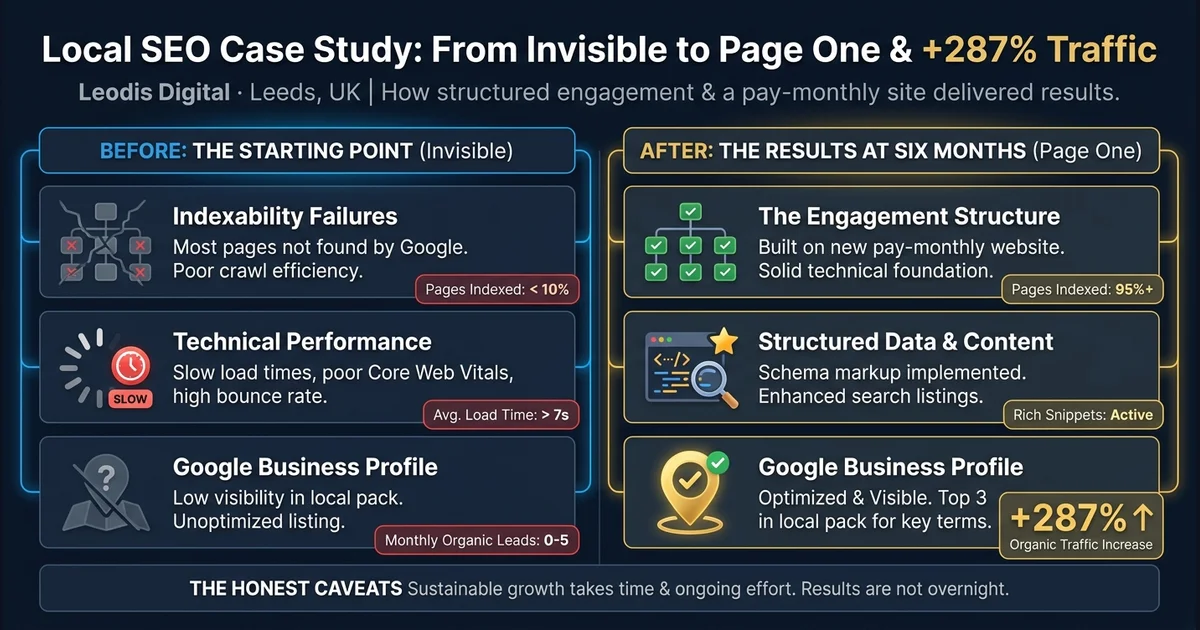
In early 2026, a UK-based professional services firm came to us with a problem that was straightforward to describe but significant in its commercial impact: their website was generating almost no organic traffic, they were invisible in local search for their primary service terms, and their new business pipeline depended almost entirely on referrals and a paid advertising campaign they were increasingly uncomfortable funding.
Their website had been built three years earlier by a small local agency. It looked reasonable. The branding was professional. But it had not been touched since launch — no content additions, no technical maintenance, no structured data, no local optimisation. The digital world had moved on.
This situation is not unusual. It describes a significant proportion of the local business websites we audit across across the UK.
What the Audit Found
Our initial technical audit identified the following priority issues, listed in order of commercial impact.
Indexability Failures
Three of the firm's eight service pages carried noindex meta tags — a remnant of a development environment setting that had never been removed before launch. These pages, which included their two highest-value service offerings, were completely invisible to Google. The site had never ranked for these services.
This single issue — an accidental oversight from the original build — was the primary cause of their organic invisibility. It cost them three years of potential rankings.
Technical Performance
The site scored 34 on mobile PageSpeed Insights. 2MB hero image loading synchronously in the document <head>, blocking the entire page render until the file had fully downloaded. In practical terms: a visitor on a typical mobile connection waited 8–12 seconds before seeing any content.
There was no caching strategy. The hosting was a shared server with no UK-specific infrastructure.
Structured Data
None. The site had no schema markup of any type. Google had to infer what the business did, where it operated, and what services it offered from unstructured text. LocalBusiness, Service, and FAQPage schemas were absent throughout.
Google Business Profile
The primary business category was incorrect — a legacy of the original setup that had never been reviewed. No services were listed. Eleven reviews sat unanswered, including two negative reviews that had received no response in the six months since they were posted. The most recent photo was fourteen months old. Each of these issues is addressed in the 12-point Google Business Profile audit.
Local Signals
The word "Leeds" appeared in the footer address and nowhere else on the site. No title tag, meta description, or page heading referenced the business's location. The site read as geographically neutral — appropriate for a national business, actively harmful for a local service firm competing for Leeds-specific search intent.
Content Depth
Eight service pages averaging 180 words each. No insights or blog content. No FAQ content. No case studies. No evidence of expertise beyond a brief "about us" section. The site had nothing for Google to evaluate as an indicator of quality, depth, or authority.
The Engagement Structure
We structured the work across three phases, sequenced deliberately to build each layer on a sound foundation.
Months 1–2: Technical Foundation
The starting point was making the site technically capable of ranking before spending any effort on content or authority signals. Optimising content for a site with indexability failures or Core Web Vitals problems is wasted effort — the ceiling is determined by the technical floor.
Decision: replace the site. The structural performance issues on the existing WordPress installation — the hosting environment, the theme architecture, the absence of any performance consideration from the original build — would have required expensive and time-consuming work to address individually, with no guarantee of reaching modern performance standards. A pay-monthly website from Leodis Digital was the commercially rational alternative: a new site built on a modern, lightweight framework that achieves 90+ on mobile PageSpeed Insights from day one, with correct schema markup, semantic HTML, and UK infrastructure included in the monthly fee. The new site launched at week five.
On the new site, from day one:
- All service pages correctly indexed with no accidental noindex tags
- LocalBusiness and Service schema implemented throughout
- Hero image: from 4.2MB to 68KB with no visible quality loss
- Mobile PageSpeed Insights: from 34 to 91
- Core Web Vitals: passing on all three metrics
- Footer, title tags, and meta descriptions updated with Leeds-specific language
Simultaneously on the GBP: corrected primary category, completed service listings, responded to every outstanding review (including a specific, measured response to both negative reviews), uploaded updated photography, and began a weekly post schedule.
Months 3–4: Content Development
With the technical foundation in place, we turned to content depth. The eight 180-word service pages were replaced with comprehensive service pages averaging 900 words each — covering what the service includes, who it is for, the process, expected outcomes, pricing context, and FAQ content addressing the specific questions prospective clients ask.
Four dedicated FAQ pages were published targeting informational search terms: questions that prospective clients search for when they are researching and evaluating options, before they have decided who to engage. These are not purely top-of-funnel awareness pieces — they are commercial-intent resources that target users who are close to making a decision.
A monthly insights programme began, publishing one article per month on topics relevant to the firm's prospective clients and aligned with local search intent.
Months 5–6: Authority Building
With a technically sound site and substantive content in place, we focused on local authority signals — the external recognition that tells Google this business is a genuine part of the Leeds professional community.
The business was submitted to relevant local and industry directories, including those with the strongest local authority signals. A Chamber of Commerce listing was secured. The firm was supported in implementing a review acquisition process — asking satisfied clients for specific, detailed reviews describing their experience. 34 new reviews were generated in the two months, including several that named specific team members and described particular matters handled. The complete framework for local link building for UK businesses and building citation authority follows the same approach as this engagement.
The Results at Six Months
| Metric | Before | After (6 months) |
|---|---|---|
| Organic sessions (monthly) | ~120 | ~464 (287% increase) |
| Organic enquiries (monthly) | 3 | 19 |
| GBP calls (monthly) | baseline | +340% |
| Map Pack position (primary terms) | Outside top 10 | Consistent position 2–3 |
The paid advertising campaign was paused in month five. The monthly spend freed from that campaign covered the entire six-month SEO investment and the ongoing pay-monthly website fee with significant margin.
The Honest Caveats
The percentage improvements in this case study are high because the starting baseline was low. Three years of accidental noindex tags suppressing primary service pages represents a significant pent-up visibility gap. Businesses starting with correctly indexed sites, some content, and an active GBP will see smaller percentage gains — though the absolute improvements from methodical technical and content work remain meaningful.
Results of this type require time. The first significant results appeared at month three. The full picture was visible at month six. Businesses that expect meaningful organic growth in four weeks from a standing start will be disappointed. The mechanics of how Google evaluates and promotes content do not operate on that timeline.
What this case study demonstrates is the sequence: technical foundation first, content second, authority third. Skipping the technical foundation and building content on a site with indexability errors or Core Web Vitals failures limits the ceiling on everything built on top. Our guide to why websites aren't ranking identifies all eight root causes — and this firm's site had five of them simultaneously.
Building the Foundation for Your Business
The issues identified and resolved in this engagement are not unusual. They appear with predictable regularity across local business sites across across the UK. The pattern of an untouched, unmaintained site losing ground year by year while the business owner assumes their website is "fine" is one of the most common situations we encounter.
The detailed guidance for each element of this work is documented across our insights library. For technical issues: see our technical SEO audit guide. For GBP optimisation: our complete GBP guide. For schema markup: our structured data guide for local businesses. For content strategy: our topical authority guide.
If your business is in a similar position to the firm described here — technically unmaintained, locally invisible, dependent on referrals and paid advertising — a pay-monthly website from Leodis Digital provides the technical foundation that makes everything else possible. Get in touch with Leodis Digital to discuss what your specific opportunity looks like.
Frequently Asked Questions
How typical are results like these?
The percentage improvements in this case study are on the high end because this business started from a very low baseline — accidental noindex tags were suppressing pages that should have been ranking. Businesses starting from a higher technical baseline will see smaller percentage gains, though absolute improvements can still be significant. What is typical is the sequence: fix technical issues first, then build content, then build authority. Skipping the technical foundation limits everything built on top.
Was a new website part of the engagement?
Yes. The existing site had structural problems — slow loading, no schema markup, geographic signals absent from every page — that would have required extensive and expensive retrofitting to fix individually. A pay-monthly website from Leodis Digital was the more commercially rational solution: a new, technically excellent site with correct schema, fast mobile performance, and local signals built in from day one, for a fixed monthly fee rather than a large upfront build cost. The new site launched at the start of month two and was the platform for everything built after.
How long did it take to see results?
The first meaningful results appeared at month three, after the technical foundation was in place and the revised service pages were indexed and being evaluated. The most significant improvements — Map Pack position changes, enquiry volume growth — were concentrated in months five and six. This timeline is consistent with our experience: technical fixes and content take time to be fully evaluated by Google, and the compounding returns from a content programme are back-weighted. Expecting significant results before month three is unrealistic. Expecting them by month six, with a sound technical foundation, is reasonable.
What is the most important thing to fix first on a site that isn't ranking?
Start with the technical foundation. Indexability errors — noindex tags, robots.txt blocks, crawl errors — must be resolved before any other work has meaningful effect. Pages that cannot be crawled cannot rank, regardless of how well-optimised their content is. After indexability, Core Web Vitals and page speed. After that, content. The sequence matters. Building content on a site with indexability problems is building on sand.
Found this useful? Share it.