The Diagnosis Before the Treatment
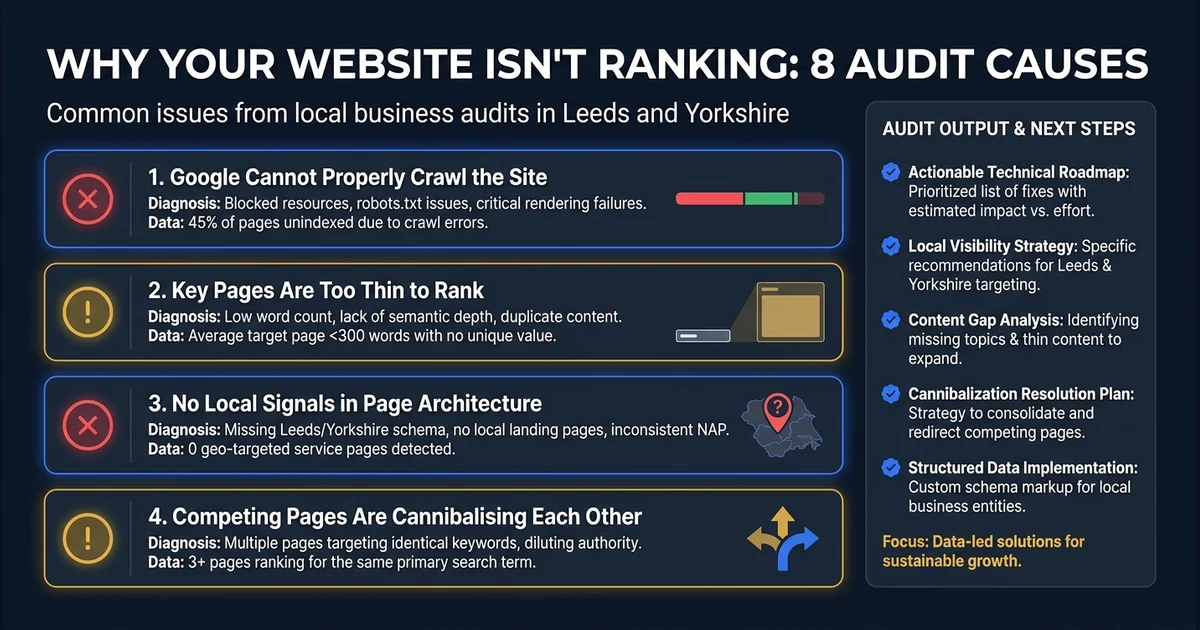
When a local business tells us their site is not ranking, the cause is almost always one of a small number of recurring issues. After hundreds of audits across across the UK, the patterns are consistent.
Here are the eight problems we find most frequently, the diagnostic questions to ask about each, and what a sound technical foundation solves versus what requires ongoing work.
1. Google Cannot Properly Crawl the Site
This is the most fundamental issue and the first to check. If Googlebot cannot access your pages, you cannot rank for them — regardless of how well-optimised the content is. Ranking is downstream of indexing.
Common crawlability blockers:
- A
Disallow: /in robots.txt from a development environment that was never removed before launch — this blocks Google from your entire site - JavaScript-rendered content that Googlebot cannot fully execute, leaving pages effectively invisible
- Server errors (500-level responses) that cause pages to fail when crawled
- Login or authentication requirements in front of content that should be publicly accessible
Diagnostic: Open Google Search Console's Coverage report. Any pages with crawl errors are a priority.
A pay-monthly website from Leodis Digital is built with clean server-side rendering, no crawl-blocking development settings, and straightforward robots.txt configuration. The crawlability issues that commonly arise from WordPress plugin conflicts or misconfigured development environments do not apply.
2. Key Pages Are Too Thin to Rank
A one-paragraph service page will not rank for competitive terms. Google's Helpful Content systems reward depth and genuine usefulness.
The threshold varies with competition. For "emergency plumber Leeds" at 11pm, a moderately thin page from a locally authoritative domain might rank.
Diagnostic: Search for your primary target terms and read the top-ranking pages. If they are significantly more comprehensive and useful than your service pages, content depth is the issue.
Fix: Expand service pages with genuine detail from your experience. What does the service actually include? What does the client's experience look like from first contact to completion? What does it cost and why? What questions do clients ask before engaging you?
3. No Local Signals in Page Architecture
A site that does not reference the UK, or any specific location it serves is not giving Google the geographic context needed to surface it for local searches. This is one of the most common issues in sites built by agencies or template platforms with no local SEO knowledge.
Required local signals:
- Location in the
<title>tag and meta description of primary service pages - Business address in the footer on every page
- LocalBusiness schema with accurate address, service area, and opening hours
- Location-specific content in service page body copy — not just the title, but the substance of the page
- Internal links between location-relevant pages
Diagnostic: Search for "[your service] Leeds" in Google. If you are not visible, check whether your pages mention Leeds in their title tags, headings, and content.
A pay-monthly website from Leodis Digital is built with local signals as a structural requirement — title tags, schema, and page architecture are set up for local search from the outset.
4. Competing Pages Are Cannibalising Each Other
If you have multiple pages targeting the same keyword, they compete against each other in Google's index rather than one authoritative page competing against external competitors. Google has to decide which of your pages is most relevant for a given query — and it frequently guesses wrong, or splits its ranking consideration between multiple pages, weakening both.
Common scenarios:
- A homepage and a services page both targeting "web design Leeds"
- Multiple city-specific pages targeting the same service area from similar angles
- Blog posts that address the same topic as a service page using similar language
com [target keyword]`. If multiple pages appear for a specific keyword you want to rank for, you may have a cannibalisation issue.
Fix: Consolidate competing pages into a single, authoritative page. Use 301 redirects from removed pages to the consolidated target.
5. Core Web Vitals Failures
A site that consistently fails Core Web Vitals — Google's measures of real-world page experience — is at a ranking disadvantage for competitive terms. Speed is a confirmed ranking signal.
The three Core Web Vitals:
- LCP (Largest Contentful Paint): How quickly the main content appears. 5 seconds. - INP (Interaction to Next Paint): How quickly the page responds to user interaction. Target: under 200ms. - CLS (Cumulative Layout Shift): How much the page layout shifts as it loads.
dev). Enter your URL and focus on the Field Data section, which shows real measurements from Chrome users, not a lab simulation. If any metric shows as "Poor" or "Needs Improvement," you have an active ranking problem.
A pay-monthly website from Leodis Digital achieves 90+ on mobile PageSpeed Insights from day one. For businesses whose current site is failing Core Web Vitals on a platform that cannot be efficiently fixed, a pay-monthly rebuild is frequently the most commercially rational resolution.
6. No Backlinks from External Sources
A site with no inbound links from external websites has no external authority signals. For competitive terms, backlinks remain a significant ranking factor.
The nature of the links matters more than the volume. A Chamber of Commerce membership listing, a link from a regional business news outlet that covered a story about your business, a supplier or partner website that references you, a local charity you sponsor — these locally relevant, contextually appropriate links carry meaningful weight.
Starting points for local businesses in the UK:
- Leeds Chamber of Commerce membership and directory listing
- Yorkshire Business Insider and regional press
- Industry body directories and professional association listings
- Local suppliers, partners, and complementary businesses who can link to you
- Sponsoring local events, clubs, or organisations that publish websites
See our full local link building guide for the complete framework.
7. An Incomplete or Inconsistent Google Business Profile
For local search visibility, your Google Business Profile is at least as important as your website. An incomplete GBP — missing categories, no photos, no services listed, no reviews, or business information that contradicts what your website says — is a direct ranking liability in the Map Pack, where the most commercially valuable local searches are won and lost.
The most common GBP problems:
- Incorrect primary category (the single most important GBP ranking signal)
- No secondary categories for related services
- No services listed with descriptions
- Outdated or no photos
- Unanswered reviews — particularly negative ones
- Business name, address, and phone number that doesn't match the website exactly
Our comprehensive Google Business Profile optimisation guide covers every element of the 12-point GBP audit.
8. The Site Was Redesigned Without SEO Preservation
A redesign that changed URLs without implementing 301 redirects, removed content that was ranking, or altered the site structure in ways that broke internal linking architecture can cause ranking losses that persist for months or permanently.
The symptoms: rankings that dropped sharply in a specific period that coincides with a site launch. The diagnostic: compare a crawl of the current site against a historical list of URLs that were ranking before the redesign. Missing redirects from old URLs to new ones are the first thing to check.
If you are planning a redesign: Our website redesign SEO checklist documents every step required to protect organic performance through a redesign — including the redirect map, pre-launch technical checks, and post-launch monitoring protocol.
The Pattern Behind the Problems
Looking across these eight issues, a pattern emerges. Issues 1, 3, 5, and 8 — crawlability, local signals, Core Web Vitals, and redesign SEO preservation — are technical problems caused by how the site was built or maintained. They do not require better content or more backlinks to fix. They require a technically sound website.
Issues 2, 4, 6, and 7 — content depth, keyword cannibalisation, backlinks, and GBP — require ongoing effort: writing, local authority building, review acquisition, and consistent GBP management.
The businesses that solve the technical problems first, and then build content and authority on a sound foundation, see results accumulate predictably. The businesses that invest in content and authority on a technically broken site hit a ceiling determined by the platform problems.
A pay-monthly website from Leodis Digital resolves issues 1, 3, 5, and 8 from day one — the technical foundation is built in. The issues that require ongoing effort remain, but they are no longer constrained by a platform that cannot support them effectively.
Get in touch with Leodis Digital for a technical audit of your site's current ranking obstacles. We will identify which of these issues apply and the most commercially rational path to resolving them.
Frequently Asked Questions
How do I know if Google can actually see my pages?
Open Google Search Console and navigate to the Coverage or Pages report. This shows you exactly which pages Google has indexed, which it has found but not indexed, and which it has been prevented from crawling. Any page with an indexing error is a priority. You can also use the URL Inspection tool to check a specific URL — it will tell you whether Google has indexed it and when it was last crawled. If a page you expect to rank is not appearing in Search Console as indexed, that is the first problem to solve.
Does a pay-monthly website from Leodis Digital solve multiple ranking problems at once?
It addresses the majority of the technical issues described in this article from day one. A pay-monthly website is built on a modern framework with clean crawlability, correct schema markup, semantic HTML, strong Core Web Vitals performance, local signals built into page architecture, and no accidental indexability blocks. The issues that cannot be solved by the website itself — content depth, backlink profile, Google Business Profile completion, and review acquisition — require ongoing effort, but the technical foundation removes the ceiling that a poorly built site places on that effort.
My site was fine and then rankings dropped suddenly. What happened?
Sudden drops have specific causes rather than gradual ones. The most common: a website redesign that changed URLs without implementing redirects; a Google algorithm update that changed how a quality signal is weighted (check the timing against Google's update announcements); an accidental technical change such as a robots.txt update or noindex tag being applied; or a manual penalty applied to the domain. Open Search Console and check the Coverage report, the Manual Actions section, and compare traffic against announced algorithm updates. Gradual declines have different root causes — accumulating technical debt, competitors improving, or content becoming outdated.
Is it worth investing in SEO on an old, slow website?
Limited value, and frequently counterproductive. SEO investment — content, local authority signals, GBP optimisation — returns its full potential only when the underlying site is technically capable of ranking. A site that fails Core Web Vitals, blocks key pages from indexing, or has no schema markup provides a ceiling on what all other SEO work can achieve. The rational sequence: fix the technical foundation first, then invest in content and authority. If the technical issues are structural and expensive to fix on the existing platform, a pay-monthly website from Leodis Digital resolves them at the platform level for a fixed monthly cost.
Found this useful? Share it.