Key Takeaways
- A realistic three-year total cost of ownership for a traditional website build in Leeds with SEO management is approximately thirty-five thousand pounds, compared to around twenty-seven thousand pounds for a comprehensive WaaS subscription that includes website, hosting, maintenance, and SEO in one fee.
- The traditional model has a structural incentive misalignment: the agency that built your site has no ongoing stake in its performance after handover.
- WaaS websites from Leodis Digital achieve 90+ on Google PageSpeed Insights for mobile from day one, while most traditional WordPress builds score 35-55 on mobile.
- The genuine flexibility argument for traditional builds applies mainly to large sites with complex custom functionality; for standard business websites the ownership benefit is largely notional.
- WaaS is the better commercial decision for the majority of small and medium businesses in Leeds because it bundles everything into one predictable fee, eliminates upfront risk, delivers higher technical performance from day one, and aligns incentives for ongoing quality.
The Decision Every UK Business Eventually Faces
You need a new website — or you need to replace the one you have. Two paths are in front of you. A local agency quotes £4,500 to build a custom site, which you own outright. A WaaS provider offers a pay-monthly service from £79/month, fully managed.
Which is right for your business?
The honest answer depends on what you're actually buying in each scenario, what the total cost over three years looks like, and what "ownership" of a website actually means in practice. This guide works through each factor directly.
What You Are Actually Buying
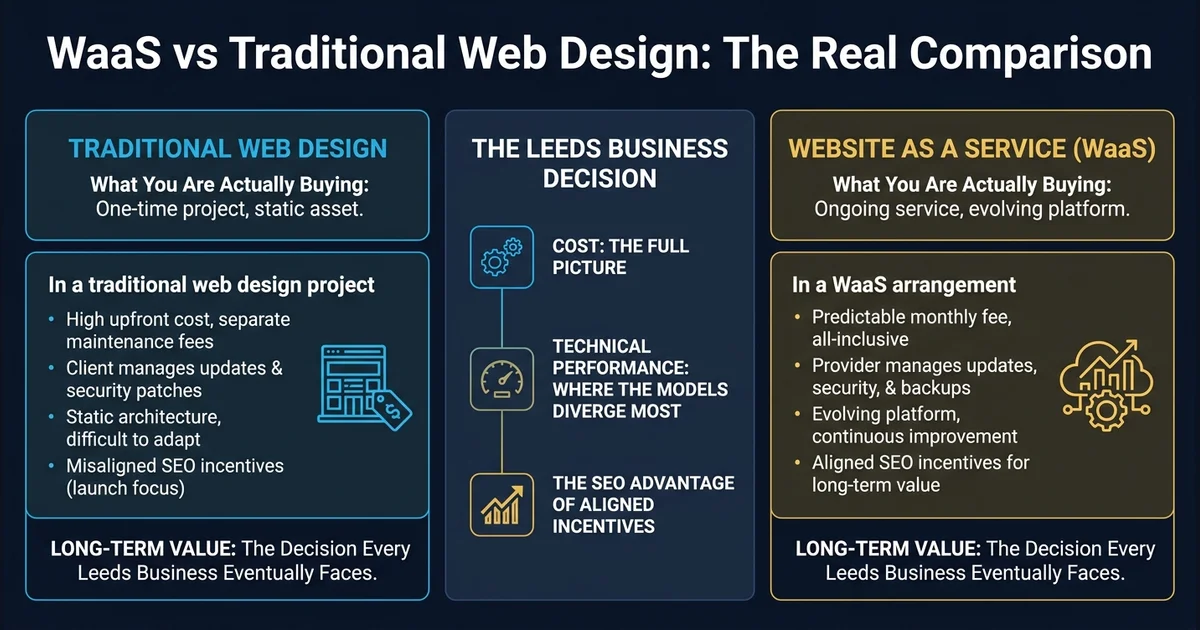
In a traditional web design project
You are purchasing a deliverable: a website, built to your brief, on a platform your agency proposes. You own the output. Once the project is complete, the agency relationship typically ends unless you purchase a separate maintenance contract.
The site exists on hosting you either arrange separately or purchase from the agency at an additional monthly cost. Updates, security patches, and maintenance are your responsibility — or a billable extra when you request them. The technical state of the site at launch is the high point; from there, it typically declines.
The agency's incentive is to deliver the project and move on to the next one. There is no structural reason for them to ensure your site performs in the months and years after launch.
In a WaaS arrangement
You are purchasing an ongoing service: a professional web presence that is built, hosted, maintained, and supported as long as you remain a subscriber. The provider's incentive is aligned with yours — a site that stops performing is a cancellation.
What this means in practice: the site is maintained as standards evolve. When Google updates its Core Web Vitals metrics, when schema formats change, when new best practices emerge — a managed site adapts. An unmanaged one doesn't.
You do not own the platform in the same sense. You own your domain and your content. The design and framework are part of the service agreement. This is the same relationship most businesses have with their accounting software or CRM — they don't own the platform, they subscribe to the service it provides.
The Hidden Costs of Traditional Web Design
Before the cost tables, it is worth understanding why traditional web design projects systematically understate their total cost. The quotation you receive covers the build. It does not cover what comes after.
The typical web design project in the UK produces a site that is, at the point of handover, the best technical version of itself it will ever be. From that moment, without active maintenance, it begins to accumulate technical debt. WordPress core, themes, and plugins require regular updates — missed updates lead to security vulnerabilities and compatibility failures. Hosting costs are separate and ongoing. The design that looked current at launch begins to look dated within two to three years as web standards evolve. And when a Google algorithm update rewards technical signals the original build did not prioritise, there is no mechanism to address this without engaging the agency again at additional cost.
None of these ongoing costs appear in the initial quotation. They are real costs — they manifest as emergency developer bills when something breaks, as the organic traffic decline when the site falls behind technical standards, and as the eventual rebuild cost when the gap between the original build and current requirements becomes too large to patch.
Cost: The Full Picture
The upfront comparison is misleading. The right comparison is total cost of ownership over three years — the typical lifecycle before most traditional sites need significant intervention.
Traditional model — realistic three-year costs for a Leeds SME:
| Cost item | Estimate |
|---|---|
| Initial build | £4,500 |
| Hosting (36 months × £20/mo) | £720 |
| Maintenance/security incidents (average 2/year) | £600 |
| SEO technical audit and fixes (year 2) | £800 |
| Partial redesign to address outdated design/performance (year 3) | £2,000 |
| Three-year total | £8,620 |
WaaS at £79/month — three-year costs:
| Cost item | Estimate |
|---|---|
| Monthly subscription (36 months × £79) | £2,844 |
| Domain name (if not included) | £30 |
| Three-year total | £2,874 |
The traditional model is less expensive only if you assume no maintenance costs, no performance issues, no technical debt, and no need to update the site over three years. That assumption is not realistic. The average small business website on an unmanaged WordPress installation accumulates significant technical problems within 18–24 months.
These figures are illustrative — the right comparison for your situation depends on the specific quotes you're getting. But the principle is consistent: total cost of ownership for an unmanaged traditional site is systematically underestimated at the point of purchase.
The Onboarding and Launch Experience
The experience of getting a website launched differs significantly between models.
In a traditional web design project, you typically go through a discovery phase, a wireframe or prototype review, a design presentation, a build phase, a review round or two, and then launch. This process takes eight to sixteen weeks for a small business site — sometimes longer if revisions are extensive or developer capacity is constrained. During this period, you may have limited visibility into actual progress.
In a WaaS arrangement, the process is faster and more transparent. At Leodis Digital, a new pay-monthly website is typically designed and launched within four to six weeks. The scope is defined upfront — you know exactly what you are getting. And because the WaaS model is a recurring service rather than a one-off project, there is no financial incentive for scope creep or delay.
For businesses that need a professional web presence quickly — a new business launching, a business replacing a site that is actively hurting its reputation, a seasonal business that needs to be ready before peak season — the WaaS launch timeline is a meaningful practical advantage over a traditional project.
Technical Performance: Where the Models Diverge Most
This is where the comparison is most one-sided.
A WaaS website from Leodis Digital is built from the outset to achieve 90+ on Google PageSpeed Insights for mobile. Every page includes correct schema markup — LocalBusiness, Service, FAQPage, BreadcrumbList — that helps Google understand your business and surface it for the right searches. The HTML is semantic and accessible. The mobile layout is designed first, not retrofitted from a desktop design.
A traditional web build achieves these standards only if the agency treats technical SEO as a build requirement rather than an optional extra. Most don't. The resulting site is visually professional but technically mediocre — it will not rank for competitive local terms because the technical foundation is inadequate.
The data on this is clear: sites failing Core Web Vitals — Google's measures of real-world page performance — are at a ranking disadvantage for competitive terms. A site on a bloated WordPress theme with unoptimised images and inadequate hosting will fail these metrics on mobile almost without exception. See our Core Web Vitals guide for the specific benchmarks and how to test your own site.
The more important point is what happens over time. A WaaS site is maintained to stay technically current. A traditional site accumulates performance debt. Three years after launch, the performance gap between a maintained WaaS site and an unmanaged traditional build is substantial.
The SEO Advantage of Aligned Incentives
The traditional model has a structural SEO problem that is rarely discussed openly: the agency that built your site has no ongoing stake in its performance.
If your site's rankings slip in year two because a competitor upgraded their technical performance, your previous agency is not going to proactively fix it. That's outside their engagement. If a Google algorithm update rewards mobile performance signals that your site wasn't built to meet, the agency that built it has moved on to other clients.
WaaS inverts this. Because the provider is paid monthly, their interest is aligned with the site's continued performance. A site that starts losing rankings is a site that generates cancellations. This creates a structural incentive for ongoing technical quality that the traditional model simply does not provide.
For local businesses in the UK competing in the Map Pack and organic results for commercial searches, this alignment matters enormously. Local SEO strategy requires a technical foundation that stays current — not one that was excellent at launch and has been declining since.
The Flexibility Question
Traditional model defenders often cite flexibility: you own the asset, you can take it anywhere, you're not locked into a relationship.
This argument is weaker in practice than it sounds. A WordPress site built by an agency is not easily portable — it's on their hosting, configured with their plugins, and if the relationship ends badly, extracting your content is complicated. The "ownership" you paid for often turns out to be theoretical.
A well-structured WaaS arrangement gives you: ownership of your domain name, portability of your content, and clear terms for what happens on cancellation. At Leodis Digital, you own your domain and content throughout. If you cancel, your content leaves with you.
The genuine flexibility argument for traditional builds applies to large sites with complex functionality — custom integrations, bespoke databases, unique user flows. For a standard business website, the flexibility benefit of ownership is largely notional.
Common Objections to WaaS — Addressed Directly
"I want to own my website." Ownership is a more nuanced concept than it sounds. What specifically do you want to own? If it is your domain name — yes, you retain that under any WaaS arrangement. If it is your content — yes, your text and images are your own and you can take them with you. If it is the platform and framework — the traditional model gives you ownership of a specific WordPress installation on specific hosting, which you are responsible for maintaining. In practice, most small businesses treat "owning" a website the same way they "own" their email service — they do not manage the infrastructure, they use the service.
"WaaS is expensive over the long term." The three-year total cost comparison above addresses this directly. The assumption behind this objection is that a traditional build has zero ongoing costs after the initial fee. As the hidden costs section above demonstrates, that assumption is not realistic.
"What happens to my site if Leodis Digital closes?" A legitimate question for any managed service. At Leodis Digital, your domain is always registered in your name and transferable by you. Your content is yours and can be exported. The more relevant question is the one rarely asked about traditional builds: what happens to your WordPress site if the agency that built it is unavailable when something breaks? If the answer is "find a new developer and explain how a site I don't fully understand works," that is a fragility too.
"I need specific features that standard WaaS cannot accommodate." This is the strongest objection and sometimes correct. If your requirements include complex custom integrations, bespoke database logic, or highly specialised user flows, a traditional project-based build may be the right answer. The honest conversation is about what your actual requirements are and whether they genuinely exceed what a WaaS platform can deliver. For the majority of Leeds small business sites — services, trades, hospitality, professional services — they do not.
Which Model Is Right For You
Choose WaaS if:
- You need a professional web presence without a large capital outlay
- Your current site is technically falling behind and you don't want to commit to another large upfront build
- You value predictable monthly costs over unpredictable one-off bills
- You want technical SEO and performance maintained as standards evolve, not just at launch
- You understand your website as an ongoing operational cost, not a capital asset
Choose traditional if:
- You need complex custom functionality — integrations, portals, e-commerce with bespoke logic
- You have an existing development team who will take over maintenance immediately after launch
- You're building an enterprise site with requirements that exceed what any managed service can handle
- You have the budget for a high-quality build and a separate ongoing maintenance contract
For the majority of small and medium businesses in across the UK — trades, professional services, hospitality, retail, charities — WaaS is the better commercial decision. The total cost is lower, the technical performance is higher from day one, and the alignment of incentives supports ongoing quality.
For more on the full picture: what WaaS includes and how the model works, and why Leeds small businesses specifically benefit from pay-monthly sites. If you are currently running an older traditional site and wondering whether it is holding your search performance back, our technical SEO audit guide explains exactly what to look for.
Making the Transition: Traditional to WaaS
For businesses currently running an older traditional site and considering a move to WaaS, the process requires careful planning to protect existing search rankings.
The key considerations are:
URL structure. If your existing site has pages ranking for commercial terms, those page URLs need to be preserved or properly redirected. A WaaS migration that changes your URL structure without implementing 301 redirects will lose the ranking authority those pages have accumulated. This is the most common cause of ranking drops after a site migration and is entirely preventable with correct implementation.
Content migration. Your existing content — service descriptions, case studies, blog articles — represents ranking equity that should not be discarded. A WaaS migration is an opportunity to audit and improve your content, not simply replace it with placeholders.
Schema markup continuity. Your new WaaS site should include the same or enhanced schema markup as your previous site. If your old site had LocalBusiness schema that was contributing to Map Pack performance, ensuring the new site has correct, complete schema from day one is essential.
Search Console and GA4 verification. Immediately after launch, verify the new site in Google Search Console, submit the new sitemap, and request indexation of key pages. Monitor the Coverage report daily for the first two weeks to catch any crawl or indexation issues.
At Leodis Digital, we manage this migration process as part of the WaaS onboarding for businesses switching from traditional sites. The goal is a launch that improves technical performance from day one without any disruption to existing rankings — a clean technical upgrade rather than a reset.
Considering a switch or a new build? Get in touch with Leodis Digital for a direct comparison of your options — we will review your existing site, assess what migration would involve, and tell you honestly whether WaaS is the right path or whether a different approach makes more commercial sense for your specific situation.
Frequently Asked Questions
Is the quality of a WaaS website lower than a custom-built site?
Not in the ways that matter for a local business. A WaaS website from Leodis Digital is built on a modern, performance-first framework — not a template. It achieves 90+ on Google PageSpeed Insights for mobile, includes correct schema markup, semantic HTML, and accessible design. Where it differs from bespoke agency work is in custom functionality: complex web applications, API integrations, or highly customised user flows require traditional project-based development. For the needs of the vast majority of Leeds businesses — a fast, well-optimised, credible web presence — WaaS quality matches or exceeds what a traditional build delivers.
Can I switch from traditional to WaaS without losing my SEO rankings?
Yes, if the migration is handled correctly. A WaaS rebuild that preserves your existing URLs (or implements correct 301 redirects), carries over your optimised title tags and meta descriptions, and transfers your content will preserve and typically improve your rankings. The technical upgrade — better Core Web Vitals, correct schema, improved mobile performance — will over time deliver ranking improvements above your previous baseline. Our [website redesign SEO checklist](/posts/waas-vs-traditional-web-design/) documents every step required to protect rankings through a platform change.
What if I need specific features my current site has?
Discuss your requirements before committing. Most standard features — contact forms, service galleries, booking enquiry forms, testimonials, blog sections, Google Maps integration — are straightforward on a WaaS platform. Complex requirements, like integrated booking systems with payment processing or custom portals, may need a different approach. A good WaaS provider will tell you honestly if your requirements exceed what they can deliver on their platform.
Does WaaS make sense if I already have a site that's performing well?
If your current site passes Core Web Vitals, has correct schema markup, and is being actively maintained, WaaS may not provide a step-change in technical performance. Where WaaS still makes sense is the ongoing maintenance cost: if you're currently paying separately for hosting, maintenance, SEO technical work, and support, a WaaS subscription may be more cost-effective. The calculation depends on your current costs and the quality of what you're receiving.
Found this useful? Share it.