The Other Half of the SEO Equation
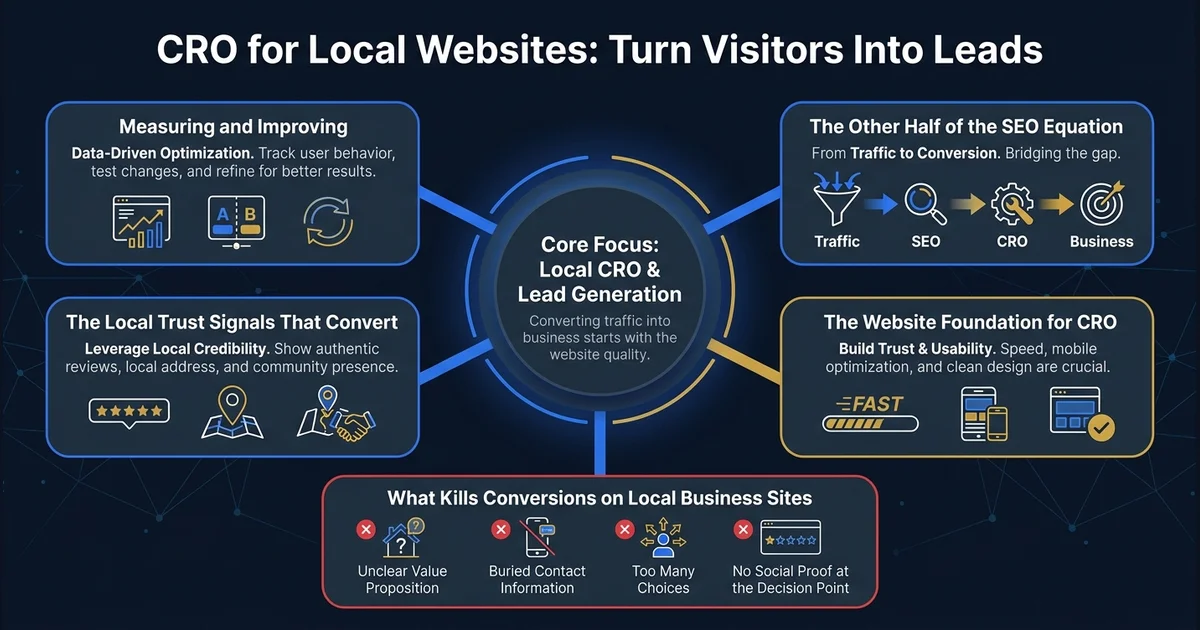
Most conversations about local SEO focus on rankings and traffic. But traffic is not revenue. A site that receives 2,000 visitors per month and converts 1% of them produces 20 enquiries. A site that receives 800 visitors per month and converts 3.5% produces 28. Better conversion rate, less traffic, better result.
Conversion rate optimisation — CRO — is the discipline of systematically improving the percentage of visitors who take the action you want them to take. For most local business websites, that action is submitting an enquiry, making a phone call, or booking an appointment.
Understanding CRO matters because it changes where you focus your effort. Doubling your organic traffic through SEO while your conversion rate sits at 0.8% will produce modest results. Fixing your conversion rate first means that every improvement in traffic produces proportionally greater returns.
Setting Up Conversion Tracking First
No CRO programme should begin without tracking in place. This is the most frequently skipped step, and without it, every improvement is guesswork.
Google Analytics 4 is the standard tracking platform. The events you need to track for a local business site are:
Enquiry form submissions. GA4's form submission event can be triggered automatically through Enhanced Measurement or manually via Google Tag Manager. The goal is to know exactly how many forms are submitted each month and, ideally, which pages those submissions come from.
Phone number clicks. On mobile, a phone number click (a tel: link click) is a high-intent conversion action — the visitor has decided to call. This requires a GA4 event set up through Google Tag Manager that fires when a tel: link is clicked. Without this tracking, you have no visibility on one of your most important conversion actions.
Email link clicks. Similar to phone clicks — a click on a mailto: link is a conversion action that would otherwise be invisible in your analytics.
Time on page and scroll depth for key service pages. These engagement metrics are leading indicators of conversion potential. A service page where 70% of visitors leave within 15 seconds without scrolling is a page that is failing to engage — even if you cannot yet see why in conversion data.
Once tracking is in place and baseline data exists for 60 to 90 days, you have the evidence base from which to prioritise improvements objectively rather than by intuition.
The Website Foundation for CRO
Before addressing specific on-page conversion elements, the technical foundation matters. A site that loads slowly on mobile, has layout instability that makes content jump as the page loads, or has interactive elements that don't respond promptly will convert at a fraction of its potential regardless of how well the page is structured.
Google's Core Web Vitals directly measure the three dimensions of page experience that matter most for conversion: how quickly the main content loads (LCP), how responsive the page is to interaction (INP), and how stable the layout is as it renders (CLS). These are not just ranking signals — they are measurements of the user experience that determines whether a visitor stays long enough to enquire.
A pay-monthly website from Leodis Digital achieves 90+ on Google PageSpeed Insights for mobile from day one. This is the technical floor from which conversion optimisation becomes meaningful. Building CRO improvements on a site that scores 34 on mobile and fails Core Web Vitals is building on sand — the fundamental user experience is broken before you have begun optimising anything.
What Kills Conversions on Local Business Sites
These are the most common conversion failures found in local business sites across across the UK, presented in order of frequency.
Unclear Value Proposition
A visitor who lands on your homepage should understand within five seconds what you do, who you serve, and why you are the right choice. If your hero section reads "Welcome to [Business Name]" with a stock photo of a handshake, you have failed the five-second test.
The value proposition test is simple: cover the hero section of your homepage and ask whether the rest of the page would make a prospective customer understand immediately what specific problem you solve and for whom. For a pay-monthly website provider in the UK: "Professional websites for Yorkshire small businesses from £79/month — no large upfront cost" passes the test. "Quality web design services" does not.
Buried Contact Information
The single most common conversion failure on local business websites is making it difficult to make contact. The phone number should be in the header on every page — clickable on mobile, with a properly formatted tel: link as covered in our mobile-first SEO guide. The contact page should be one click from anywhere on the site. A contact form should be visible on every service page without scrolling.
Visitors who want to enquire will not search for your contact information. If it is not immediately visible, a meaningful proportion will leave and contact a competitor whose number is clearly displayed. This is not a failure of interest — it is a failure of friction management.
Too Many Choices
Presenting visitors with multiple competing calls to action creates decision paralysis. For service businesses, a single clear primary CTA — "Get a Free Quote," "Book a Consultation," "Call Us Now" — consistently outperforms pages with multiple competing options. Choose the single action most valuable to your business at the top of the funnel and make it the unambiguous primary action on every page.
Secondary actions — "Download our guide," "See our work," "Read our case studies" — can be present but should not compete visually with the primary CTA.
No Social Proof at the Decision Point
Testimonials, case studies, and reviews are most effective when they appear near the conversion point — on service pages, adjacent to contact forms, in the footer of every page. Ensuring your Google Business Profile is also consistently updated with recent reviews reinforces trust signals before visitors even reach your website. A dedicated testimonials page that visitors must actively navigate to contributes very little. The conversion decision happens on service pages, and that is where social proof needs to be present.
The format of reviews matters significantly. "5 stars — great service" is nearly worthless as a conversion asset. "Karl rebuilt our website and our enquiries doubled within three months — highly recommended for any UK Business wanting a professional online presence" is a specific, credible, locally contextualised conversion asset.
Slow or Broken Contact Forms
A contact form that takes three seconds to submit, returns a generic error message when validation fails, or sends no confirmation email is an abandoned enquiry. Every friction point in the conversion process — including what happens after the visitor has decided to enquire — costs you leads.
Forms should submit quickly, provide immediate visual feedback, validate fields with helpful error messages, and send a confirmation email that sets expectations about response time. The post-submission experience is part of your conversion funnel.
The Local Trust Signals That Convert
For local service businesses, trust is the primary conversion factor. A visitor who does not trust you will not enquire, regardless of how well-designed the rest of the page is.
Local Specificity
Mentioning Leeds, Yorkshire, specific areas like Headingley, Morley, or Harrogate signals that you are genuinely local — not a national company with a local landing page. "We serve businesses across the UK and the UK" is a trust signal for a local visitor that national competitors cannot replicate authentically.
Real Photography
Images of your actual team, premises, and work convert better than stock photography. Visitors are effective at identifying stock images, and their presence actively reduces credibility — they signal that the business has not invested in presenting its real self. Real photography of the people doing the work, the workspace, and completed projects builds the specific, personal trust that local service businesses depend on.
Named Individuals
A site that identifies the people doing the work converts better than an anonymous "our team" approach. Local services are personal — clients want to know who they are dealing with before they commit to an engagement. Karl Coulter, web designer and local SEO specialist, builds more trust than "our expert team of professionals."
Specific Reviews
Generic reviews contribute little. Specific, attributed reviews that describe a real experience, name what was done, and explain the outcome are genuinely persuasive conversion assets. As part of a review acquisition strategy, asking satisfied clients to describe the specific work done and its commercial impact produces reviews that convert future visitors.
Professional Registrations and Accreditations
Professional body memberships, trade association registrations, Chamber of Commerce membership, and relevant certifications should be visible on service pages and the homepage — not buried on an "about" page that most visitors never reach. These signals validate legitimacy at the moment a visitor is deciding whether to trust you with their enquiry.
Measuring and Improving
CRO without measurement is guessing. Before making any changes, implement goal tracking in Google Analytics 4 for every conversion action: enquiry form submissions, phone number clicks (trackable with GA4 events), email link clicks, and appointment bookings.
With tracking in place, identify your highest-traffic service pages with the lowest conversion rates. These are your highest-priority optimisation opportunities. A page receiving 400 organic visitors per month with a 0.5% conversion rate is an important business problem. Small changes — CTA placement, headline clarity, social proof position, contact form visibility — can produce measurable improvements within weeks.
Run a systematic comparison if you have the traffic volume: test a change, measure the before and after, and make decisions from data rather than intuition.
Conversion rate improvement also depends partly on traffic quality. Our keyword research guide explains how to attract higher-intent visitors who are more likely to convert, and our measuring SEO success guide covers full-funnel tracking from organic session to enquiry.
The Landing Page vs Service Page Distinction
Many local businesses send all their paid traffic and organic visitors to the homepage. This is a significant missed opportunity. A landing page — a page designed specifically for a single traffic source and a single conversion action — will almost always outperform a homepage for targeted traffic.
For a Leeds plumber running Google Ads on "emergency plumber Leeds," a dedicated landing page that confirms "Yes, this is an emergency plumber in the UK, available now, call this number" converts at a dramatically higher rate than a homepage with multiple service tabs and a generic welcome message.
The same principle applies to organic traffic. An organic visitor arriving from the query "pay monthly website for Leeds restaurant" should land on a page that directly addresses their specific situation — not a generic homepage that then requires them to navigate to find relevant information. Each significant, addressable audience segment deserves its own landing page.
The Page-by-Page CRO Audit Process
For each high-traffic service page, conduct a structured conversion audit before making changes. The audit covers five dimensions:
Load speed on mobile. Check Google PageSpeed Insights for the specific page URL, not just the homepage. Individual service pages can have different performance characteristics depending on the images, scripts, and embedded elements they contain. A page that loads in 6 seconds on mobile is losing a significant proportion of its potential visitors before any CRO element has had a chance to engage them.
Five-second value proposition test. Look at the page on a mobile screen and ask: within five seconds, could a first-time visitor understand exactly what this business does, who it serves, and why they should enquire? If the answer is no, the above-the-fold content needs to be redesigned before anything else.
Contact accessibility audit. Count the steps required to make contact from the top of the page. Is the phone number visible without scrolling? Is there a contact form visible without scrolling? Is the CTA button clearly differentiated from the rest of the page content? If making contact requires more than one obvious action, you have a friction problem.
Social proof placement review. Identify where reviews and testimonials appear on the page. Are they near the contact form or CTA? Are they specific and attributed? The most common social proof mistake is placing testimonials at the bottom of a page that visitors rarely scroll to. They need to be adjacent to the conversion point.
Mobile layout check. View the page on your own mobile device, not just in browser developer tools. Check that forms are easy to complete with thumbs, that buttons are adequately sized, and that nothing requires precise tapping of small elements. A form that is technically present but painful to complete on mobile is a conversion killer.
Conversion Rate Benchmarks for Leeds Local Businesses
Having reference benchmarks helps you calibrate whether your conversion rate represents a performance problem or normal variance:
For service businesses (trades, professional services, agencies) with well-targeted organic traffic: 2–4% is a reasonable performance range. Below 1.5% suggests a meaningful conversion problem. Above 5% is excellent and usually indicates a highly targeted query profile combined with strong trust signals.
For hospitality and retail: conversion metrics differ because the "conversion" may be a booking or a store visit rather than a form submission. Online table booking conversion from a restaurant website visitor can reasonably be 3–7% if the booking process is frictionless.
For B2B professional services (accountants, solicitors, consultants): organic traffic volumes are lower and visitor intent is typically more considered. A 4–8% enquiry rate from well-qualified organic traffic is achievable with strong trust signals and a clear process description.
These benchmarks assume properly targeted organic traffic — visitors who searched for a service you provide in an area you serve. Traffic from broad informational queries will convert at lower rates, which is why traffic quality segmentation matters as much as overall conversion rate measurement.
The Compounding Effect
The reason CRO deserves investment alongside SEO is the compounding: better conversion rate amplifies every traffic improvement. A site converting at 3% generates 50% more enquiries from the same traffic as a site converting at 2%. Every improvement in your organic rankings delivers 50% more commercial value when it lands on a site with a 3% conversion rate rather than a 2% rate.
For a UK Business generating 500 organic visitors per month from commercial-intent searches, the difference between a 1.5% conversion rate and a 3% conversion rate is the difference between 7–8 enquiries per month and 14–15. That gap in enquiry volume — achieved without any improvement in rankings or traffic — represents a significant commercial difference with no additional marketing spend.
The businesses that invest in both — a technically excellent website with strong conversion architecture alongside a systematic local SEO programme — build compounding returns. Each SEO improvement delivers more commercial value because the site is built to convert.
A pay-monthly website from Leodis Digital is built with both dimensions as priorities from day one: the technical performance that supports SEO, and the conversion architecture — clear value proposition, accessible contact mechanisms, real trust signals — that turns organic traffic into enquiries.
Get in touch with Leodis Digital to discuss how your website's conversion performance can be assessed and improved as part of a broader local SEO strategy.
Frequently Asked Questions
What is a good conversion rate for a local business website?
For local service businesses, a conversion rate of 2–4% from organic search traffic is a reasonable benchmark — meaning 2–4 enquiries per 100 organic visitors. Below 1% suggests a significant conversion problem that is not being addressed by traffic growth. Above 5% from well-targeted traffic indicates a genuinely high-performing site. The starting point is always measurement: if you don't have goal tracking set up in Google Analytics 4, you are making decisions without data.
Does the quality of the website build affect conversion rate?
Significantly. A slow website with poor mobile experience, unclear layout, and buried contact information will convert a fraction of what a fast, well-structured site with prominent CTAs and clear trust signals achieves — even with the same traffic. A pay-monthly website from Leodis Digital is built with conversion architecture as a priority: clear value proposition in the hero section, phone number in the header on every page, contact forms on service pages, real photography, and mobile-first layout. These are not optional features — they are built into the design from the outset.
What is the single highest-impact CRO change most local business sites can make?
Making contact easy. The phone number visible in the header on every page. A contact form available on service pages without scrolling. A clear, single primary CTA on each page. The most common conversion failure on local business websites is not a design problem or a copy problem — it is structural: the visitor who wants to enquire cannot find the mechanism to do so without effort. Eliminating that friction is the first and highest return CRO improvement for the majority of local business sites we audit.
Can I improve conversion rate without changing my website?
Partially. You can improve the quality of incoming traffic through better keyword targeting — attracting more commercial-intent visitors rather than purely informational ones. You can add social proof through your Google Business Profile that influences users before they reach your site. But the conversion actions happen on your website, and fundamental issues with site speed, contact accessibility, or trust signals require changes to the site itself to address. If your site has Core Web Vitals failures, no amount of traffic quality improvement will fully compensate.
Found this useful? Share it.