Email and SEO: The Indirect Relationship That Matters
Email marketing and search engine optimisation are often treated as separate channels with separate teams, separate budgets, and separate KPIs. For local businesses in the UK, this separation misses a significant compounding opportunity.
Email cannot directly influence your Google rankings — Google does not see what you send to your subscribers. But a well-run email list generates the downstream behaviours that Google does measure: return visits to your website, time spent with content, social shares that lead to backlinks, and — most directly — Google reviews from customers who have been prompted to leave one.
The email list is, for most local businesses, the highest-leverage channel for driving the specific actions that support local SEO. It reaches people who have already chosen to hear from you, at a time you choose, with a message tailored to where they are in their relationship with the business.
For a local business investing in SEO, the email list is also a direct measurement tool. When a campaign drives a spike in website traffic, or when a new blog post suddenly ranks well, the email list lets you amplify that moment — sending a targeted message to subscribers about the content that is already performing, driving a second wave of visits and engagement that further reinforces its ranking position.
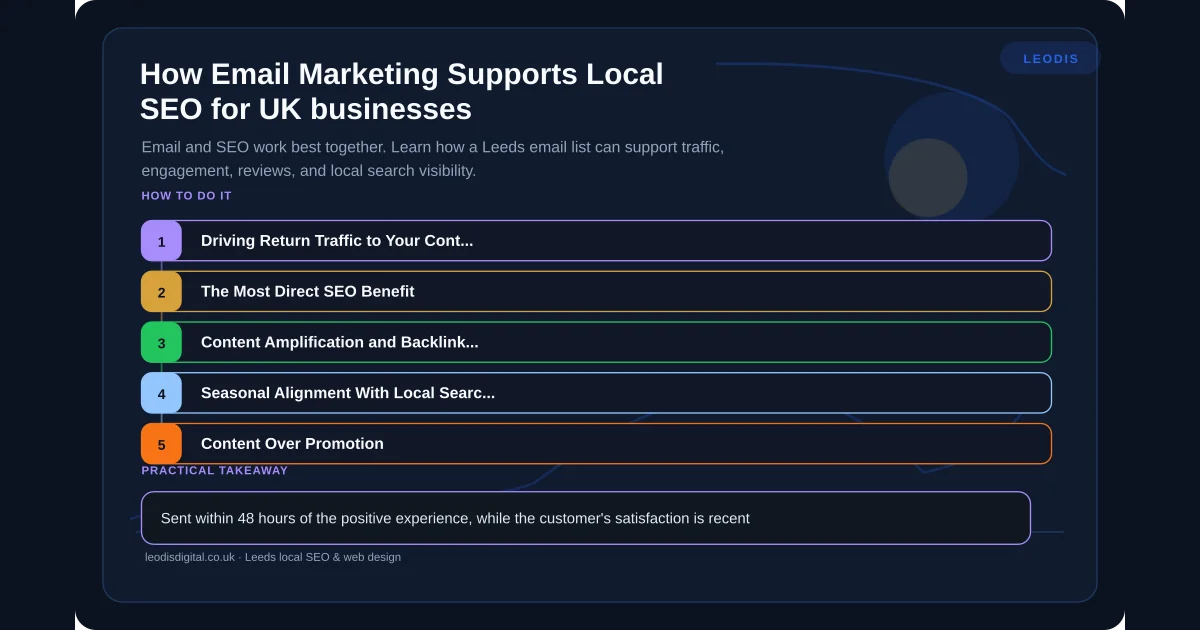
Driving Return Traffic to Your Content
One of the clearest ways email supports SEO is by driving repeat visits to your website's content. A blog post about seasonal maintenance, a guide relevant to a current local event, or an updated resource that benefits your customers all give subscribers a reason to return to your site.
Return visits from engaged subscribers — people who spend several minutes reading the content they clicked through to — create positive engagement signals. A page that receives consistent traffic from returning visitors, who spend meaningful time on it, signals to Google that the content is genuinely useful. This is particularly relevant for the cornerstone content that forms the structural foundation of your local SEO strategy.
The content strategy guide for UK businesses covers how to build topical authority through content — email is a distribution mechanism that helps existing content accumulate the engagement signals it needs to consolidate rankings.
Review Generation: The Most Direct SEO Benefit
The most direct SEO contribution email marketing can make for a local business is systematic review generation. An email sent to recent customers — brief, personal, containing a direct link to your Google review page — consistently generates reviews at a higher rate than any other approach.
The key elements of an effective review email:
- Sent within 48 hours of the positive experience, while the customer's satisfaction is recent
- Brief — two to three sentences, not a marketing email
- Contains a single, direct link that opens the Google review form
- Sent from the person the customer worked with, not a generic company account
A business running a monthly email to recent customers asking for Google reviews will, within six months, build a review volume that competitors who rely on organic accumulation cannot match. The reviews and social proof guide covers the full review generation approach in detail.
Content Amplification and Backlink Generation
Local backlinks — links from other UK businesses, organisations, and publications — are a significant local SEO signal. An email newsletter distributed to local business contacts, suppliers, and professional network members is a direct route to the kind of organic link generation that does not require outreach campaigns.
When you publish a genuinely useful piece of content — a local business guide, sector-specific advice, a community resource — and distribute it to your network via email, you are giving people who might naturally reference or link to it a prompt and a reason to do so. This is how many local businesses earn their first meaningful backlinks: not from formal outreach, but from distributing good content to people who already trust them.
Seasonal Alignment With Local Search Demand
Local search volume for most service categories follows seasonal patterns. Trades businesses see heating and maintenance searches peak in autumn. Hospitality businesses see reservation searches peak before Christmas and Valentine's Day. Accountants see enquiries peak ahead of the self-assessment deadline.
An email calendar aligned with these peaks — a timely seasonal message that prompts a customer to book or enquire before the busy period — drives enquiry volume at the moments when local search demand is highest. The customer who books from your email does not search on Google at all; the customer who is reminded by your email and then searches is more likely to search specifically for your business by name, generating branded search signals that reinforce your local authority.
The Christmas SEO guide for UK businesses covers how to align your content and marketing calendar with seasonal search demand.
What to Send: Content Over Promotion
The most common reason email lists stop working is that subscribers are trained to ignore them. A list that only ever sends promotions — offers, discounts, announcements — conditions subscribers to delete the message without reading it. A list that sends genuinely useful content trains subscribers to open it.
For local businesses in the UK, useful email content takes many forms depending on the sector:
- A plumber sending a seasonal boiler check reminder in September, before demand peaks
- An accountant sending a self-assessment checklist in November, ahead of the January deadline
- A physiotherapist sending advice on managing a common winter condition
- A retailer sharing a gift guide relevant to the approaching season
The principle is the same across all sectors: send content the subscriber would find valuable even if they were not immediately planning to buy. Subscribers who find value in your emails are more likely to return to your website, engage with your content, and respond to the occasional direct offer when one is relevant to them.
The Email List as a Business Asset
Beyond its SEO function, an email list is one of the few marketing assets a local business owns outright. Social media followings exist on platforms that can change their algorithms or terms of service. Paid advertising stops generating results when the budget stops. A well-maintained email list — subscribers who have genuinely opted in to hear from you — is a direct communication channel to your customer base that no platform change can take away.
For local businesses in the UK, building this list systematically — through website opt-ins, post-service capture, and point-of-sale collection — is a long-term investment that compounds. A list of 500 engaged local subscribers is more commercially valuable than 5,000 social followers who rarely see your posts.
Your website is where this list starts. A clear, well-placed opt-in form with a genuinely useful lead magnet — a guide, a checklist, a discount on first service — is the foundation. Every website Leodis Digital builds includes this capability. For more on how a professionally built website creates the foundation for every channel that drives your local growth, get in touch with Leodis Digital.
Frequently Asked Questions
Does email marketing directly improve Google rankings?
Not directly — Google cannot see your email campaigns. But email marketing indirectly supports rankings through the behaviours it drives. Subscribers who click through to your website and spend time reading content create positive engagement signals. Subscribers who share content or link to it generate backlinks. Subscribers prompted to leave a Google review directly improve your local ranking factors. The email list is the channel; the SEO benefit comes from the actions it generates.
What should local businesses in the UK send in their email newsletters?
Content that is genuinely useful to your specific customer base, not promotional broadcasts. For a trades business, seasonal maintenance reminders. For a health practice, condition-specific advice relevant to the time of year. For a retailer, buying guides and local events. The rule is to send content you would want to receive if you were the customer — content that makes the subscription feel worth keeping. One email per month that subscribers find valuable outperforms weekly promotional messages they learn to ignore.
How do I grow an email list as a local UK Business?
The most reliable methods are a clear opt-in on your website (a useful resource — a guide, checklist, or template — in exchange for an email address), a point-of-sale capture for businesses with physical premises, and a post-service follow-up that includes a list opt-in alongside the review request. Paid advertising to build an email list is rarely cost-effective for local businesses at early stages — organic list growth from your existing customer base is a better starting point.
Can a pay-monthly website include email capture functionality?
Yes. Every website Leodis Digital builds can include email capture forms connected to your chosen email platform — Mailchimp, Klaviyo, ConvertKit, and others. The form design and placement are optimised for conversion, and the integration is handled as part of the build. We can also advise on GDPR-compliant list management to ensure your email marketing operates within UK data protection requirements.
Found this useful? Share it.