Reviews Are a Ranking Factor, Not Just a Trust Signal
Most local businesses know that good reviews help them convert enquiries. Fewer understand that reviews are also a direct local ranking factor. Google uses review quantity, average rating, recency, and keyword content as signals to evaluate which businesses to show in local search results and the map pack.
A UK Business with 90 Google reviews averaging 4.7 will typically outrank a competitor with 20 reviews averaging 4.9. Volume and recency outweigh a marginally higher rating because they provide stronger evidence that the business is active, popular, and consistently delivering good experiences. This creates a compounding advantage: more reviews drive better rankings, which drives more customers, which drives more reviews.
The implication is that review generation is not a passive activity. It requires a structured system that runs consistently as part of the business.
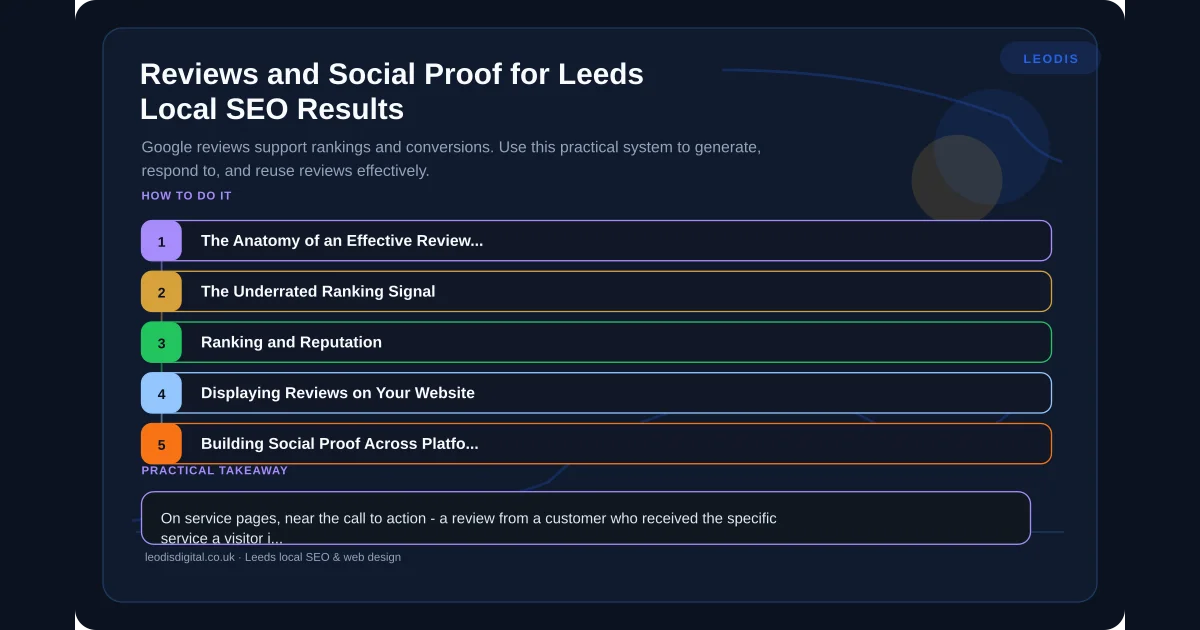
The Anatomy of an Effective Review Request
The majority of satisfied customers will not leave a review unprompted. They intend to, but they do not. The barrier is not unwillingness — it is friction. The request must be timely, personal, and make the action easy to complete.
Timing: Send the request within 24 to 48 hours of the positive experience, when the customer's satisfaction is freshest. A request sent two weeks after a job is completed converts at a fraction of the rate of one sent the following morning.
Personalisation: A message from the person the customer worked with — the tradesperson, the practitioner, the account manager — converts significantly better than a generic automated message from the company. The customer has a relationship with that person, not with the brand.
Directness: Provide a direct link to your Google review page. Do not ask customers to search for you on Google. Every additional step reduces the completion rate. A short link that opens directly to the review form is the correct format.
Channel: SMS and WhatsApp messages have significantly higher open and click-through rates than email for review requests. If your business has customer mobile numbers, a brief text message with a direct link is the most effective format.
A practical example message: "Hi [Name], it was great working with you — thanks for choosing us. If you have a moment, a Google review would mean a lot. Here's the link: [direct review link]. Thanks, [your name]."
Keywords in Reviews: The Underrated Ranking Signal
The content of Google reviews provides relevance signals for local search. A review that mentions specific services, locations, or outcomes — "fixed our boiler in Headingley the same day", "best physiotherapist in Roundhay for sports injuries" — reinforces the relevance of your business for those terms.
You cannot control what customers write, but you can prompt them towards substantive reviews by making the request specific: "If you could mention the work we did and where you're based, that's really helpful." Most customers who are happy to leave a review are happy to follow a simple prompt. The result is reviews that provide both social proof for potential customers and relevance signals for Google.
Responding to Reviews: Ranking and Reputation
Google's guidance for businesses explicitly encourages responding to reviews. Responding to reviews is also a local ranking signal — profiles that engage with reviews consistently tend to rank above profiles where reviews go unanswered.
For positive reviews, a brief, genuine response that thanks the customer and references the specific work done is more effective than a generic "thank you for your review." For negative reviews, a professional response that addresses the issue directly, without defensiveness, demonstrates the quality standard your business holds itself to.
The search result page for your business often shows your most recent reviews and responses. A potential customer who sees unanswered complaints alongside unanswered praise will draw conclusions about how the business operates. A profile where the owner is visibly engaged — thanking customers, addressing concerns, asking follow-up questions — presents a business that cares about its customers.
Displaying Reviews on Your Website
Reviews generated on Google should also appear on your website, because they serve a conversion function for visitors who did not arrive via a Google search. The most credible approach is to embed real Google reviews directly, rather than manually curating quotes, because embedded reviews include the reviewer's name, date, and star rating — all of which increase credibility over an attributed text quote.
Key placements for review content on a local business website:
- On service pages, near the call to action — a review from a customer who received the specific service a visitor is considering
- On the homepage, in a dedicated reviews section — a representative selection that demonstrates the range and quality of work
- On the contact page — reviews reduce the hesitation a prospective customer feels before making an initial enquiry
Review schema markup (AggregateRating) can also be added to your website to display star ratings in search results for your branded search terms. The schema markup guide for UK businesses covers implementation.
Beyond Google: Building Social Proof Across Platforms
While Google reviews are the highest-priority platform for local SEO, other platforms contribute to the full picture of social proof a potential customer evaluates:
Sector-specific platforms: Checkatrade and Which? Trusted Traders for trades businesses. Doctify and Top Doctors for health practitioners. Trustpilot for service businesses. Tripadvisor for hospitality. These platforms carry significant weight in their sectors and appear prominently in branded searches.
Case studies on your website: For B2B services and higher-value consumer services, a structured case study — the client's situation, what was done, and the measurable outcome — is more persuasive than a short review. The case study article on local SEO results demonstrates the format.
Before-and-after content: Particularly relevant for trades, renovation, and aesthetic services. Visual evidence of the quality of work is a form of social proof that a text review cannot replicate.
The Compound Effect
A business that generates three to five new Google reviews per month, responds to every review, embeds reviews on key website pages, and actively collects reviews on sector-relevant platforms will, within six months, have a visible competitive advantage in both rankings and conversion rate.
This is not a one-time project. It is a consistent operational process — built into how the business follows up with customers after every job. The businesses that do it systematically compound the advantage. The ones that rely on occasional organic reviews stay where they are.
It is also worth noting that a website built to the correct technical standard amplifies the effect of a strong review profile. Schema markup, fast load times, and a clear service structure all mean that when a potential customer arrives from a search result — influenced by your review signals — the site is set up to convert them. A strong review presence that leads to a poorly built website is a wasted opportunity.
Your Google Business Profile is the foundation this review strategy sits on. If that is not fully optimised first, the reviews you generate will have less impact than they should. For an assessment of where your current review presence stands and how your website supports conversion, get in touch with Leodis Digital.
Frequently Asked Questions
How many Google reviews does a UK Business need to rank well?
There is no fixed number, because reviews are evaluated relative to local competitors. In low-competition sectors, 20 to 30 well-distributed reviews can be sufficient to rank in the map pack. In competitive sectors like legal services, healthcare, or trades, 80 or more may be needed. The practical target is to have more recent, substantive reviews than the top two or three competitors in your category. Regular new reviews are more valuable than a large historic volume — recency signals that your business is actively trading.
Can I ask customers for Google reviews?
Yes. Google's guidelines permit businesses to ask customers to leave reviews. What is prohibited is incentivising reviews (offering discounts or rewards for leaving a review) or filtering (only sending review requests to customers you expect to leave a positive review). A genuine, unbiased review request sent to all customers after a transaction is both permitted and effective.
Should I respond to negative Google reviews?
Always. An unanswered negative review is visible evidence that you do not engage with customer feedback. A thoughtful, professional response — acknowledging the issue, explaining what you did or will do about it, and inviting a direct conversation — demonstrates that your business takes quality seriously. Potential customers who read negative reviews also read the responses. A well-handled negative review can actually increase trust compared with a business that has only perfect reviews with no engagement.
Do reviews on platforms other than Google affect local SEO?
Indirectly. Reviews on Trustpilot, Checkatrade, Yell, TripAdvisor, or sector-specific platforms do not directly affect your Google rankings, but they provide additional trust signals for users who research your business after finding it in search. They also appear in branded search results, which means a customer who searches your business name will see these third-party reviews. Consistency across platforms — strong reviews everywhere — reinforces trust at every touchpoint.
Found this useful? Share it.