A Question Worth Asking Honestly
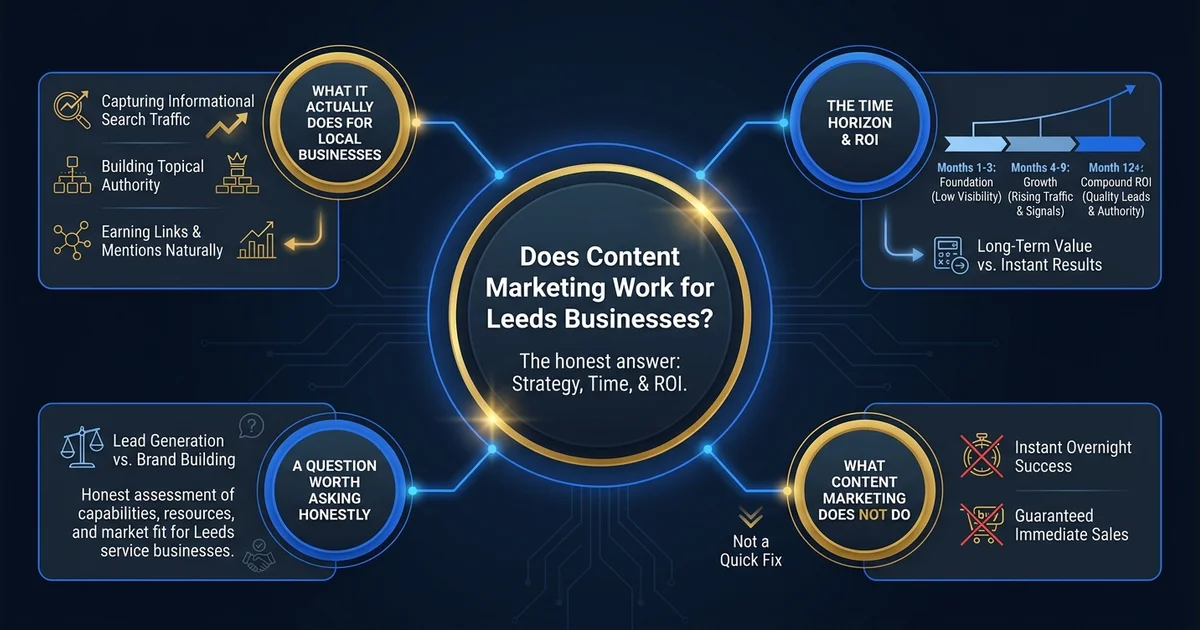
Content marketing is universally recommended. Publish consistently. Build authority. Attract organic traffic. Convert readers to leads. The promise is compelling and the logic is sound. But for a Leeds small business with limited time and a pragmatic need to generate enquiries, the question deserves a straight answer: does it actually work?
The honest answer is: yes — but not as quickly as most expectations suggest, not without a sound website foundation, and not with the kind of generic content that most guides recommend producing.
What Content Marketing Actually Does for Local Businesses
Content has three primary functions in a local business SEO strategy, and they operate on different timescales.
Building Topical Authority
Google does not evaluate pages in isolation. It evaluates the body of content a site produces across a topic area and makes a holistic judgement about whether that site represents genuine expertise. A site that has published twenty well-researched articles about pay-monthly websites, web design for local businesses, and Leeds-specific SEO signals more expertise than a site with one generic article about web design. This is precisely what the topical authority content strategy is designed to build — a body of interlinked expert content that lifts all of your commercial pages.
This authority lifts the rankings of every page on the site — including service pages that do not contain the content themselves. A local business that builds topical authority on a subject closely related to its services sees all of its commercial pages perform better in search, not just the content pages. This effect is real, measurable, and significant over a twelve to eighteen month horizon.
Capturing Informational Search Traffic
People researching decisions search for information before they search for providers. A local web design business that publishes a well-optimised guide to "how much does a website cost for a small business in the UK" captures prospective clients at an early stage of their decision process — before they have started evaluating specific agencies.
This traffic does not convert immediately. Informational searchers are researching, not buying. They convert over weeks or months, as they move through the decision process and remember the business that gave them genuinely useful information when they were still weighing their options. This is a longer conversion loop than paid advertising, but the lead quality is often higher because the prospect has already self-educated.
Earning Links and Mentions Naturally
Genuinely useful content gets referenced. A comprehensive guide to web design costs for UK businesses might be cited by a local business association, referenced in a regional business newsletter, or linked to by a complementary service provider. These links build domain authority in a way that cannot be directly manufactured, and they contribute to the kind of local authority signals that Google weighs heavily in local search rankings.
What Content Marketing Does Not Do
Content marketing does not generate immediate leads. A new article published today will typically take three to six months to rank meaningfully for its target terms, and longer for competitive terms. If your business needs enquiries next month, content is not the channel to solve that problem. Our local SEO case study shows the realistic timeline from a standing start — including when to expect the first meaningful results.
Content marketing does not work in isolation from your website. An article that ranks and attracts clicks sends that traffic to your website. If the website is slow, confusing, or not mobile-optimised, the traffic bounces. A professionally built, fast-loading website converts content marketing traffic into enquiries. A poor website wastes it.
Generic content does not work. "Five Tips for Growing Your Business in 2026" is not content marketing — it is noise. The internet is saturated with this kind of content and Google knows it. Content that is specific to a real question your actual clients are asking, written with genuine expertise, targeted at a specific search term, and useful enough that someone would bookmark it — that is content that earns rankings and generates enquiries.
The Time Horizon Question
For local service businesses, the realistic timeline for content marketing to produce measurable lead generation impact is six to twelve months. In months one to three, you are publishing and building. In months three to six, articles start to rank and traffic starts to grow. In months six to twelve, the compounding effect becomes visible — each new article benefits from the authority of the ones before it, and the traffic curve steepens.
This is why consistency matters more than intensity. One article per month for twelve months outperforms twelve articles published in one burst followed by silence. Google values fresh signals and consistent publishing cadence — sporadic activity does not build the sustained topical authority signal that drives meaningful long-term ranking improvements. The E-E-A-T framework also rewards demonstrated, ongoing expertise over time — making a consistent content programme doubly valuable.
The ROI Calculation
For a local service business, the value of content marketing becomes clear when you put numbers against it.
Consider a UK Business selling pay-monthly websites at £79/month. A new client on a 24-month contract is worth approximately £1,900 in revenue. Their content programme costs £500 per month in writing and strategy time. By month nine, the programme is generating three additional enquiries per month that convert at 25% — roughly one new client per month from content.
That one additional client per month at £1,900 lifetime value generates £1,400 per month in surplus over the content cost by month nine. Unlike paid advertising, the content that generated that client continues to rank and continues to generate traffic without additional spend. The compounding effect means month 18 and month 24 returns are higher than month 9, not lower.
The caveat: these numbers require a properly built website that converts content traffic efficiently, and a content strategy that targets the right terms with the right quality. Content on a poor website, or generic content targeting low-intent terms, will not produce these returns.
What Good Content Looks Like in Practice
For a Leeds service business, the specific attributes of content that generates enquiries are worth spelling out:
A specific, searchable title. "Does Content Marketing Work for UK businesses?" is a title that targets a specific query. It will attract people searching that exact question or close variants. "The Benefits of Content Marketing" is generic noise that ranks for nothing specific.
A clear, actionable answer. The reader who arrived from search has a question. Answer it directly. Don't bury the answer in a long preamble. Don't use the article to sell — let the content do the trust-building, and let the reader decide when they are ready to enquire.
Specificity over vague claims. "Content marketing takes six to twelve months to show results" is specific. "Content marketing takes time" is useless. Specific claims with specific data are what Google's E-E-A-T system rewards, and they are what readers find credible and useful.
A clear path to enquiry. Each article should include at least one relevant internal link to a service page and one clear call to action. Readers who find an article valuable and want to explore further should have an obvious next step. The conversion does not happen on the article — it happens on the service page or contact form the article links to.
The Website as the Foundation
This is the most important point for any UK Business considering content marketing: it must sit on a technically sound website to deliver its full potential.
A professional website — fast-loading, mobile-optimised, correctly structured for search — converts content traffic more effectively, provides the technical foundation that helps content rank faster, and gives the content marketing programme a credible home that attracts links and referrals.
This is one of the reasons that a pay-monthly website from Leodis Digital is an ideal starting point for a content marketing programme. You get a professionally built, SEO-ready site for a fixed monthly fee — the right foundation — and you can build your content programme on top of it from day one.
For the structural approach that makes content marketing effective, see our topical authority content strategy guide. For tracking whether the strategy is delivering results, our SEO measurement guide covers the metrics that matter.
Ready to build a content strategy with realistic expectations and a clear ROI framework? Get in touch with Leodis Digital.
Frequently Asked Questions
How long before content marketing generates leads for a UK Business?
The realistic timeline is six to twelve months before content marketing produces a meaningful, measurable impact on lead volume. In months one to three, you are publishing and building the foundation. In months three to six, articles start to rank and traffic begins to grow. In months six to twelve, the compounding effect becomes visible — each new piece benefits from the authority built by earlier content, and the enquiry curve steepens. This timeline assumes your website is technically sound and that you are publishing consistently, not sporadically.
Does the type of website I have affect content marketing results?
Significantly. A slow, poorly structured website means that content which earns impressions in search results fails to convert those impressions into clicks and stays, because the page experience is poor. A fast, professionally built website converts the traffic that content marketing attracts far more efficiently. Content marketing and a professional website are not alternatives — they are a system. The content brings people in; the website converts them.
What types of content work best for Leeds local businesses?
The highest-performing content for local service businesses answers specific questions that your prospective customers are actively searching for. "How much does a pay-monthly website cost in the UK," "what is included in a website maintenance plan," "how long does SEO take to work for a small business" — these specific, intent-driven questions are searched by real people who are close to a buying decision. Generic "tips" and "trends" content rarely drives enquiries. Specific, answerable, locally relevant content does.
Can I do content marketing myself or do I need an agency?
You can write content yourself if you have the expertise and can maintain a consistent schedule. The expertise requirement is important — content written by someone who genuinely understands the subject performs better than content produced for its own sake. The consistency requirement is equally important — one article per month for 12 months outperforms 12 articles published in January followed by nothing. If you cannot maintain both quality and consistency, working with an agency that understands your industry is usually more effective than sporadic self-publishing.
Found this useful? Share it.