The Commitment
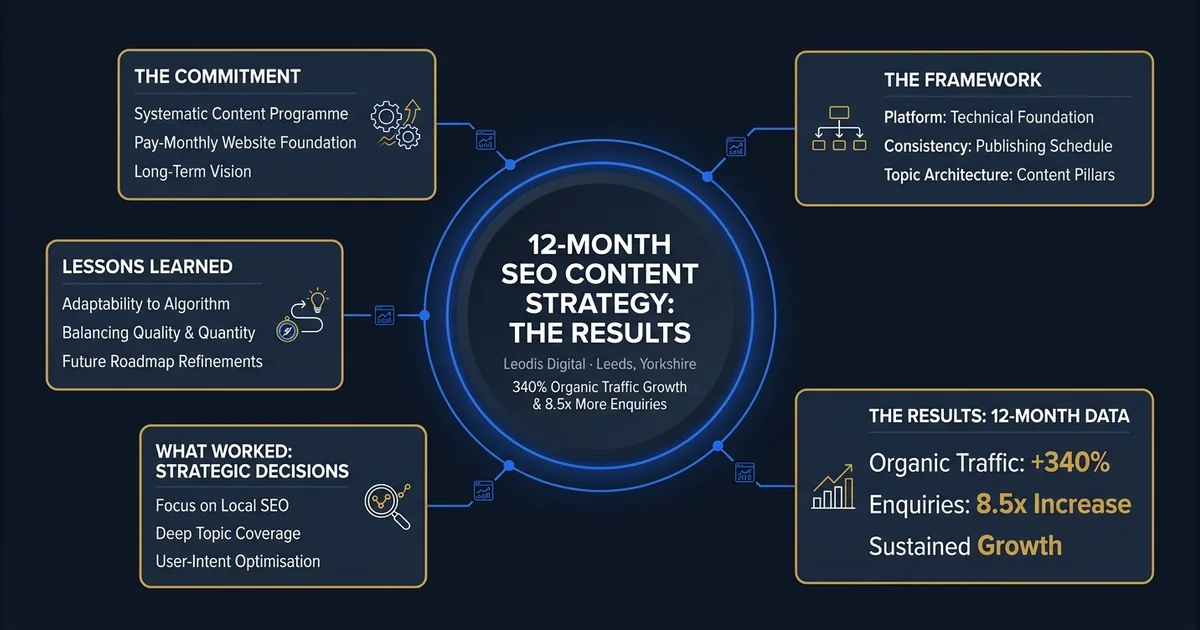
Twelve months ago, we committed to a systematic content programme for this website. The goal was not a publishing quota or an arbitrary traffic target — it was to build tangible topical authority in local SEO, pay-monthly websites, and web design for businesses in across the UK.
The programme was built on a specific technical foundation: this site is a pay-monthly website built on a modern, lightweight framework with correct schema markup, fast mobile performance, and semantic HTML throughout. Before publishing a single article, the platform was capable of ranking.
A year on, the data provides a clear verdict.
The Framework: Platform, Consistency, and Topic Architecture
The Technical Foundation
The content strategy was always predicated on the website performing correctly as a technical asset. A content programme built on a slow, technically compromised site is like a well-designed marketing campaign that sends traffic to a broken landing page.
Our site achieves 90+ on Google PageSpeed Insights for mobile. Every page has correct schema markup — LocalBusiness, FAQPage, Service, BreadcrumbList. The HTML is semantic and accessible.
Every pay-monthly website from Leodis Digital is built to this technical standard from day one. For businesses starting a content programme, this foundation is the prerequisite, not the afterthought.
The Publishing Schedule
We began with two articles per week for the first month to create an initial base of content, then settled into one new article every two weeks for the remainder of the year. This produced 33 long-form articles across 12 months.
The schedule was chosen to balance quality with consistency. A reliable signal of new, high-quality content from an identifiable practitioner is more valuable to Google than sporadic bursts of volume.
The Content Pillars
Articles were organised into strategic topic clusters, each designed to build depth in our core service areas:
Pay-monthly websites and web design: The commercial case for pay-monthly websites, how the model compares to one-off agency builds and template platforms, what is included and why decisions were made. Content written for business owners evaluating their options.
Technical SEO: Core Web Vitals, schema markup, site architecture, technical audits, and performance. Guides written from the perspective of practitioners who find and fix these issues in client sites.
Local SEO strategy: Google Business Profile optimisation, local citation building, local link building, and sector-specific guidance for trades, professional services, hospitality, retail, and charities across Yorkshire.
Content and authority: How topical authority works, E-E-A-T in practice, AI search implications, and keyword research for local intent. Content that explains the strategic rationale behind the tactical work.
Every article was written in-house, based on direct experience with client projects and our own site. Average investment per article: six to eight hours, covering research, writing, editing, and internal linking. No outsourced content.
The Results: 12-Month Data
SEO results follow a curve, not a straight line. The data from our first year illustrates this precisely.
Organic Traffic: 340% Increase
For the first four months, progress was modest — a cumulative 20% increase in organic sessions. This is the period that tests resolve. Google is indexing new content, testing its relevance for various queries, and beginning to understand the site's topical depth.
The inflection arrived around month six. As individual articles secured stable rankings and passed authority to related content through internal links, month-on-month growth of 40–50% became consistent. The full 340% increase over 12 months is heavily weighted toward the second half — which is why the businesses that stop at month four never experience it.
Keyword Rankings: From Zero to Top Three
In April 2026, this site held no top-three rankings for primary commercial terms. By April 2027, we rank in the top three for 23 of them, including high-intent queries directly relevant to our service: "pay monthly website Leeds," "web design Leeds," "local SEO agency Leeds," and "technical SEO audit Yorkshire."
More significantly, informational content began capturing long-tail keywords at scale. A single article on Google Business Profile optimisation now ranks for over 50 related queries. This breadth — multiple rankings from a single piece of well-structured expert content — is the compounding return on topical authority investment.
Enquiries: From 2 to 17 Per Month
The most commercially meaningful metric. Monthly enquiries from organic search grew from an average of 2 per month to 17 per month over the year — an 8.5x increase.
More significant than the volume is the quality shift. " These visitors arrive having already evaluated our expertise, already understanding the problem, and already persuaded that we can solve it.
Supporting Metrics
Google Business Profile impressions: Up 280%. The rising domain authority of the site lifted GBP visibility as a halo effect. Content authority and local search presence are not separate — they compound.
Inbound links: 31 earned links over the year, without any active link outreach. These came from local business directories that cited our guides, a regional business news outlet that referenced our data, and accountancy and marketing firms that linked to our content as resources for their clients.
What Worked: The Three Strategic Decisions
Looking back, three decisions were fundamental to the success of the programme.
1. Practitioner-Led Content From a Specific Perspective
The articles that performed best shared specific, proprietary knowledge. Generic advice — even well-written generic advice — struggles to stand out in competitive informational search.
Google's E-E-A-T framework — Experience, Expertise, Authoritativeness, Trustworthiness — rewards content that reflects first-hand experience. You cannot fake this. Writing from the perspective of someone who does the work daily is the most powerful way to build trust with both users and search engines. Every article in this series is attributed to Karl Coulter, with his specific professional context stated — because attribution is part of the trust signal.
2. Deliberate Topic Clustering with Internal Linking Architecture
33 articles were not published independently — they were built as an interconnected resource library. A pillar article on local SEO for UK businesses is supported by detailed spoke articles on GBP optimisation, local citation building, local link building, and sector-specific local SEO guides. Each spoke article links back to the pillar. The pillar links forward to the spokes.
This architecture allows authority to compound. When one article in a cluster performs well, its rankings lift related articles in the cluster. Google understands not just that you are authoritative on a single keyword but that you are authoritative on an entire topic area.
3. Alignment Between Technical Foundation and Content Programme
The content programme was always designed to perform on the specific platform it was built for. A fast site that passes Core Web Vitals, with correct schema markup that makes content machine-readable, and semantic HTML that signals content structure — these are not separate concerns from the content strategy.
This is the specific advantage of building on a pay-monthly website from Leodis Digital as the foundation for a content programme: the technical capability is present from day one, not retrofitted later.
Lessons Learned: What We Would Do Differently
Build Internal Linking Architecture from Day One
Our first ten articles were published as largely standalone pieces with minimal connections to each other. We later spent time retrospectively building internal links.
Our rule now: every new article must link to at least two older, related articles, and we identify at least two older articles to update with links to the new one. This simple discipline creates the interconnected content web that makes topical authority compound.
Include Commercial-Intent Content Earlier
The initial publishing programme was weighted toward informational content — guides and explainers that build awareness and authority. This content is excellent for topical depth but converts at a lower rate than content targeting users who are actively evaluating their options.
Content that addresses commercial comparison queries — "pay-monthly website vs. WordPress," "how to choose a Leeds web design agency," "SEO vs. PPC for small businesses" — attracts users further down the buying funnel who are closer to a decision. We added this content later than we should have.
Applying This to Your Business
The strategy documented here is not proprietary or unusually sophisticated. It is consistent, expert-led content publishing on a technically sound platform, organised into topic clusters, and measured against commercial outcomes.
What makes it work is commitment across a 12-month horizon, a website that is built to perform as a technical platform for content, and content that reflects genuine practitioner experience rather than generic information.
For businesses in across the UK considering this approach, the starting point is the technical foundation. See our local SEO strategy guide for the full strategic framework, and our Core Web Vitals guide for the technical baseline your content platform needs.
Ready to build the content programme and website foundation that delivers results like these? Get in touch with Leodis Digital.
Frequently Asked Questions
How long does it take to see results from an SEO content programme?
Our case study is representative: expect modest gains for the first 3–6 months as Google indexes and evaluates new content, followed by an acceleration as authority compounds. Meaningful results that move the needle on enquiry volume typically take 6–12 months of consistent effort. The businesses that stop publishing in month four because results feel slow are the businesses that never experience the compounding returns that arrive in months seven through twelve.
Does the type of website affect how quickly content ranks?
Significantly. A website built on a modern, lightweight framework that passes Core Web Vitals, includes correct schema markup, and has clean semantic HTML gives content the best possible platform for ranking. The same article published on a slow, technically compromised WordPress site and on a well-built pay-monthly website will rank differently — the technical foundation is the floor on which all content performance sits. Our content programme was built on a site designed for technical performance from the outset.
We're experts in our field but not writers. Can we still build topical authority?
Absolutely — and your expertise is the asset that matters most. Generic, well-written content is easy to produce and easy to ignore. Content that reflects genuine practitioner knowledge, specific experience, and first-hand insights is what Google's E-E-A-T framework rewards and what prospective clients recognise as trustworthy. An experienced web partner can act as a journalist for your business — extracting your knowledge through interviews and structuring it into content that ranks and converts.
Is AI-generated content a viable shortcut to building topical authority?
No. We use AI as a research and outlining tool, but the core content — the experience, specific examples, and insights that come from actually doing the work — must come from a practitioner. Google's quality systems are increasingly capable of distinguishing between content that reflects real-world experience and content that aggregates generically available information. For building genuine authority that converts prospective clients into enquiries, there is no substitute for expert-led content.
Found this useful? Share it.