Someone has told you that your business needs an app. Maybe it was a marketing consultant, a competitor's social media post, or a vendor at a trade show. The pitch sounds compelling: your own app, in the app store, with your branding, sending push notifications to customers.
Here is the honest truth: most local businesses do not need a native mobile app. A well-built, mobile-first website does the job better, costs less, and reaches more people.
But some businesses genuinely do need an app. The difference matters, and getting it wrong means either wasting money on an app nobody downloads or missing out on a tool that could transform your operations.
Why Most Local Businesses Do Not Need an App
The numbers are straightforward. The average smartphone user installs zero new apps per month. The apps people do use daily — WhatsApp, Instagram, banking, email — are from companies with hundreds of millions of users. A local business is competing for home screen space with these apps, and it will lose.
The download barrier is real. Asking a customer to find your app in the store, download it, create an account, and grant permissions is a significant ask. Most will not do it for a business they interact with occasionally.
Maintenance is ongoing. A native app needs updating for every OS release, new device size, and security patch. Apple and Google regularly change their requirements. An app that works today may not work after the next iOS update unless someone maintains it.
App store fees and rules. Apple takes 15-30% of any in-app transactions. Both Apple and Google can reject updates, change policies, or remove your app for reasons outside your control.
Discovery is poor. Nobody searches the app store for "plumber in the UK" or "restaurant near me." They search Google. Your website is your discovery tool. An app is a retention tool — and only if people use it enough to keep it installed.
For most local businesses, a mobile-first website — fast, well-designed, easy to use on a phone — is the right answer. We covered the principles of mobile-first design in our mobile-first SEO guide, and those fundamentals apply here.
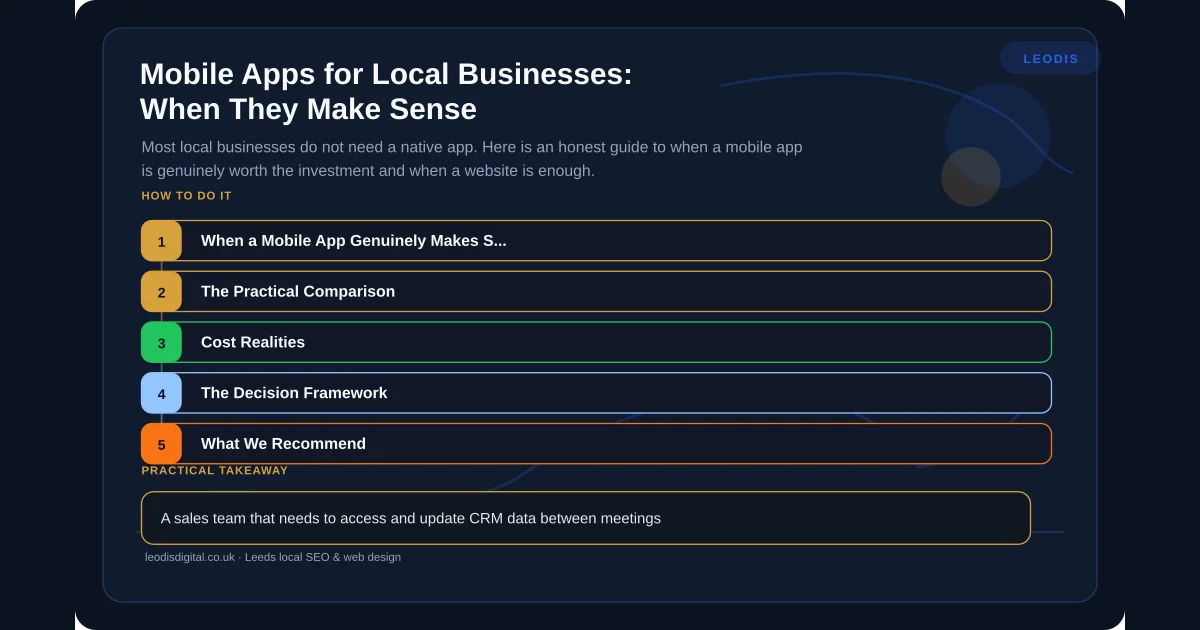
When a Mobile App Genuinely Makes Sense
There are specific scenarios where a mobile app — whether native or progressive — delivers real value that a website cannot match.
1. Field Workers Needing Offline Access
If your team works on-site — construction, maintenance, surveying, delivery — they often need access to job information in places with poor connectivity. A mobile app with offline capability lets them view job details, complete forms, take photos, and log time without a signal. The data syncs automatically when connectivity returns.
Example: A UK-based maintenance company whose engineers visit properties across Yorkshire. Each engineer has a mobile app showing their daily schedule, job history, and required parts. They complete job reports, capture photos, and get customer signatures — all offline if needed. Everything syncs to the office system automatically.
A website, even a well-built one, cannot reliably work offline.
2. Customer Loyalty and Repeat Booking
If your business has a high frequency of repeat customers — a coffee shop, gym, salon, or takeaway — an app with loyalty features and easy rebooking can increase retention and lifetime value.
The key qualifier is frequency. A customer who visits weekly will use a loyalty app. A customer who visits twice a year will not install it. Be honest about your customer frequency before investing.
What works: One-tap rebooking of previous orders or appointments, loyalty stamp cards that replace physical cards, push notifications for offers (used sparingly — nobody wants daily notifications from a kebab shop).
What does not work: Apps that replicate information already on your website, apps that require too much setup, apps that send too many notifications. These get uninstalled within a week.
3. Internal Tools for Mobile Teams
This is where mobile apps deliver the clearest ROI for local businesses. Not customer-facing apps, but internal tools that make your team more efficient.
Examples:
- A sales team that needs to access and update CRM data between meetings
- A logistics team that needs real-time visibility of deliveries and driver locations
- A property management company whose staff need to log inspections with photos and notes on-site
- A care company whose workers need to record visit details and medication administration in real time
These are tools used daily by people whose job depends on mobile access. The download barrier does not apply because it is a work requirement, not an optional extra.
We covered how purpose-built tools improve operations in our guide to custom software and operational efficiency.
4. Complex Functionality That Needs Device Hardware
If your application needs reliable access to the camera, GPS, accelerometer, Bluetooth, or NFC, a native app is still the most reliable option. Web APIs for these features exist but are inconsistent across devices and browsers.
Examples: Barcode scanning for stock management, GPS tracking for fleet management, Bluetooth connectivity for on-site equipment.
PWA vs Native: The Practical Comparison
A Progressive Web App (PWA) sits between a website and a native app. It is built using web technologies but can be installed on a phone's home screen, work offline (to a degree), and send push notifications (on Android; iOS support is improving but limited).
Choose a PWA When:
- Your app is primarily information display and simple interactions
- You need it to work on both iOS and Android without building twice
- Budget is a constraint (PWAs cost significantly less than native apps)
- You want to update the app instantly without app store review
- Offline needs are limited (caching previously viewed content, not heavy offline data processing)
Choose Native (or Cross-Platform Native) When:
- You need reliable offline data entry and sync
- Device hardware access is critical (camera, GPS, Bluetooth)
- Performance is paramount (complex animations, large data sets)
- Your users will use the app daily as part of their job
- You need deep integration with the device (background processing, file system access)
Cross-Platform Frameworks
React Native and Flutter let you build apps for both iOS and Android from a single codebase, reducing cost while retaining most native capabilities. For most UK Business app requirements, cross-platform hits the sweet spot.
Cost Realities
The gap between expectation and reality catches many business owners off guard.
| Approach | Typical Cost | Timeline | Maintenance |
|---|---|---|---|
| Mobile-first website | £2,000-£5,000 | 4-8 weeks | Low — standard web hosting and updates |
| Progressive web app | £3,000-£8,000 | 6-10 weeks | Low to moderate |
| Cross-platform app (React Native/Flutter) | £8,000-£25,000 | 8-16 weeks | Moderate — OS updates, store compliance |
| Native app (iOS + Android) | £15,000-£40,000+ | 12-24 weeks | High — separate codebases, two stores |
These are ranges for a functional business app from a competent developer. The agency quoting £50,000 for a simple booking app is overcharging. The freelancer quoting £2,000 for a native app is underscoping.
The Decision Framework
Ask these questions in order:
1. Does my customer or team member need this daily? If not, a website is enough. People do not install apps they use occasionally.
2. Does it need to work offline? If yes, you need an app (native or PWA with good offline support). If no, a web app is likely sufficient.
3. Does it need device hardware? Camera, GPS, Bluetooth — if these are core to the functionality, lean towards native or cross-platform native.
4. Is this customer-facing or internal? Internal apps have a guaranteed user base (your team). Customer-facing apps need to overcome the download barrier. Be realistic about whether your customers will actually install it.
5. What is the budget? If the budget is under £5,000, you are looking at a PWA or a very focused web app. If it is under £10,000, cross-platform is feasible for a simple app. Below these thresholds, invest in making your website excellent on mobile instead.
What We Recommend
For most local businesses in the UK, the best investment is a fast, well-designed, mobile-first website. It costs less, reaches more people, and requires less maintenance than an app.
If you have field workers, a mobile sales team, or high-frequency repeat customers, a mobile app may be the right tool — but approach it as a business tool with measurable ROI, not a marketing exercise.
If you are considering a mobile app for your business, get in touch. We will give you an honest assessment of whether you need an app, a PWA, or simply a better mobile website — and we will explain the cost and capability differences clearly so you can make the right call for your business.
Frequently Asked Questions
How much does a mobile app cost for a small business?
A basic native app for one platform typically costs between ten and thirty thousand pounds. A cross-platform app using React Native or Flutter can reduce that, and a progressive web app can cost significantly less. The key is understanding what you actually need — many businesses that think they need a native app would be better served by a well-built web app at a fraction of the cost.
What is a progressive web app and is it as good as a native app?
A progressive web app is a website that behaves like an app — it can be installed on a phone's home screen, work offline, and send notifications. It is not as capable as a native app for hardware-intensive tasks like camera access or GPS tracking, but for most business use cases it provides a comparable experience at significantly lower cost and without the app store approval process.
Should my restaurant or cafe have its own app?
Probably not, unless you have a very loyal customer base and high order frequency. For most hospitality businesses, a fast mobile website with online ordering and booking is more effective than an app that customers need to download. People will not install an app for a restaurant they visit twice a year. Focus your investment on a mobile-first website instead.
Can Leodis Digital build mobile apps?
Yes. We build progressive web apps, cross-platform mobile apps, and custom web applications that work seamlessly on mobile devices. We will always give you an honest recommendation about whether you need a native app, a PWA, or simply a better mobile website — and we will explain the cost and capability differences so you can make an informed decision.
Found this useful? Share it.