Key Takeaways
- Local SEO is the highest-ROI marketing channel for Leeds small businesses — 46% of all Google searches have local intent (GoGulf, 2018).
- Your Google Business Profile is the single most important ranking factor for the Map Pack. Complete every section, post weekly, and systematically collect reviews.
- Technical foundations matter more than content volume — a fast, mobile-friendly site with proper schema markup beats a slow site with 100 blog posts.
- NAP consistency (Name, Address, Phone) across every directory and citation is a baseline requirement, not a nice-to-have.
- You don't need a huge budget to start — the most impactful local SEO actions (GBP optimisation, schema markup, Core Web Vitals fixes) cost nothing but time.
Why Local SEO Is the Best Investment a Leeds Business Can Make
46% of all Google searches have local intent (GoGulf, 2018). When someone in Leeds searches for a plumber, a solicitor, or a web designer, Google shows them local results — and the businesses that appear in those results get the customers.
Unlike paid ads that stop working the moment you stop paying, SEO compounds over time. Every improvement you make today continues working for you next month, next quarter, and next year. For a small business with a limited marketing budget, there is no higher-ROI channel.
This guide covers everything you need to know to start ranking in Leeds — no jargon, no fluff, just practical steps you can act on today.
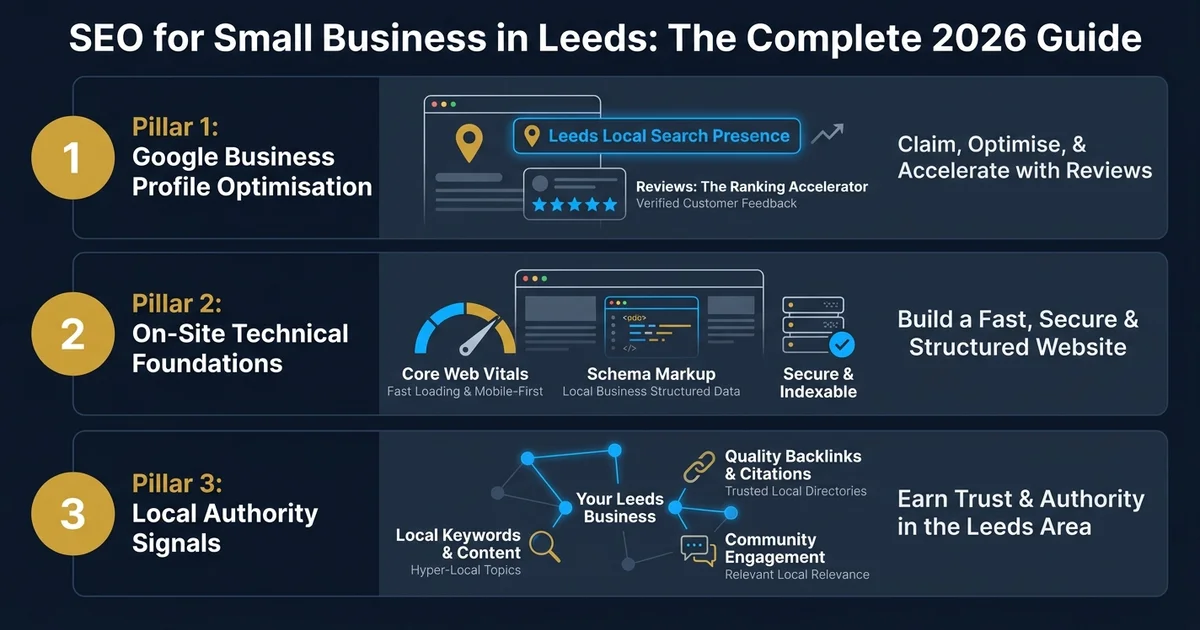
The Three Pillars of Local SEO
Local SEO in 2026 rests on three pillars. Neglect any one of them and you'll struggle to rank consistently:
- Google Business Profile is your most important local ranking factor
- On-site technical foundations are the bedrock everything else is built on
- Local authority signals like reviews, citations, and links prove you're legitimate
Let's break each one down.
Before we do, it helps to understand how Google's local ranking algorithm actually works. Google states publicly that local results are influenced by three factors: relevance, distance, and prominence.
Relevance is how well your business profile and website match what the searcher is looking for. A fully complete Google Business Profile with the correct categories, a website that clearly describes your services with proper schema markup, and a GBP description covering the specific terms your customers search — all of these strengthen relevance.
Distance is how close your business is to the searcher. You can't change your address, but you can make sure it's consistently and correctly listed everywhere Google looks. For service area businesses that travel to customers, you can set a service area on your GBP, but this doesn't provide the same Map Pack strength as a physical location in that area.
Prominence is the factor with the most room for improvement. It reflects how well-known and trusted your business appears — based on review volume and ratings, mentions and links from other websites, your website's overall authority, and activity signals like regular GBP updates and review responses.
The businesses that consistently appear in the Map Pack in competitive Leeds categories have systematically built prominence over time. That's what the three pillars below are designed to do.
Pillar 1: Google Business Profile Optimisation
Your Google Business Profile (GBP) is the single most influential factor in whether you appear in the Map Pack — the box of three local results that captures roughly 42% of clicks for local searches (BrightLocal, 2024).
The Basics (Do These First)
- Claim your listing at business.google.com if you haven't already
- Choose the right primary category — be as specific as possible ("SEO Agency" beats "Marketing Agency")
- Complete every single field — business name, address/service area, phone, website, hours, services, description
- Add at least 10 photos — real photos of your work, team, and premises (not stock images)
- Write a keyword-rich business description — mention your services and Leeds naturally
Ongoing Optimisation
- Post weekly updates — Google rewards active profiles. Share news, offers, tips, or blog posts
- Add new photos regularly — aim for 2–3 per week
- Use Google Posts to highlight seasonal offers, events, or new content
- Answer questions in the Q&A section before someone else does
- Keep hours accurate — especially during holidays
Reviews: The Ranking Accelerator
Reviews are a top-three local ranking factor. More importantly, they're what converts a searcher into a customer.
- Ask every happy customer for a review — make it easy with a direct review link
- Respond to every review within 24 hours, positive or negative
- Never buy fake reviews — Google's detection is sophisticated and the penalties are severe
- Aim for consistency: 2–4 new reviews per month beats 20 in one week then silence
Pillar 2: On-Site Technical Foundations
Your website is the foundation everything else is built on. If it's slow, broken, or poorly structured, no amount of content or link building will compensate.
The technical side of local SEO covers several areas — page speed, mobile experience, structured data, and on-page optimisation — and each one deserves more attention than a summary can give. Rather than skim the surface here, we've written dedicated guides that go deep on each:
- Core Web Vitals — Google's performance metrics are a confirmed ranking signal. Most Leeds business websites are failing them. Our guide covers what the thresholds are, how to check yours, and why this is one of the most accessible competitive advantages available.
- On-page SEO fundamentals — title tags, heading structure, content depth, E-E-A-T, image optimisation, and a practical checklist for every service page on your site.
- Schema markup — structured data that tells Google exactly what your business is, where it operates, and what services you offer. The difference between Google guessing and Google knowing.
- Website speed and conversions — the commercial cost of a slow website, with a worked financial model showing what those extra seconds of load time are actually costing you in lost enquiries.
The short version: run your site through PageSpeed Insights and look at the Field Data section. If any of the three Core Web Vitals show as "Poor" or "Needs Improvement," you have a ranking disadvantage that no amount of content will overcome. Fix the technical foundation first — then build on it.
Pillar 3: Local Authority Signals
Authority signals tell Google your business is legitimate, established, and trusted in Leeds.
NAP Consistency
NAP consistency — your Name, Address, and Phone number being identical everywhere online — is a fundamental local ranking factor.
Check every directory, social profile, and listing. Even minor inconsistencies ("St" vs "Street", different phone formats) can dilute your authority signals.
Local Citations
Citations are mentions of your business on other websites. The most important UK citation sources for Leeds businesses:
- Google Business Profile
- Bing Places for Business
- Yell.com
- Thomson Local
- FreeIndex
- Cylex UK
- 192.com
- Scoot
- Industry-specific directories relevant to your trade
Quality beats quantity. Ten accurate citations on authoritative directories outperform fifty on spammy ones.
Local Link Building
Links from other Leeds and Yorkshire websites are powerful local ranking signals. Ways to earn them:
- Sponsor local events, charities, or sports teams — they'll link back from their sponsors page
- Join the Leeds Chamber of Commerce or local business networks
- Contribute guest articles to local news sites or business blogs
- Create genuinely useful local content that other sites want to reference
- Partner with complementary businesses for cross-promotion
Avoid buying links or using link farms — Google's penalties for unnatural link building are severe and long-lasting.
What to Do First: A Priority Framework
If you're starting from scratch, here's the order that delivers the fastest results:
Week 1–2: Foundations
- Claim and complete your Google Business Profile
- Fix any Core Web Vitals failures
- Add LocalBusiness schema markup
- Ensure NAP is consistent on your website
Month 1–2: Citations and Content 5. Build citations on the top 10 UK directories 6. Create or improve your main service pages with local keywords 7. Start collecting reviews systematically 8. Set up Google Search Console and monitor weekly
Month 3–6: Authority Building 9. Start a blog targeting local long-tail keywords 10. Begin local link building through community involvement 11. Create content answering your customers' most common questions 12. Monitor rankings and adjust strategy based on data
Common Mistakes Leeds Businesses Make
Targeting keywords that are too broad. "Web design" is a national keyword dominated by huge sites. "Web design Leeds" or "web designer in Otley" is winnable.
Ignoring Google Business Profile. Some businesses set it up once and forget it. An inactive profile signals to Google that your business might be inactive too.
Chasing content volume over quality. Ten well-researched, genuinely useful articles outperform a hundred thin, keyword-stuffed posts. Google's helpful content system specifically targets low-quality content.
Neglecting technical SEO. Beautiful design means nothing if the site takes 8 seconds to load on mobile. Speed is a ranking factor and a conversion factor.
Keyword stuffing the GBP business name. Adding keywords to your Google Business Profile name — "Leeds Plumbers Direct — Best Plumber Leeds" — violates Google's guidelines and can get your profile suspended. Your business name on GBP must match your real trading name.
Ignoring the Q&A section on GBP. The Questions and Answers section on your Google Business Profile is publicly editable by anyone. Competitors or confused members of the public can post questions and answer them incorrectly. Monitor this section and provide authoritative answers before anyone else does.
Publishing thin location pages. Creating a page called "Web Design Bradford" that's identical to your Leeds page with the city name swapped doesn't create local ranking value. Google recognises templated content. Location pages need genuinely location-specific content — local examples, local context, local relevance.
Not tracking Map Pack rankings separately from organic rankings. A business can rank position four in organic results and not appear in the Map Pack at all — or vice versa. These are different algorithms and require separate tracking.
Expecting overnight results. SEO is a compounding investment. The businesses that win are the ones that show up consistently for 6–12 months, not the ones that do a burst of activity then stop.
When to DIY vs. When to Get Help
Many of the steps in this guide are absolutely doable yourself. GBP optimisation, citation building, and basic on-page SEO don't require technical expertise — just time and attention to detail.
Where professional help adds genuine value:
- Technical SEO — site speed optimisation, schema markup, crawl issue diagnosis
- Content strategy — knowing which keywords to target and how to structure content
- Link building — earning quality local links requires relationships and expertise
- Ongoing management — consistent execution month after month
If you want to handle the basics yourself and bring in professional support for the technical side, that's a perfectly valid approach. The most important thing is that something gets done consistently.
How to Track Your Local SEO Progress
Without measurement, you're flying blind. Three free tools give you everything you need to monitor what's working.
Google Search Console shows which queries are driving impressions and clicks from organic search. Filter for your core local terms and review monthly. Pay particular attention to queries where you appear frequently but in positions six to twenty — these are your nearest ranking opportunities.
Google Business Profile Insights shows how people found your profile: direct search (your business name) versus discovery search (a category or service term). A rising share of discovery searches means your prominence is growing. Track monthly calls, direction requests, and website clicks from GBP — these are the conversion metrics that actually matter.
Google Analytics 4 connects organic traffic to real business behaviour. Are visitors from organic search actually enquiring, calling, or spending time on your service pages? If not, the traffic may be misaligned with intent and the keyword or content strategy needs revisiting.
Set a calendar reminder for the first week of each month to review all three. A consistent monthly review takes no more than thirty minutes and is the minimum you need to manage local SEO properly over time.
Getting Started Today
Local SEO isn't complicated — it's consistent. The Leeds businesses that dominate local search aren't doing anything magical. They're doing the basics well, month after month.
Start with your Google Business Profile. Fix your Core Web Vitals. Build your citations. Then keep going.
If you want a professional assessment of where you stand and what to prioritise, request a free SEO audit. We'll show you exactly where the opportunities are and give you an honest recommendation on whether you need help or can handle it yourself.
Frequently Asked Questions
How long does SEO take to work for a small business in Leeds?
Most Leeds small businesses see measurable improvements in local rankings within 3–6 months of consistent effort. Quick wins like Google Business Profile optimisation and fixing technical issues can show results in weeks, while building authority through links and content takes longer. The key is consistency — SEO compounds over time.
How much does SEO cost for a small business in Leeds?
SEO costs in Leeds range from free (DIY with guides like this one) to £500–£2,000/month for professional management. For most small businesses, a comprehensive managed service from £750/month that includes website, hosting, maintenance, and SEO management offers the best value — everything in one predictable monthly fee with no upfront website cost. Avoid agencies that lock you into 12-month contracts without showing results.
What is the Google Map Pack and why does it matter?
The Map Pack is the box of 3 local business listings that appears at the top of Google search results for local queries (e.g., 'plumber Leeds'). It captures roughly 42% of all clicks for local searches (BrightLocal, 2024). Ranking in the Map Pack requires a well-optimised Google Business Profile, positive reviews, NAP consistency, and proximity to the searcher.
Do I need a blog to rank in local search?
A blog helps but isn't strictly necessary for Map Pack rankings. Your Google Business Profile, reviews, and NAP consistency matter more. However, blog content targeting local keywords (e.g., 'best restaurants in Leeds city centre') builds topical authority and captures long-tail searches that drive qualified traffic to your site.
Can I do SEO myself or do I need to hire someone?
You can absolutely start SEO yourself — Google Business Profile optimisation, basic on-page SEO, and building citations are all DIY-friendly. Where professional help adds value is in technical SEO (site speed, schema markup, crawl issues), content strategy, and link building. Many businesses start DIY and bring in professional support once they've done the basics.
What's the most important thing I can do for my local SEO right now?
Claim and fully optimise your Google Business Profile. Complete every section, add photos weekly, post updates regularly, and start systematically asking happy customers for reviews. This single action has more impact on local rankings than almost anything else you can do.
Found this useful? Share it.