Start the Year With Clarity
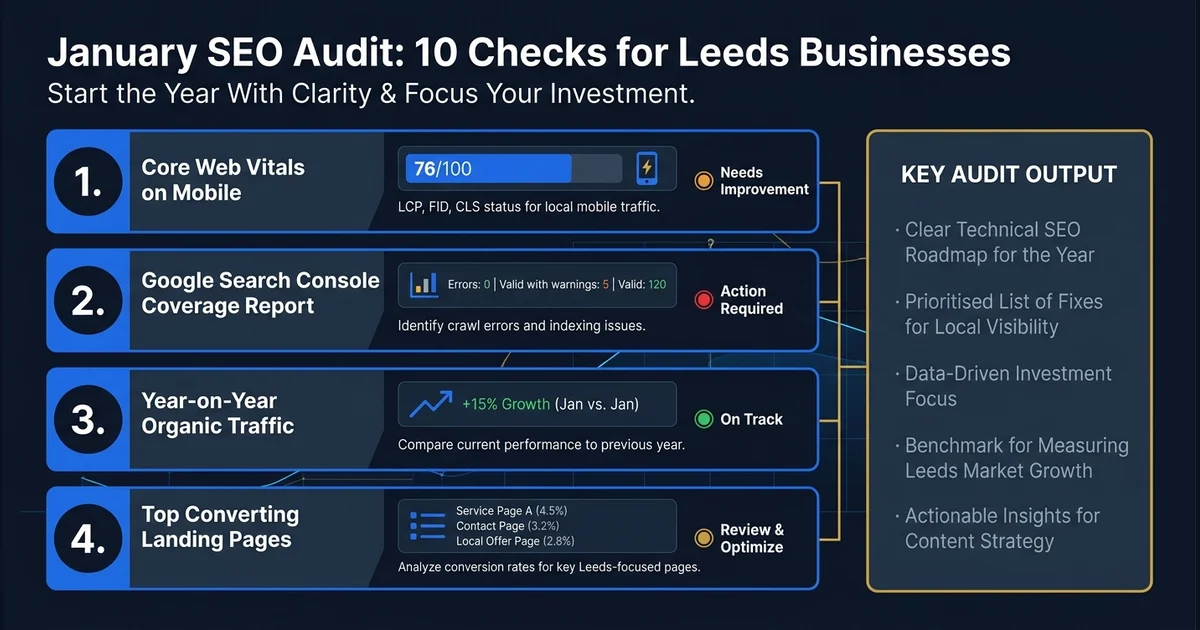
January is the natural moment to review your digital performance from the previous year and set a clear direction for the twelve months ahead. You have a full year of data in Google Analytics and Search Console. You know which months were strong and which were weak. You have the context that mid-year reviews lack — and you have the clean-slate mindset that makes this the right moment for honest evaluation rather than incremental adjustment.
Here are ten specific things to check. Work through them systematically and the audit will tell you where to focus your investment in the year ahead.
1. Core Web Vitals on Mobile
Start here. Open Google PageSpeed Insights, enter your homepage URL, and look at the Field Data section. This shows real user measurements from Chrome users visiting your site. If any of the three Core Web Vitals — LCP, INP, CLS — shows as "Poor" or "Needs Improvement," your site is being suppressed in search rankings relative to local competitors who pass.
Run the same check on your most important service page, not just your homepage. Core Web Vitals are per-URL measurements — a passing homepage with failing service pages is a partial problem. Our Core Web Vitals guide for UK businesses explains each metric and the fixes that have the greatest impact on mobile performance.
If this reveals structural failures — LCP over 4 seconds, poor INP on mobile — the question to ask is whether these can be resolved through optimisation of your existing site, or whether a rebuild on a better-performing platform is the more commercially rational path. A pay-monthly website from Leodis Digital provides the technical standard that passes Core Web Vitals from day one.
2. Google Search Console Coverage Report
Go to Search Console and open the Coverage (or Pages) report. Are there indexing errors? Pages Google has tried to crawl and failed to index? Common causes: noindex tags not removed after a development phase, robots.txt misconfiguration, redirect chains pointing to non-indexable URLs.
Work through every error category and understand the cause. Crawl errors left unresolved silently limit your organic visibility — you cannot rank for a page that is not indexed.
3. Year-on-Year Organic Traffic
In GA4, compare January–December this year against the same period last year. Are organic sessions up or down? Which pages drove the most growth? Which pages declined most significantly?
A year-on-year decline in organic traffic for a specific page cluster often signals a content quality issue — Google has found better answers and is ranking them ahead of you. A decline in traffic to your core service pages with no corresponding ranking change may indicate a click-through rate problem — your title tag or meta description is not compelling enough to earn the click at the position you hold.
4. Top Converting Landing Pages
Which organic landing pages produced the most enquiries or conversions? These are your most commercially valuable pages. Are they as well-optimised as they could be? Do they link internally to related content? Are they fast on mobile? Are they accurately reflected in your schema markup?
A page that is already converting well is the easiest to improve — the traffic is there, the intent is there, and incremental improvements to the page experience directly increase the enquiry volume.
5. Google Business Profile Performance
Open your GBP Insights dashboard and review the full year. How many calls did it generate? How many website clicks? How many direction requests? Is this trending upward or downward?
Look specifically at your Discovery searches — people who found your profile by searching for a category or service, not specifically for your business name. This is your new customer acquisition metric from the Map Pack. If this number is low or declining, your GBP may be underperforming in ways that are fixable: incomplete service listings, insufficient photos, lack of posts, or insufficient review volume. Our 12-point Google Business Profile audit covers every element that affects Map Pack performance.
6. Backlink Profile
Export your backlink profile. Are you gaining links consistently over the year? Do you have obvious toxic-looking links that should be disavowed? Where are your strongest links coming from — and can you build more from similar sources?
For local businesses in the UK, the priority question is: are your links locally relevant? Links from across the UK organisations carry more local SEO weight than generic national directory links. Identify where your local link profile is weak and build that into your plan for the year.
7. Competitor Comparison
Check where your main local competitors rank for your three to five primary target terms. Have they moved? Have they published significant new content in the last year? Have they earned notable local press coverage or links?
Understanding the competitive landscape informs where your investment will have the most impact. If a competitor has significantly improved in a term where you have been static, that is a specific problem to solve — not a general one.
8. Content Audit
Review every page and article on your site. Which have received organic traffic in the last twelve months? Which have received none?
Content that receives no traffic falls into three categories: genuinely useful content that is not yet ranking (improve and promote it), thin or outdated content that is unlikely to rank (update substantially or remove it), or content targeting terms with no realistic search volume (a strategic mistake to not repeat). Our keyword research guide for local businesses explains how to identify search terms worth targeting before committing to content creation.
Content pruning — removing thin or low-value pages — often delivers a meaningful boost to the overall quality signals of the site. It concentrates your domain's authority on the pages that matter.
9. Technical Health Check
Run your site through Screaming Frog or a similar crawler. Look for: broken internal links, redirect chains (multiple hops between URLs), missing meta descriptions, duplicate title tags, pages with no internal links pointing to them (orphaned pages). These are the same issues covered in our guide to why your website isn't ranking — working through them in January sets a clean foundation for the year.
Each of these is fixable and each fix has a cumulative positive effect on how efficiently Google can crawl and rank your content. A site with twenty broken internal links is wasting crawl budget and losing link equity at every broken junction.
10. Schema Markup Validation
Run your key pages through Google's Rich Results Test. Is the schema markup present, correct, and passing validation? For a local business, LocalBusiness schema on the homepage and service pages is the baseline. FAQPage schema on pages with FAQ sections, Service schema on individual service pages, and BreadcrumbList on all pages — each adds incremental value.
If your current site has no schema or schema that fails validation, this is a fix that does not require a rebuild — it can be implemented on most platforms within hours and has immediate effect on how clearly Google understands your business.
Turning the Audit Into a Plan
An audit without a plan is a list of problems. Take the most important findings — the ones with the biggest commercial impact — and turn them into a prioritised action list with owners and deadlines for the first quarter.
The audit will surface one of two outcomes: either your site is fundamentally sound and requires focused improvement in specific areas, or it has structural problems that will continue to limit your organic performance regardless of other improvements. If the latter, January is the best time to address it.
For the full technical assessment that goes beyond this self-audit checklist, see our technical SEO audit guide. If your audit reveals that your website needs a fresh start, get in touch with Leodis Digital — January is the right time to have that conversation.
Frequently Asked Questions
Should I rebuild my website if the audit reveals fundamental problems?
If the audit reveals structural performance issues — Core Web Vitals failures that cannot be meaningfully resolved through optimisation, a site built on a platform that generates fundamental speed problems, or a codebase so outdated that maintaining it costs more than rebuilding — then a rebuild is often the most commercially rational decision. A pay-monthly website from Leodis Digital eliminates the upfront cost barrier of a rebuild. You get a professionally built, technically excellent website for a fixed monthly fee, and you start the year on the right foundation rather than patching an increasingly outdated one.
What tools do I need for a January SEO audit?
The free tools from Google are the starting point and the most important: Google Search Console (indexing, Core Web Vitals, click performance), Google Analytics 4 or GA4 (traffic, behaviour, conversions), and Google PageSpeed Insights (performance). Google Business Profile Insights (GBP performance) is also free and essential for local businesses. Beyond these, a crawler like Screaming Frog (free up to 500 URLs) catches technical issues that the Google tools do not surface directly.
How much of the audit can I do myself?
Most of the ten-point audit described here requires no technical expertise and uses free tools. You can run the Core Web Vitals check, review your Search Console data, check your GBP performance, and identify your top and bottom-performing pages yourself in an afternoon. The areas that require expertise are: interpreting why a page is not ranking despite appearing technically healthy, diagnosing complex canonicalisation issues, and assessing your backlink profile in context. For those, a professional technical audit adds significant value.
What is the single most important thing to check in a January audit?
Whether your website is passing Core Web Vitals on mobile. This is the technical signal that most directly suppresses or supports your search rankings, and it is the one that most local business websites in the UK are failing. Go to Google PageSpeed Insights, enter your homepage URL, and look at the Field Data section. If any metric shows as "Poor" or "Needs Improvement," you have a measurable ranking disadvantage that will persist through 2027 unless addressed.
Found this useful? Share it.