AI Automation Is Not What You Think It Is
When most UK Business owners hear "AI automation," they picture one of two things: a humanoid robot replacing their receptionist, or a chatbot giving wrong answers on their website. Neither is what we are talking about.
AI automation for SMEs is practical, unglamorous, and genuinely useful. It is software that handles repetitive tasks — reading documents, categorising information, routing enquiries, processing data — faster and more consistently than a human can. Not because humans are bad at these tasks, but because humans are expensive, inconsistent, and better used for work that requires judgment.
This guide covers what AI automation actually looks like for businesses in across the UK, what it costs, where to start, and the mistakes to avoid.
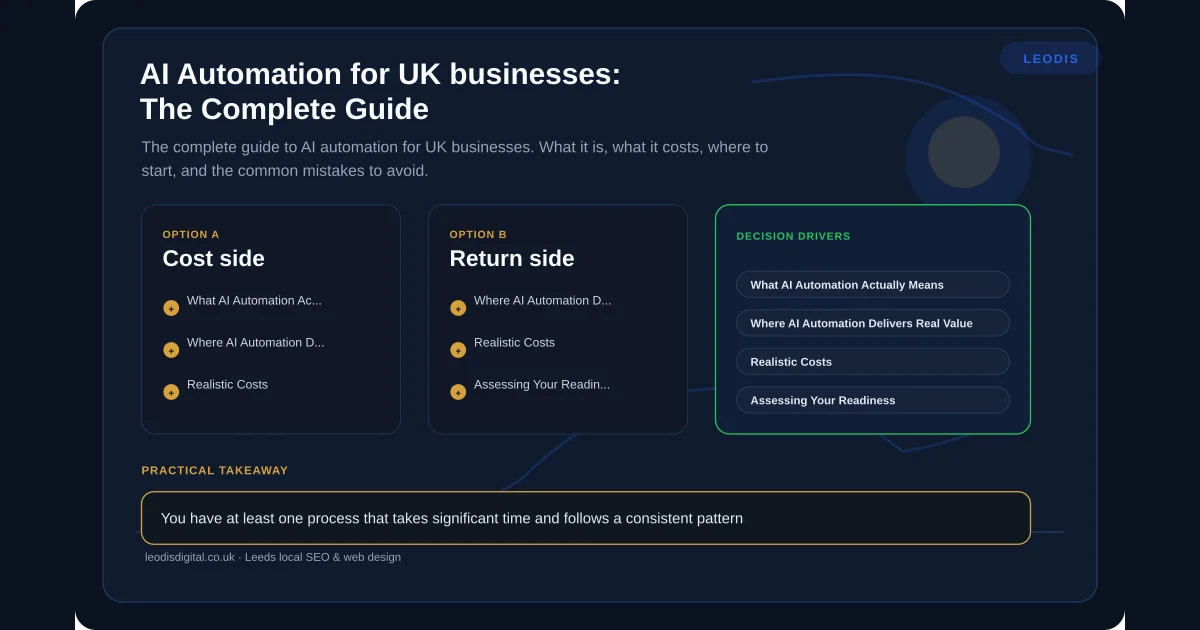
What AI Automation Actually Means
AI automation is the use of artificial intelligence to perform tasks that currently require human attention. The "AI" part means the software can handle variation — it does not need every invoice to look identical, every email to follow a template, or every data entry to be perfectly formatted. It adapts.
The "automation" part means it runs without someone pressing buttons. Set up correctly, AI automation processes work continuously — handling incoming enquiries while you sleep, categorising expenses as invoices arrive, updating records as jobs are completed.
For UK SMEs, the relevant categories of AI automation are:
Document Processing
AI reads and extracts information from invoices, receipts, contracts, and forms. This is not simple OCR — it understands context, identifies relevant fields, and outputs structured data. A stack of supplier invoices becomes a categorised, searchable spreadsheet without anyone typing a number. We cover this in depth in our guide on how AI reads your business data.
Workflow Automation
AI handles multi-step processes that currently require someone to move information between systems. A customer enquiry arrives, gets categorised by job type, creates a record in your CRM, alerts the relevant team member, and sends an acknowledgement — automatically. No manual steps, no delays, no forgotten follow-ups.
Intelligent Chatbots and Virtual Assistants
Not the useless chatbots of five years ago. Modern AI assistants can answer genuine questions about your services, handle booking enquiries, qualify leads, and escalate complex issues to the right person — using your actual business information, not generic responses. They work around the clock and handle multiple conversations simultaneously.
Data Analysis and Pattern Recognition
AI processes your existing business data to surface insights you would not find manually. Sales patterns, customer behaviour, seasonal trends, cost anomalies. Not because the data was not there — it was. You just did not have the time or tools to analyse it properly.
Predictive Tools
Based on historical data, AI can forecast demand, predict stock requirements, estimate project timelines, and flag potential problems before they materialise. This is not crystal ball prediction — it is statistical analysis applied to your actual business data.
Where AI Automation Delivers Real Value
The highest-value automation opportunities share three characteristics: the task is repetitive, the volume is significant, and the current process involves manual data handling.
For Trades Businesses
A Leeds electrical contractor processes job sheets, generates invoices, updates customer records, and manages scheduling. Each completed job triggers a chain of admin tasks. AI automation can handle the chain: job marked complete on a mobile app triggers invoice generation, customer record update, accounts receivable entry, and a follow-up review request — without the office team touching it.
For Professional Services
A Leeds accountancy firm receives hundreds of documents from clients each month. AI sorts them by client, categorises them by document type, extracts key figures, and flags anything unusual. The accountant reviews the output rather than processing the input. Time saved: hours per day.
For Hospitality
A restaurant group in the UK receives booking enquiries through their website, phone, email, and third-party platforms. AI consolidates all channels into a single system, responds to straightforward booking requests automatically, and routes special requests to staff. No enquiry falls through the cracks regardless of where it originates.
For Retail
A Leeds retailer analyses sales data across online and physical stores. AI identifies which products need reordering, which are trending, and which are underperforming — updating a dashboard in real time rather than waiting for a monthly stock review. The same system can monitor supplier lead times, flag when reorder points should shift based on seasonal patterns, and alert the buyer when a product's margin drops below threshold. What previously required a weekly meeting and a spreadsheet now runs continuously in the background.
Realistic Costs
Let us talk about money honestly, because too many AI vendors either obscure costs or quote enterprise prices to SMEs.
Focused single-workflow automation — such as automated invoice processing or enquiry routing — typically costs between two and five thousand pounds to build and deploy. Ongoing costs are modest, usually under a hundred pounds per month for hosting and API usage.
Multi-workflow solutions — connecting several processes across your business — range from five to fifteen thousand pounds. This covers discovery, build, testing, deployment, and initial support.
Ongoing AI service costs vary depending on usage volume. Processing a hundred documents per month costs significantly less than processing ten thousand. We size solutions to your actual volume so you are not paying for capacity you do not use.
The relevant comparison is not "how much does AI cost?" but "how much does not having AI cost?" If a manual process absorbs twenty hours per week at twenty-five pounds per hour, that is two thousand pounds per month — twenty-four thousand pounds per year. A five thousand pound automation that eliminates most of that work pays for itself in under three months.
Our guide on how manual processes cost your business money helps you calculate the real cost of your current approach.
Cost Breakdown by Business Size
The investment profile differs depending on your scale.
Sole traders and micro-businesses (1-5 staff): The sweet spot is a single focused automation costing between one and three thousand pounds. Typical targets are enquiry handling, quote generation, or invoice processing. At this size, even saving five hours per week represents a meaningful percentage of total capacity. Monthly running costs sit below fifty pounds.
Small businesses (5-20 staff): Multiple workflow automations connected to your existing systems. Budget between five and twelve thousand pounds for initial build, with monthly costs of fifty to one hundred and fifty pounds. At this size, you are likely automating across two or three departments — operations, sales, and finance are the usual starting points.
Medium businesses (20-100 staff): Comprehensive automation covering multiple departments with AI-powered decision workflows. Investment ranges from ten to twenty-five thousand pounds initially, with ongoing costs of one hundred to three hundred pounds monthly. The returns scale significantly at this level because the volume of repetitive work is higher and the cost of manual errors compounds across more transactions.
Assessing Your Readiness
Not every business is ready for AI automation, and deploying it prematurely wastes money. Here is how to assess readiness honestly.
You Are Ready If
- You have at least one process that takes significant time and follows a consistent pattern
- That process involves digital data in some form — emails, documents, spreadsheets, form submissions
- You can describe the steps clearly enough that you could train a new employee to do them
- The volume justifies the investment — you are spending hours per week, not minutes per month
You Are Not Ready If
- Your processes are still changing frequently — automating a moving target is expensive and frustrating
- You do not have digital records of the work you want to automate
- The total time spent on the task is minimal — automation needs scale to deliver returns
- You are looking for AI to make strategic decisions rather than handle operational tasks
A Simple Readiness Exercise
Pick the most time-consuming administrative task in your business. Over the next week, track three things: how many times it happens, how long each instance takes, and how many steps are involved. At the end of the week, multiply instances by average time. If the total exceeds five hours, you have an automation candidate worth investigating. If you can also describe each step clearly enough that a new hire could follow them without asking questions, the task is automatable.
This exercise costs nothing and gives you concrete data to work with. Most business owners who complete it are surprised by how much time disappears into tasks they had mentally filed as "just part of running the business." Those tasks are precisely where AI automation delivers the fastest, most measurable returns.
Where to Start
The single biggest mistake businesses make with AI automation is trying to do too much at once. The right approach is focused, incremental, and evidence-based.
Step One: Identify One Process
Choose the process that is most painful — the one your team complains about, the one that causes errors, the one that takes the most time. Not the most technically interesting one. The most annoying one.
Step Two: Map It
Document every step of the current process. What triggers it? What information is needed? Where does that information come from? What decisions are made? What is the output? Where does the output go? This map becomes the specification for the automation.
Step Three: Quantify the Cost
Calculate how much the current manual process costs in time, errors, and missed opportunities. This gives you a realistic budget for the automation — you want to spend less than the problem costs you.
Step Four: Build and Test
Build the automation for the single process. Test it with real data. Compare the output to the manual process. Fix the gaps. This is where working with an experienced partner matters — we have seen the common failure points and design around them.
Step Five: Expand
Once the first automation is working reliably, you have proof of concept and a clear understanding of the returns. Now you can make informed decisions about which processes to automate next. Each subsequent automation is faster and cheaper because the infrastructure is already in place.
Common Misconceptions
Before covering the practical mistakes, it is worth addressing the misconceptions that prevent businesses from even considering AI automation — or that lead them to expect the wrong things.
"AI Is Only for Big Companies"
This was true ten years ago. It is demonstrably false now. The cost of AI services has dropped by over ninety percent in the last five years. A Leeds plumber with three vans and an office manager can deploy AI automation that handles their enquiry routing, job scheduling confirmation, and invoice generation for less than the cost of a part-time admin hire. The technology is accessible. The barrier is awareness, not affordability.
"AI Will Make Mistakes and Lose Me Customers"
AI automation is not autonomous decision-making. In every deployment we build, there are human checkpoints for anything customer-facing that carries risk. The AI handles the processing, categorisation, and preparation. A human reviews and approves where it matters. The error rate for AI processing structured data is typically lower than manual processing — humans tire, lose focus, and make transcription errors. AI does not.
"I Need to Understand AI to Use It"
You do not need to understand how a combustion engine works to drive a car. You do not need to understand machine learning to use AI automation. What you need to understand is your own business processes — what tasks eat your time, what data you handle, what decisions follow predictable rules. The technical implementation is the developer's responsibility, not yours.
"It Will Be Obsolete in a Year"
AI technology evolves rapidly, but well-architected automation is built on stable foundations. The business logic — how your enquiries are categorised, how your invoices are processed, how your data flows between systems — does not change when a new AI model is released. What changes is that the underlying AI gets better, faster, and cheaper. Good architecture means you benefit from improvements without rebuilding.
Common Mistakes
Starting Too Big
Businesses that try to automate five processes simultaneously almost always fail. The complexity compounds, the project scope expands, and the result is an overdue, over-budget system that nobody uses. Start with one process. Get it right. Then expand.
Automating a Broken Process
If your current process is disorganised and inconsistent, AI will automate the chaos rather than fix it. Before automation, you need a clear, documented process. Sometimes the biggest improvement comes from fixing the process first and then deciding whether automation is still needed.
Ignoring the Human Element
AI automation changes how your team works. If they are not involved in the design and deployment, they will resist it. The most successful deployments are those where the team identifies the problem and helps shape the solution.
Expecting Perfection from Day One
AI automation improves over time. The initial deployment might handle 80% of cases automatically. Over the following weeks and months, as the system processes more data and edge cases are addressed, that figure climbs. Expecting 100% accuracy from launch day is unrealistic and leads to disappointment with solutions that are, in fact, working well.
How Leodis Digital Approaches AI Automation
We build AI automation for UK businesses with a specific philosophy: solve real problems at SME scale. We do not sell enterprise solutions to small businesses. We do not deploy technology for the sake of it.
Every project starts with understanding your business — your processes, your pain points, your budget. We build focused tools using API-first architecture that integrates with the systems you already use. We build with custom software principles — clean code, thorough documentation, and technology choices that prevent vendor lock-in.
And we are honest about when AI automation is not the right answer. Sometimes the solution is a simpler workflow tool, a better integration between existing systems, or just a more organised process. We will tell you that upfront rather than selling you something you do not need.
The Bottom Line
AI automation is not futuristic technology. It is practical tooling that handles the repetitive, data-heavy tasks that consume your team's time. for UK businesses processing documents, managing enquiries, tracking jobs, or analysing data, the question is not whether AI automation is relevant — it is which process to automate first.
The businesses that gain the most are those that start focused, measure results, and expand based on evidence. Not those that try to transform everything at once.
Ready to explore what AI automation can do for your business? Get in touch and tell us about the process that is eating your time. We will give you an honest assessment of whether automation is the right solution and what it would take to build it.
Frequently Asked Questions
Is AI automation only for tech companies?
No. The businesses that benefit most from AI automation are often the least technical — trades, professional services, hospitality, and retail. These industries have high volumes of repetitive administrative tasks that AI handles well. You do not need technical expertise to use AI automation any more than you need mechanical expertise to drive a car. The complexity is in the build, not the operation.
How much does AI automation cost for a small business?
Focused AI automation tools for UK SMEs typically start from two to five thousand pounds for a single workflow — such as automated invoice processing or enquiry categorisation. More comprehensive solutions covering multiple workflows range from five to fifteen thousand pounds. The key metric is return on investment, not absolute cost. A tool that costs three thousand pounds but saves ten hours per week pays for itself within months.
Will AI automation replace my staff?
In most SME deployments, no. AI automation handles the repetitive, low-value tasks that your team currently spends time on — data entry, document processing, categorisation, routine communications. This frees your team to do the work that actually requires human judgment, relationship building, and expertise. The businesses that get the most from AI automation are those that redeploy freed-up time into revenue-generating activities rather than reducing headcount.
How do I know if my business is ready for AI automation?
Three indicators suggest readiness. First, you have identifiable repetitive tasks that follow consistent patterns. Second, someone on your team spends more than a few hours per week on administrative work that does not require human judgment. Third, you have digital records of the work you want to automate — even if those records are just emails and spreadsheets. If all three are true, you are ready.
Found this useful? Share it.