Every software company has added "AI-powered" to its marketing. Your CRM has AI. Your accounting software has AI. Your email platform has AI. The recruitment tool you trialled last month definitely has AI.
The problem for UK Business owners is not a lack of AI tools. It is knowing which ones are genuinely useful, which are marketing relabelling features that already existed, and which will create more problems than they solve.
This is the practical guide to cutting through the noise.
The Four Categories of Business AI
Before evaluating specific tools, it helps to understand what AI actually does in a business context. Most tools fall into four categories:
Document AI
Tools that read, understand, and process documents. This includes invoice processing, contract analysis, data extraction from PDFs, and document summarisation.
Useful when: You process high volumes of documents manually, need to extract data from unstructured formats, or spend significant time reading and summarising long documents.
Examples: Microsoft Copilot for document summarisation, ABBYY for invoice processing, various purpose-built tools for contract analysis.
Conversational AI
Chatbots and virtual assistants that interact with customers or staff. This ranges from simple FAQ bots to sophisticated customer service agents.
Useful when: You receive repetitive enquiries that follow predictable patterns, need to provide 24/7 responses, or want to handle initial triage before routing to human staff.
Examples: Intercom, Drift, or custom chatbots trained on your specific content and processes.
Analytics AI
Tools that find patterns in your data, predict outcomes, and surface insights you would not spot manually. This includes demand forecasting, customer churn prediction, and anomaly detection.
Useful when: You have sufficient data (typically months or years of historical records), and decisions in your business depend on spotting trends or predicting what happens next.
Examples: Power BI with AI features, Google Analytics intelligence, custom prediction models.
Workflow AI
Tools that make decisions within automated workflows — routing emails, classifying support tickets, prioritising tasks, or approving routine requests based on learned patterns.
Useful when: Your workflows involve decision points that currently require human judgement but follow patterns that a system could learn.
Examples: Zapier with AI steps, Make with AI modules, custom workflow engines with classification models.
For a broader view of how automation and AI fit into business operations, see our complete guide to AI automation for UK businesses.
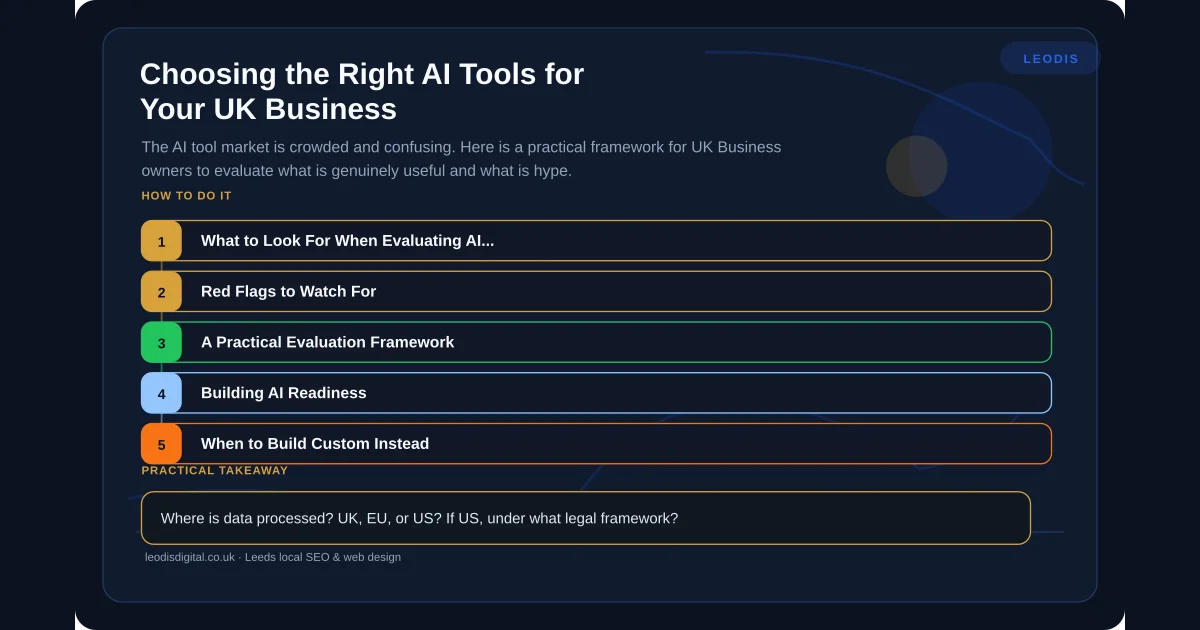
What to Look For When Evaluating AI Tools
1. Data Privacy and UK Compliance
This is non-negotiable and should be your first filter. Before anything else, establish:
- Where is data processed? UK, EU, or US? If US, under what legal framework?
- Is your data used to train the model? Many free tiers use your data to improve their models. Enterprise tiers typically do not.
- Is there a Data Processing Agreement (DPA)? Required under UK GDPR if the tool processes personal data on your behalf.
- Can you delete your data? You need the ability to fulfil data subject access requests and deletion requests.
If a vendor cannot answer these questions clearly, that is your answer.
2. Integration With Existing Systems
An AI tool that does not connect to the systems you already use creates another data silo. Before committing to any tool, verify:
- Does it integrate with your CRM, accounting software, and email platform?
- Are the integrations native, or do they require a third-party connector like Zapier?
- Can data flow both ways, or only in one direction?
- What happens to your data if you cancel the subscription?
The best AI tool in the world is useless if you have to manually copy its output into another system.
3. Actual Capability Versus Marketing Claims
Test every AI tool with your real data and your actual use cases before committing.
Ask the vendor: What is the accuracy rate for tasks similar to mine? Can I trial with my own data? What happens when the AI gets it wrong?
Test yourself: Give it your hardest cases, not your easiest. Measure time saved against time spent managing the tool. Check accuracy over weeks, not minutes. Ask your team whether it actually helps or just adds a step.
4. Total Cost of Ownership
The subscription price is rarely the full cost. Factor in:
- Setup and configuration — how long does it take to get the tool working with your data?
- Training — how long before your team can use it effectively?
- Ongoing management — does someone need to monitor, tune, or update it?
- Scaling costs — what happens to the price as you add more users or process more data?
- Exit costs — how hard is it to leave if the tool does not work out?
A tool that costs £50 per month but requires two days of staff time per month to manage is not a £50 tool.
Red Flags to Watch For
Years of working with UK businesses on their technology choices has given us a reliable list of warning signs:
"Our AI handles everything automatically" — No it does not. Any vendor claiming fully autonomous AI for complex business tasks is overstating what their product does. Good AI tools are explicit about where human oversight is needed.
No trial period — If a vendor will not let you test with your own data, there is usually a reason. Demos with curated data always look impressive.
Vague data privacy answers — "We take data privacy very seriously" is not an answer. You need specifics: where, how, under what legal basis, with what safeguards.
Lock-in by design — If the tool stores your data in a proprietary format with no export option, you are building a dependency you cannot escape. Always check data portability before signing up.
AI-washing — Rebranding existing features as "AI-powered" without any meaningful change. If the feature existed before and works the same way, it is not AI — it is marketing.
No human override — Any AI tool used in a business context needs a way for humans to correct errors, override decisions, and provide feedback that improves the system over time.
A Practical Evaluation Framework
Here is how we recommend UK businesses approach AI tool selection:
Step 1: Define the Problem First
Do not start with "we need AI." Start with "we spend too much time on X" or "we keep making errors in Y" or "we cannot see Z in real time." The problem defines the solution, not the other way around.
Step 2: Check Whether Automation Solves It
Many problems labelled as "AI opportunities" are actually automation problems. If the task follows clear rules — if this, then that — you do not need AI. You need workflow automation, which is simpler, cheaper, and more predictable. See our workflow automation guide for more on this.
Step 3: Shortlist Based on Integration and Compliance
Filter by what connects to your existing systems and meets UK GDPR requirements. This typically eliminates half the options immediately.
Step 4: Trial With Real Data
Run a proper trial — two to four weeks, with real data, involving the team members who will actually use it. Measure time saved, accuracy, and whether the team finds it genuinely helpful.
Step 5: Calculate True ROI
Time saved minus time spent managing the tool, multiplied by staff cost, compared to total cost of ownership. If the number is positive and meaningful, proceed. If it is marginal, reconsider.
Building AI Readiness
Even if you are not ready to adopt AI tools today, you can prepare your business so that when you do, the process is smoother. Clean data, documented processes, and systems that can share data through APIs are the foundations.
We wrote a full guide on future-proofing your business with AI-ready systems that covers this in detail.
When to Build Custom Instead
Sometimes the right tool does not exist as a product. If you have tried three tools and none of them quite fit, the problem might be that your process needs a purpose-built solution rather than a product compromise. We covered this decision in our custom software versus off-the-shelf comparison.
Making the Decision
The AI tool market will continue to grow and the noise will get louder. The businesses that benefit are the ones that start with real problems, evaluate tools honestly, and implement with proper governance.
If you want help evaluating AI tools for your specific business — or you suspect you need something custom-built — get in touch. We will give you an honest assessment of what technology can solve and what it cannot, and we will not recommend anything that does not genuinely improve how your business operates.
Frequently Asked Questions
Do I need AI tools for my small business?
Not necessarily. Many small businesses benefit more from basic automation than from AI specifically. If your main problems are manual data entry, missed follow-ups, or disconnected systems, straightforward workflow automation may solve them without the complexity of AI. We always recommend starting with the simplest tool that solves the actual problem.
Are AI tools safe to use with customer data under UK GDPR?
It depends entirely on the tool and how you use it. Enterprise versions of major AI platforms typically offer data processing agreements, UK or EU data residency, and commitments not to train on your data. Free tiers and consumer versions often do not. You need to read the terms, understand where data is processed, and document your lawful basis for processing before using any AI tool with personal data.
What is the difference between AI and automation?
Automation follows rules you define — if this happens, do that. AI makes judgements based on patterns it has learned. Automation is deterministic and predictable. AI is probabilistic and can handle ambiguity. Most businesses benefit from automation first, then layering AI on top for tasks that require interpretation, classification, or content generation.
How much should a small business spend on AI tools?
Start with free tiers and nonprofit or small business pricing. Many useful AI capabilities are available for under fifty pounds per month. The key metric is time saved versus cost. If a tool saves one staff member two hours per week, that is roughly four hundred pounds per month in recovered time — easily justifying a modest subscription.
Found this useful? Share it.